
The Core Problem: Slow, Brittle Service Tests
Traditional service layer testing often ties business logic to infrastructure concerns like databases and web frameworks. This coupling leads to slow test execution, brittle tests that break with infrastructure changes, and a heavy reliance on complex setup. The preceding chapters of this work established a clean architecture, separating the domain model from infrastructure and web layers. This separation is crucial. Services in this architecture orchestrate business logic without any knowledge of specific technologies like Hibernate, SQL, or HTTP. Transactionality, managed declaratively via Spring's @Transactional at the service level, defines the Use Case boundary while keeping the services themselves free of transactional implementation details.
The Dividend: Millisecond Testing
This architectural discipline pays off significantly in testing. The primary benefit is the ability to test the entire business logic in milliseconds. This is achieved by eliminating dependencies on the Spring context and, critically, any real databases. The service layer becomes a pure Java/Kotlin/etc. construct, interacting with mocked or stubbed data access objects (DAOs) or repositories. This allows developers to focus solely on the business rules and workflows, ensuring they function as intended without the overhead of booting up an entire application context or provisioning a database for each test run.
Constructing the Generic Test Fixture
The foundation of this approach is a generic test fixture. This fixture provides a standardized setup for testing any service within the architecture. It typically involves:
- Mocking the Data Access Layer: All interactions with persistent storage are intercepted. DAOs or repositories are mocked using libraries like Mockito. This ensures that the test only verifies the service's logic, not the database's behavior.
- Defining Test Scenarios: Each test method within the fixture represents a specific Use Case or a part of one. These scenarios cover various inputs, expected outputs, and edge cases.
- Asserting Business Logic: The tests assert that the service correctly manipulates data (as passed through mocks) and returns the expected results based on the business rules.
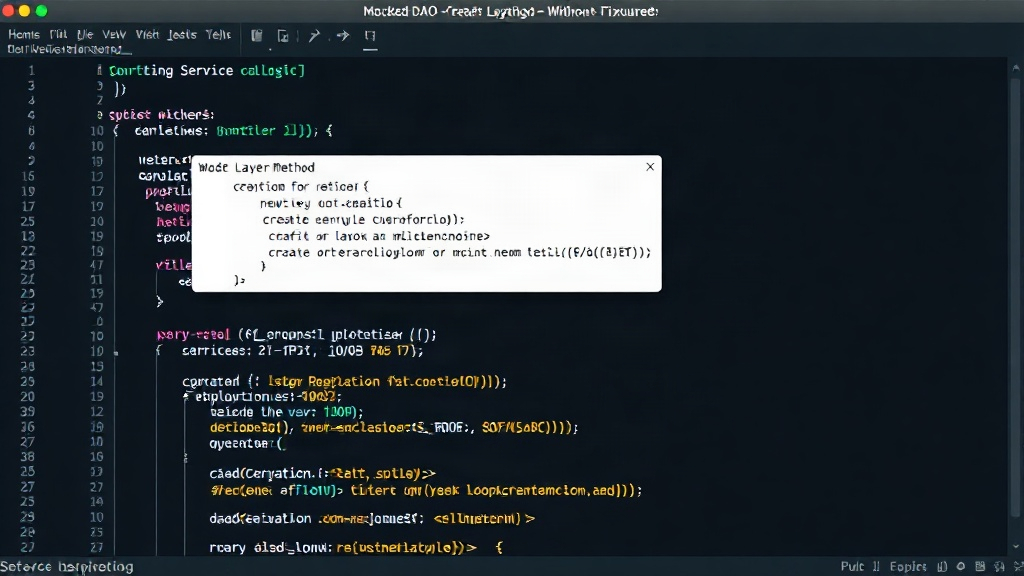
Consider a basic example of mocking a DAO's create operation. When the service calls getMockDao().create(any()), the test fixture intercepts this call. The subsequent behavior and return values can be precisely controlled. This allows for simulating various outcomes, such as successful creation, or even exceptions that the service layer is expected to handle gracefully.
Why This Matters: Speed, Reliability, and Focus
The implications of this testing strategy are profound:
- Speed: Millisecond test execution means developers get immediate feedback. This encourages more frequent testing, leading to higher code quality and faster development cycles. Running hundreds of these tests takes less time than booting a single Spring application.
- Reliability: By isolating business logic from external dependencies, tests become far more reliable. They are not susceptible to network issues, database connection problems, or environment misconfigurations. The test outcome reflects only the correctness of the code under test.
- Focus: Developers can concentrate on implementing and verifying business rules. The noise introduced by infrastructure concerns is removed from the testing loop. This leads to a deeper understanding and more robust implementation of the core business domain.
The Generic Suite's Debt to Every Service
Every service in this architecture owes a debt to this generic testing suite. It represents a contract for how services should be tested: purely, independently, and rapidly. The suite provides the framework, the mocks, and the methodology. In return, each service provides the concrete business logic that the suite validates. This symbiotic relationship ensures that as the application grows, the ability to verify its core functionality remains robust and efficient. The discipline of maintaining clean services directly enables this high-speed, low-dependency testing paradigm.
What Nobody Has Addressed Yet: Scaling the Mocking Strategy
While this approach is incredibly powerful for individual services and small groups of services, what nobody has addressed yet is how to effectively scale the mocking strategy for extremely complex, interdependent service orchestrations. As Use Cases grow to involve dozens of services, managing the intricate web of mock interactions and ensuring comprehensive coverage across all potential states becomes a significant challenge in itself. Developing patterns for managing these complex mock environments without devolving into integration test complexity is the next frontier.