The Saga Compensation Conundrum
Distributed systems often employ sagas to manage complex transactions that span multiple services. A common scenario involves creating an order: first, inventory is reserved, then payment is charged, and finally, the order is confirmed. Each step is a distinct service call. What happens when this sequence breaks in a specific, yet critical, way? Consider an order process where inventory is reserved, payment is successfully charged, but the system times out waiting for inventory reservation confirmation. This timeout triggers a cancellation flow. The problem arises when a delayed inventory success message arrives *after* the refund has already been initiated. Without careful state management, this can lead to a state where stock is erroneously held or, worse, payment is refunded twice, creating a significant financial and operational discrepancy.
The core issue lies in the race condition between the compensation (refund) and a late-arriving success event from a previously failed step. A naive implementation might not account for this temporal anomaly, leading to inconsistent system states. This isn't just a theoretical problem; it’s a practical challenge faced by developers building robust e-commerce platforms, booking systems, or any application requiring atomic-like operations across service boundaries.
Defining Events and Invariants for Robustness
To tackle this, we must first precisely define the events and invariants governing the order lifecycle. The ideal flow might look like this:
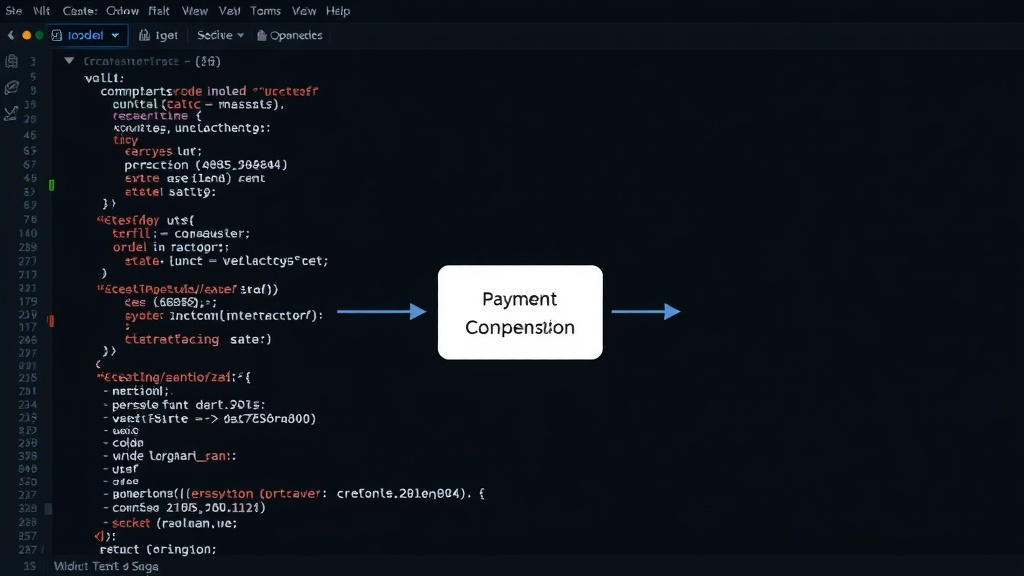
OrderCreated -> InventoryReserved -> PaymentCharged -> ConfirmedHowever, the problematic path introduces a timeout and compensation:
OrderCreated -> InventoryReserved -> PaymentCharged -> (Timeout) -> RefundRequested -> InventoryReleased -> CancelledThe critical failure point is when the InventoryReserved confirmation arrives late, after RefundRequested has been initiated. This late arrival could erroneously lead to a state where InventoryReleased (part of the compensation) is incorrectly skipped or the Confirmed state is reached despite the earlier timeout, holding both the payment and the inventory. To prevent this, we establish invariants:
- Invariant 1: A terminal
Confirmedstate must imply exactly one successful charge and one successful reservation. - Invariant 2: A terminal
Cancelledstate must imply no net charge against the customer and no inventory reservation. - Invariant 3: Each unique compensation key (e.g., an order ID) should produce at most one external effect (e.g., one refund, one inventory release).
These invariants act as guardrails, ensuring that even in the face of network delays or service timeouts, the system’s final state adheres to business logic and prevents financial losses or incorrect inventory counts.
Simulating the Edge Case
Testing such edge cases requires more than just unit tests for individual services. We need an integrated approach that can simulate the timing and failure conditions of a distributed system. Building an in-memory simulator is an effective strategy. This simulator can permute duplicate events, inject delays, and force timeouts to expose race conditions and state inconsistencies.
The simulator should orchestrate the entire saga, mimicking the communication between services. For the specific scenario of payment success and inventory timeout, the simulation would involve:
- Initiating an order.
- Successfully completing the
InventoryReservedandPaymentChargedsteps. - Introducing an artificial delay or timeout specifically for the inventory confirmation step.
- Triggering the compensation flow (
RefundRequested,InventoryReleased). - Injecting the late
InventoryReservedsuccess event *after* the compensation has begun.
By running this simulation, developers can observe the system's behavior and verify that the invariants hold. For instance, the simulator would check if, after the late inventory success, the system incorrectly proceeds to a `Confirmed` state or if it correctly handles the late event, perhaps by discarding it or ensuring it doesn’t interfere with the already initiated cancellation.
State Modeling for Idempotency
A robust state model is crucial for handling these inter-service communication complexities. Each step in the saga should not just be an action, but a state transition. When an event arrives, the system checks its current state and the nature of the event to determine the next valid state and any necessary side effects. This is where idempotency becomes paramount.
Consider the PaymentCharged step. If a duplicate PaymentCharged event arrives, the system should recognize it has already processed this event for the given order ID and take no further action. Similarly, if a late InventoryReserved success arrives after the order has been marked as Cancelled, the system should recognize that the inventory is no longer needed for a confirmed order and has already been accounted for in the cancellation process (either by being released or never having been definitively reserved in the first place due to the timeout). The state model must explicitly define how to handle out-of-order or delayed events.
The state model can be visualized as a finite state machine. For example, a state might be AWAITING_INVENTORY_CONFIRMATION. If a timeout occurs, it transitions to INITIATING_REFUND. If a late inventory success arrives while in INITIATING_REFUND or later, the system must have logic to ignore it or process it in a way that doesn't violate the invariants. This often involves checking timestamps, sequence numbers, or explicit state flags.
Implications for System Design
This specific edge case highlights a broader challenge in distributed systems: maintaining data consistency and business logic integrity across asynchronous, potentially unreliable communication channels. The solution isn't just about error handling; it’s about designing for eventual consistency with strong guarantees at terminal states.
If you are building or maintaining a distributed transaction system, this scenario is a critical test case. Neglecting it can lead to subtle bugs that are difficult to reproduce in production and costly to fix. The invariants discussed—ensuring single charges, no net charges on cancellation, and single external effects per compensation key—should be central to your state machine design and your testing strategy. Without a clear state model and rigorous simulation, you risk holding phantom inventory or issuing duplicate refunds, eroding customer trust and impacting your bottom line.