
The Vulnerability Revealed
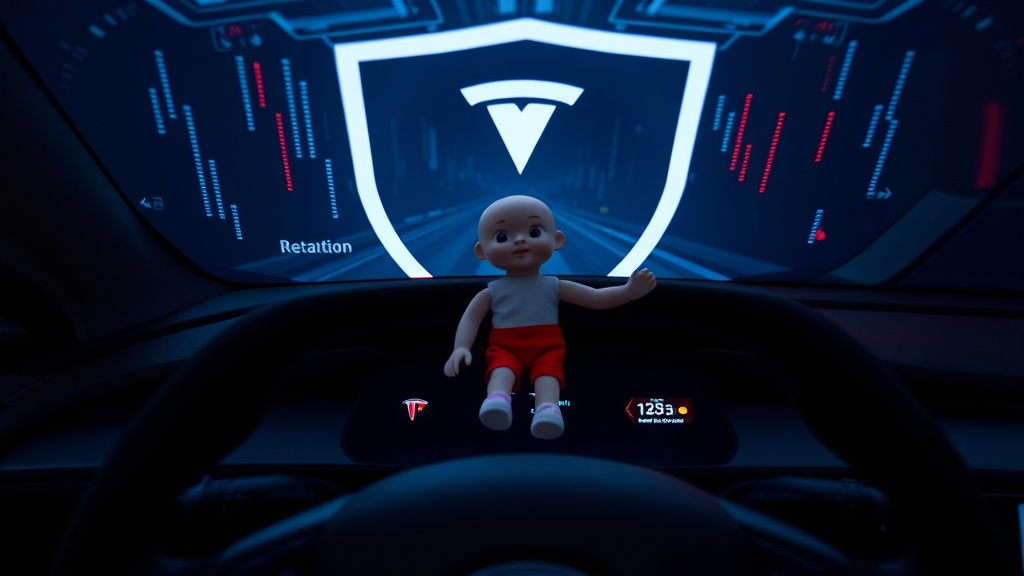
A recent viral video circulating on Reddit has exposed a surprising vulnerability in Tesla's advanced driver-assistance system (ADAS). The footage shows a seemingly innocuous scenario: a simple doll placed on the dashboard of a Tesla car. The AI, designed to perceive and react to its environment, misinterprets the doll, leading to erratic behavior. This incident, while seemingly minor, highlights significant challenges in the development and deployment of autonomous driving technology.
The video, originally posted on Reddit by user u/ImaginaryRea1ity, demonstrates how the Tesla's AI, likely its Autopilot or Full Self-Driving (FSD) beta software, struggled to correctly identify and classify the doll. Instead of recognizing it as a static object or an inanimate toy, the system appears to have perceived it as a genuine obstacle or even a pedestrian, triggering unnecessary braking or steering inputs. This misinterpretation is a critical flaw, as it suggests the AI's object recognition and prediction models are not robust enough to handle unexpected or unusual visual inputs.
How AI Systems Can Be Deceived
Artificial intelligence, particularly in computer vision tasks like those used in autonomous vehicles, relies on vast datasets and complex algorithms to learn patterns and make decisions. These systems are trained to recognize specific features associated with objects, such as shapes, textures, and movement patterns. However, they can be brittle when encountering novel or adversarial inputs – data that is intentionally or unintentionally crafted to fool the AI.
In the case of the doll, it likely presents a combination of visual cues that confuse the AI. The size and shape might resemble a human, especially from certain angles or in low light conditions. The texture of the doll's material could also be misinterpreted. Furthermore, the AI's training data, while extensive, may not contain sufficient examples of dolls placed in such a manner within a vehicle's cabin. This lack of training data for edge cases is a common challenge in AI development. Think of it less like a comprehensive understanding of the world and more like a highly specialized student who excels on known exam questions but struggles with an entirely new problem type.
Adversarial attacks on AI systems are not new. Researchers have demonstrated various methods to trick image recognition models, often by making subtle, almost imperceptible changes to an image. These changes can cause a model to classify a 'stop' sign as a 'speed limit' sign or misidentify a cat as a dog. While the doll scenario isn't a deliberate adversarial attack in the traditional sense, it functions similarly by presenting an input that falls outside the AI's expected parameters, exploiting its reliance on learned patterns.
Implications for Autonomous Driving Safety
The implications of this vulnerability are significant for Tesla and the broader autonomous driving industry. While Tesla's systems are classified as Level 2 ADAS and still require driver supervision, they are increasingly marketed and perceived by some users as fully autonomous. A system that can be so easily fooled by a common household item raises serious concerns about its reliability in unpredictable real-world driving scenarios.
The core challenge lies in the AI's ability to generalize and robustly handle the infinite variability of the real world. Object detection models need to be not only accurate but also resilient to variations in lighting, weather, occlusion, and the sheer diversity of objects and situations they might encounter. A doll on a dashboard is an example of an unexpected object within the vehicle's interior, something the AI might not be specifically trained to handle with high confidence. If the AI cannot reliably distinguish between a toy and a child, or a traffic cone and a stationary object, its safety claims are undermined.
This incident underscores the ongoing debate about the safety and maturity of current autonomous driving technologies. While AI has made remarkable strides, achieving true Level 5 autonomy – where a vehicle can handle all driving tasks under all conditions without human intervention – remains a distant goal. The complexity of human driving environments, with their inherent unpredictability and nuanced social cues, is incredibly difficult to replicate in artificial intelligence.
What This Means for Tesla and the Industry
For Tesla, this incident presents an immediate need to review and update its AI models. Developers will likely need to incorporate more diverse training data, specifically including scenarios involving unusual objects within the vehicle cabin. Furthermore, refining the AI's decision-making logic to be more conservative when faced with high uncertainty is crucial. Instead of triggering a potentially dangerous sudden maneuver, the system should ideally default to a safe state, such as alerting the driver more emphatically and preparing for a controlled stop.
The broader industry faces similar challenges. Companies developing autonomous vehicles are all grappling with the problem of ensuring AI robustness. This involves not only better algorithms and more comprehensive training data but also rigorous testing methodologies that go beyond standard road tests to include simulation and adversarial testing. The pursuit of autonomy requires a commitment to safety that prioritizes reliability in the face of the unexpected over rapid feature deployment.
What nobody has addressed yet is what happens to the public perception of AI safety when such simple, almost comical, failures are so easily demonstrated. Does it breed a healthy skepticism, or does it foster a dangerous overconfidence that AI is easily defeated and therefore not to be trusted?
Ultimately, while the doll incident may seem like a minor glitch, it serves as a potent reminder that the path to truly safe and reliable autonomous driving is paved with countless such challenges. Continuous innovation, rigorous testing, and a deep understanding of AI's limitations are paramount.