Orchestrating a Mass Flashing Operation
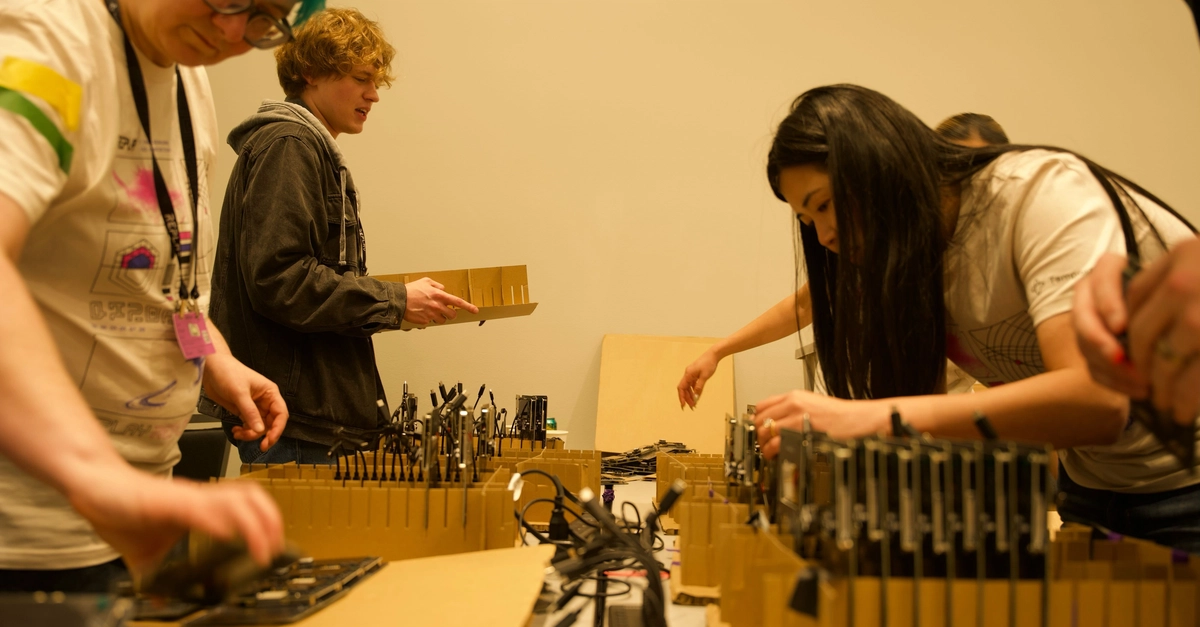
The day before Replay, the Temporal team faced a daunting task: flashing firmware onto 2,300 conference badges. This wasn't a simple task of running a command on a single machine. It involved coordinating multiple laptops, managing physical assembly lines, and ensuring each ESP32 badge received its correct firmware. The scale of the operation demanded a robust, distributed system, and the team turned to Temporal to orchestrate the entire process.
The core challenge was transforming a potentially chaotic hardware assembly into a predictable production system. Devices needed to be flashed reliably, even as they moved through different stages of assembly. A successful flash didn't guarantee the device would boot, and failures at any point could derail the entire operation. This is where Temporal's workflow engine proved invaluable, providing the necessary state management and reliability for a complex, real-world distributed task.
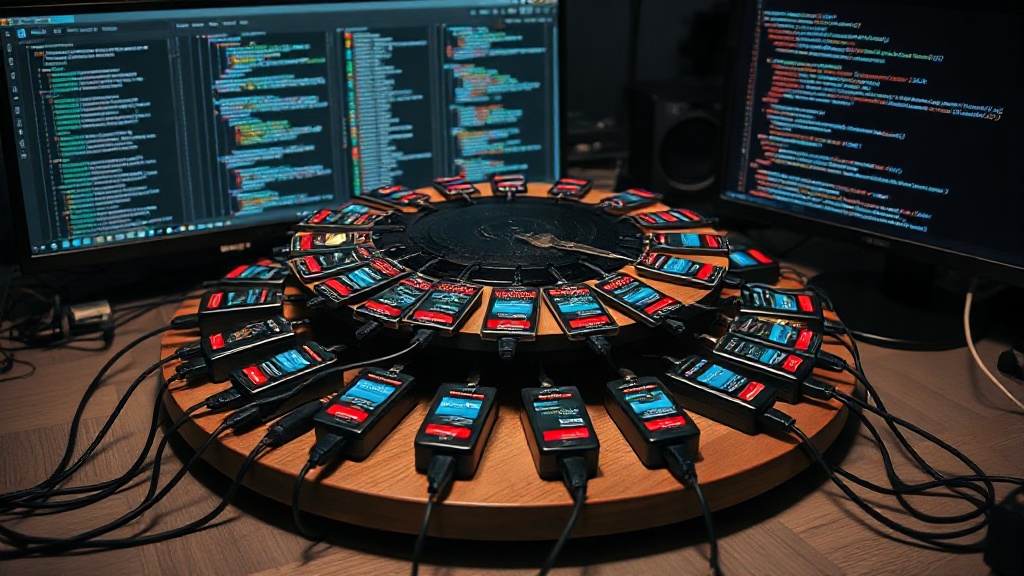
To manage the physical logistics, the team employed an ingenious solution: lazy Susans. Each lazy Susan held two 16-port USB hubs, allowing coworkers to load up to 32 badges at a time. These loaded carriers would then be passed to a flashing station. The station ran Ignition, the Temporal-powered firmware flashing system, which managed the flashing process for each badge within the carrier. Once flashed, the carrier would be returned to the assembly line. This setup effectively turned the badge assembly process into a literal distributed system, with Temporal at its digital core.
Ignition: The Temporal-Powered Flashing System
Ignition, the system developed for this task, leveraged Temporal's capabilities to manage the flashing workflows. Each badge flashing operation was treated as a Temporal workflow. This allowed the system to track the state of each individual badge, handle retries automatically, and provide visibility into the overall progress and any failures. The system was designed to be resilient, capable of recovering from transient errors such as loose USB connections or temporary network issues.
The decision to use Temporal was driven by the need for a system that could manage a large number of concurrent operations with high reliability. Flashing 2,300 devices across six laptops simultaneously is a significant undertaking. Temporal's ability to maintain state across these distributed operations, even in the face of hardware failures or network interruptions, was critical. It provided the backbone for Ignition, ensuring that the flashing process was not just a series of commands but a managed, observable workflow.
The system architecture involved multiple flashing stations, each running Ignition. These stations communicated with the Temporal cluster to start, monitor, and complete flashing workflows for batches of badges. The lazy Susan setup was key to the physical throughput, enabling a continuous flow of badges to the flashing stations. This combination of physical process engineering and robust distributed systems orchestration allowed the team to achieve their goal.
Challenges and Learnings
Despite the success, the project presented several challenges. Ensuring that a successful write operation actually meant the device had booted correctly was a key concern. The team had to implement checks to verify not just the flash completion but also the subsequent boot process. Failures at badge 17, for instance, required investigation and potential re-flashing, a process that Ignition, powered by Temporal, was designed to handle.
One of the surprising details was the sheer physical coordination required. While Temporal handled the distributed computing aspect, the physical assembly line, with its 70+ coworkers, was its own complex system. Managing the flow of hardware, ensuring consistent quality, and integrating the digital flashing process with the physical assembly required constant attention and adaptation. The phrase "distributed systems" took on a very literal meaning, encompassing both the software orchestration and the human-powered hardware pipeline.
The project highlighted the power of Temporal for orchestrating complex, real-world operational tasks that go beyond typical software development workflows. It demonstrated that Temporal can be applied to manage not just microservices but also large-scale hardware deployment and configuration. The team successfully turned a potentially overwhelming manual task into a streamlined, automated process, proving the versatility of Temporal's workflow engine for a wide range of demanding applications.
Broader Implications
This project serves as a compelling case study for how Temporal can be used to manage large-scale, distributed operations. It moves beyond theoretical use cases to demonstrate practical application in hardware provisioning and event logistics. The success of Ignition suggests that Temporal could be a powerful tool for any organization needing to manage a high volume of device configurations, deployments, or complex sequential tasks where reliability and state management are paramount.
For developers and operations teams, this showcases a tangible example of applying workflow automation to physical processes. It encourages thinking about how stateful workflows can bridge the gap between software and hardware operations. The ability to manage, retry, and observe thousands of individual operations from a central, resilient system offers significant advantages in efficiency and error reduction.
The conference badge project, while specific, embodies a broader trend: the increasing need for sophisticated orchestration tools in an ever-more distributed and complex technological landscape. Temporal's role in Ignition underscores its potential to manage not just cloud-native applications but also the tangible, physical aspects of technology deployment.