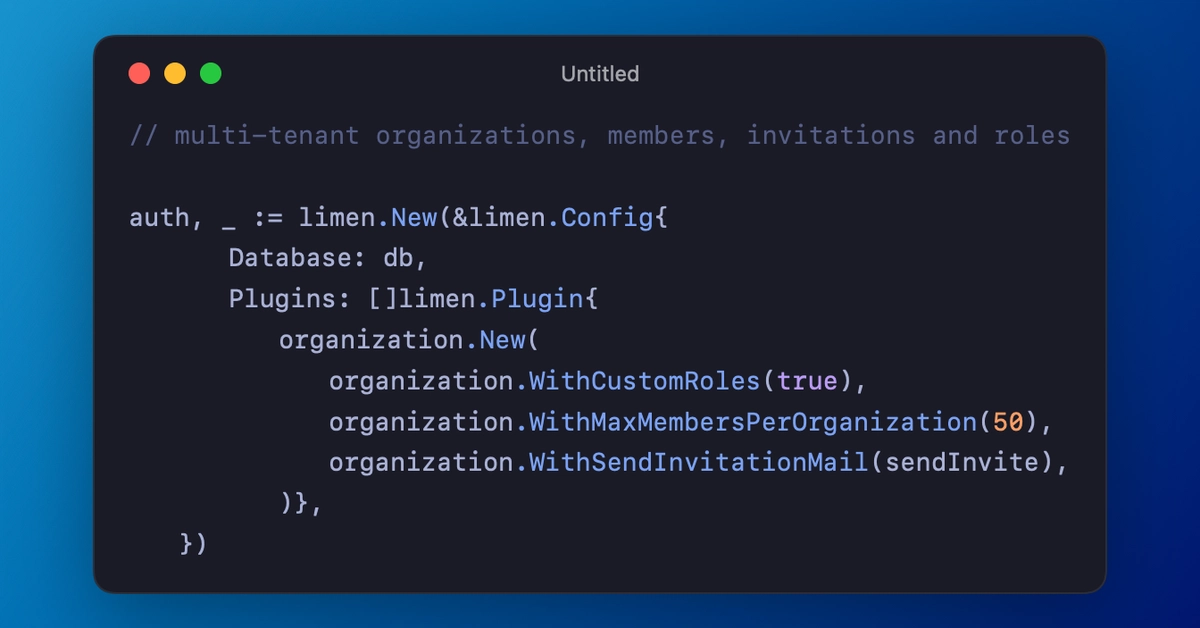
Simplifying Multi-Tenancy in Go Applications
Many Software-as-a-Service (SaaS) products are built around distinct organizational units, whether they are workspaces, teams, or customer accounts. This multi-tenant architecture requires more than just user authentication; it demands a robust system for managing organizations, handling membership, allowing users to switch between active workspaces, scoping data correctly to each tenant, and defining granular permissions for each member.
The challenge lies in ensuring that every action performed within the application is properly contextualized. A user might be signed in, but that’s only part of the equation. The system must also know which organization they are currently operating within and verify if their assigned role grants them the necessary permissions to perform the requested action. This is the core problem that Limen's new Organization plugin aims to solve for Go developers.
Limen's Organization Plugin: Key Features
Limen's Organization plugin provides a comprehensive set of tools designed to implement a multi-tenant model in your Go application. It directly addresses the complexities of managing organizations and their associated resources. The plugin offers out-of-the-box solutions for several critical components:
- Organizations: The fundamental tenant unit. This allows you to create and manage distinct customer or team entities within your application.
- Members: Managing who belongs to which organization. This involves associating users with specific organizations.
- Roles: Defining granular permissions within an organization. Developers can set up different roles (e.g., Admin, Editor, Viewer) and assign them to members, controlling what actions they can perform.
- Invitations: Streamlining the process of onboarding new members into an organization. This feature handles sending invitations and managing their acceptance.
- Organization Switching: Enabling users to seamlessly switch between different organizations they are a part of. This is crucial for users who may belong to multiple teams or client accounts.
- Tenant-Aware Handlers: Providing Go APIs that automatically handle the context of the current organization for API requests, ensuring data is always scoped correctly.
The plugin abstracts away much of the boilerplate code typically required to build these features from scratch. This allows developers to focus on the core business logic of their application rather than getting bogged down in the intricacies of tenancy management.
Implementing Tenant-Scoped Data and Actions
A practical example often involves managing projects within an organization. Each project is created within a specific organization, and access to that project is governed by the user's role within that organization. Limen's plugin simplifies this by providing the necessary primitives. When a user attempts to interact with a project, the system can easily determine:
- Who the currently signed-in user is.
- Which organization the user has selected or is currently operating within.
- Whether the user’s role in that organization permits the intended action (e.g., creating a new project, editing an existing one, or simply viewing project details).
This context is essential for enforcing security policies and ensuring data integrity. Without proper scoping, sensitive data could be exposed across tenants, leading to severe security breaches and compliance issues.
Developer Experience and API Design
Limen's approach focuses on providing a developer-friendly API. The Organization plugin is designed to integrate smoothly into existing Go applications. The tenant-aware handlers are particularly valuable. They can automatically inject the current organization's context into request handlers, removing the need for developers to manually fetch and verify this information on every request. This results in cleaner, more maintainable code. For instance, instead of writing:
func getProject(r *http.Request, userID string) (*Project, error) {
  orgID := getOrgIDFromSession(r) // Manual lookup
  role := getRole(userID, orgID) // Manual lookup
  if !role.CanViewProjects() {
    return nil, errors.New("unauthorized")
  }
  // Fetch project scoped to orgID
  return projectRepo.FindByIDAndOrg(projectID, orgID)
}
A Limen-enabled handler might look more like:
func getProject(r *http.Request, org *limen.Organization, user *limen.User) (*Project, error) {
  if !user.HasRoleInOrg(org, "viewer") {
    return nil, errors.New("unauthorized")
  }
  // Limen automatically provides org and user context
  return projectRepo.FindByIDAndOrg(projectID, org.ID)
}
This abstraction layer significantly reduces the cognitive load on developers and minimizes the potential for errors related to authorization and data scoping.
Broader Implications for SaaS Development
The availability of such plugins signifies a maturing ecosystem for building complex applications in Go. Multi-tenancy is a common requirement for SaaS, and having well-tested, community-supported libraries that abstract away much of the complexity can dramatically speed up development cycles. It allows startups and established companies alike to bring their products to market faster and with greater confidence in their security and scalability.
What remains to be seen is how effectively Limen's plugin scales with very large organizations that might have millions of members or thousands of sub-tenants. Performance benchmarks and real-world case studies will be crucial for understanding its limits and optimal deployment scenarios. However, for the vast majority of SaaS applications, this plugin offers a powerful and efficient way to implement robust multi-tenant authentication and authorization.