Introduction: What is TanStack Query?
TanStack Query, known previously as React Query, is a powerful, framework-agnostic state management library. Its primary focus is on simplifying the complexities of managing server state within applications. This includes handling data fetching, caching, background updates, and the crucial task of cache invalidation. By abstracting these common patterns, TanStack Query allows developers to concentrate on building user interfaces rather than wrestling with the intricacies of asynchronous data.
Server State vs. Client State & The Memory Reality
Understanding the distinction between server state and client state is fundamental to grasping TanStack Query's purpose.
- Client State: This refers to data that is entirely owned and controlled by the browser. Examples include UI-specific states like whether a modal is open (
isModalOpen), the selected UI theme, or form input values before submission. This state typically lives and dies with the component or the browser session. - Server State: This is data that originates from and is owned by a remote backend database. Think of user profiles, lists of posts, items in a shopping cart, or any data that persists on the server. The browser only holds a read-only temporary snapshot of this data. When this data changes on the server, the client's snapshot becomes stale.
Where is data physically stored?
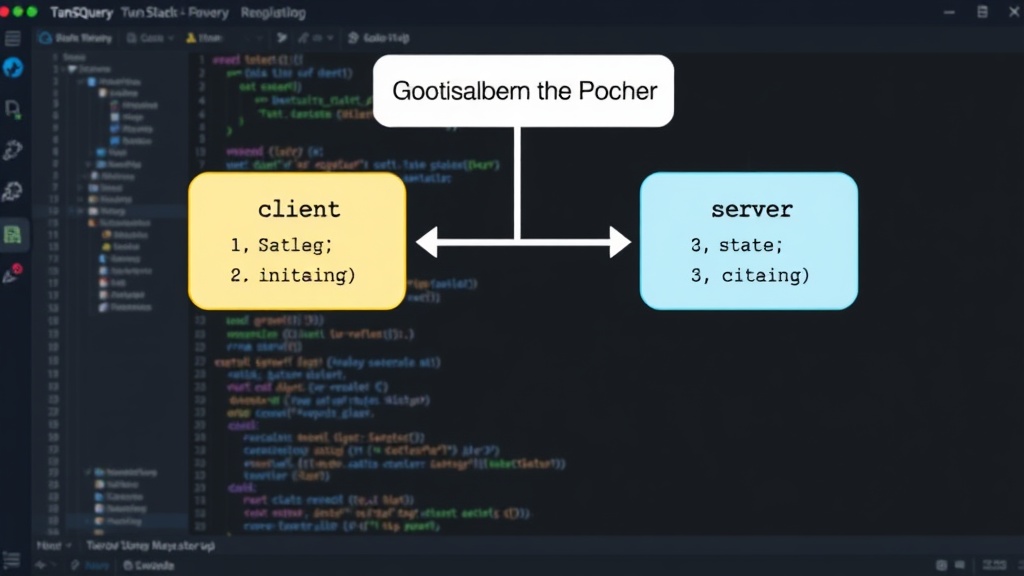
By default, cached server data resides in the browser tab's JavaScript RAM (In-Memory). This provides fast access but means the data is lost when the user navigates away or closes the tab. The 'Server' itself refers to the backend database or API where the canonical source of truth for this data lives.
TanStack Query acts as an intelligent layer between your application's UI and your backend. It fetches data when needed, stores it locally in memory, and provides mechanisms to keep that local copy synchronized with the server without manual intervention.
Key Concepts and Features
Query Client and Query Cache
At the heart of TanStack Query is the QueryClient. This instance is responsible for managing the QueryCache, which is where all your fetched server state data is stored. When you initiate a data fetch, TanStack Query uses the QueryClient to interact with the cache. If the data is already in the cache and considered fresh, it's returned immediately. Otherwise, it fetches the data from the server, stores it in the cache, and then returns it.
Queries
Queries are the primary mechanism for fetching server state. A query is defined by a unique query key (typically an array of strings and/or values) and a query function. The query key acts as the identifier for the data in the cache. The query function is an asynchronous function that returns your data (e.g., an API call). TanStack Query handles the lifecycle of this query, including fetching, caching, and re-fetching.
Consider fetching user data. Your query key might be ['user', userId], and your query function would be an `async` function that calls an API endpoint like `/api/users/${userId}`. TanStack Query ensures that for a given `userId`, the data is fetched only once and reused across your application.
Mutations
While queries are for fetching data, mutations are used for operations that change data on the server (e.g., creating, updating, or deleting data). Mutations do not automatically cache data in the same way queries do. Instead, they are designed for side effects. When a mutation successfully completes, you typically want to update your cached server state. TanStack Query provides several ways to achieve this:
- Invalidation: You can tell TanStack Query to invalidate specific queries after a mutation succeeds. This marks the cached data as stale, prompting TanStack Query to re-fetch it the next time it's needed. This is often the simplest and most robust approach.
- Optimistic Updates: For a more responsive user experience, you can perform an optimistic update. This involves updating the cache with the expected new data *before* the mutation has even completed on the server. If the mutation succeeds, great. If it fails, TanStack Query can automatically revert the optimistic update.
Background Updates and Stale-While-Revalidate
One of TanStack Query's most powerful features is its ability to keep your data fresh automatically. It employs a stale-while-revalidate strategy by default. When a query's data is considered 'stale' (based on configuration like staleTime and gcTime), TanStack Query will serve the stale data immediately while it attempts to re-fetch the data in the background. This ensures your UI remains responsive while ensuring data accuracy. This is a significant improvement over traditional approaches that might show a loading spinner or block the UI entirely.
The concept of 'stale' is configurable. Data is considered stale initially. After a configurable staleTime passes, the data is still served, but TanStack Query will trigger a background refetch. The gcTime (garbage collection time) determines how long inactive data is kept in the cache before being removed to save memory.
Handling Loading and Error States
TanStack Query provides simple boolean flags to manage loading and error states directly within your components. Each query hook (e.g., useQuery) returns an object containing properties like isLoading, isError, error, and data. This makes it straightforward to conditionally render UI elements based on the state of your data fetching operations.
For instance, you can easily show a loading indicator when isLoading is true, display an error message when isError is true, and render your data when it's available. This declarative approach eliminates the need for manual loading and error state management within individual components.
Framework Agnosticism
While originally known as React Query, TanStack Query has evolved into a framework-agnostic library. This means its core logic can be used with various JavaScript frameworks and even outside of them. Official adapters exist for React, Solid, Vue, Svelte, and vanilla JavaScript, allowing developers to leverage its powerful server state management capabilities regardless of their chosen frontend technology stack.
This agnosticism is achieved by separating the core state management logic from framework-specific bindings. The core library handles the caching, fetching, and synchronization, while the framework adapters provide the necessary hooks and components to integrate seamlessly.
Conclusion: Why TanStack Query Matters
TanStack Query tackles a pervasive problem in modern web development: managing asynchronous server state. By providing a robust, efficient, and declarative API for data fetching, caching, and synchronization, it significantly reduces boilerplate code and improves application performance and developer experience. Its ability to handle loading states, error states, background updates, and optimistic updates makes it an indispensable tool for building complex, data-intensive applications.