Beyond One-Shot Demos: The Need for Persistent AI Agents
The current landscape of AI agent demonstrations often showcases a familiar pattern: initiate a terminal session, assign a task, observe tool calls, and then witness the process terminate. While effective for ephemeral tasks like coding sessions, this approach falls short when considering an AI assistant designed to be a permanent fixture within a user's actual workflow. The limitations are clear: these agents lack the persistence, memory, and adaptability required for true integration into daily operations.
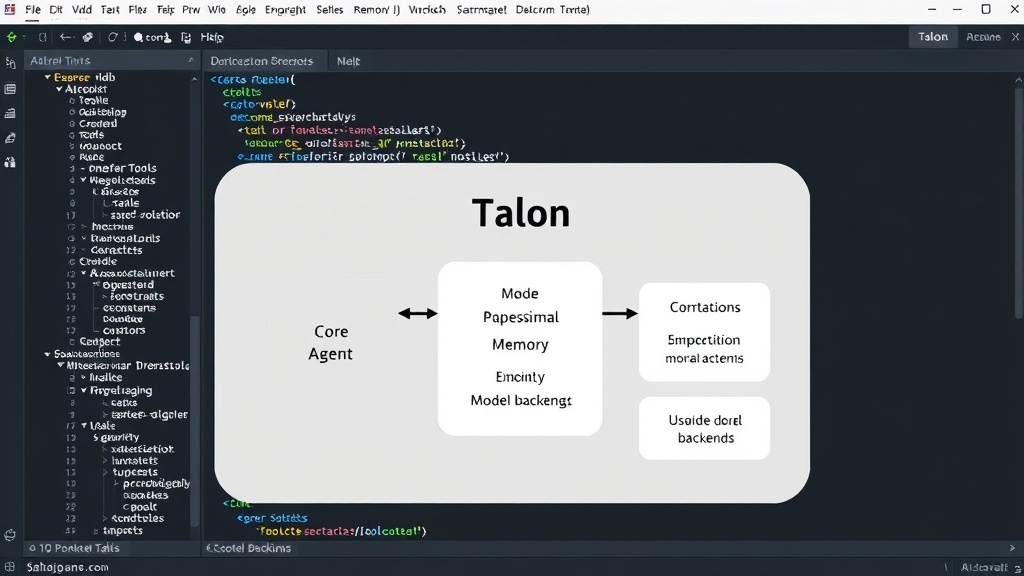
Talon emerges as a direct response to this gap. It is architected around a fundamentally different paradigm: a persistent agent process that integrates multiple components. This includes user-facing frontends, robust memory systems, flexible tool integration, background job execution, and the ability to swap out model backends. This design philosophy shifts the focus from transient interactions to continuous, long-term operation, aiming to build AI assistants that are not just functional for a single command but are truly helpful over time.
The core innovation of Talon lies in its decoupling of the agent's 'brain' from its 'mouth.' The chat interface or other user-facing elements are merely conduits. The essential state, the agent's learned tools, its memory, its defined goals, and the underlying model are all managed centrally and independently of the interface. This architectural choice enables significant flexibility and resilience.
Flexible Frontends for Ubiquitous Access
A key challenge for any AI assistant intended for real-world use is accessibility. Users interact with technology through a variety of platforms, and an agent should ideally be available wherever the user is. Talon addresses this by offering a modular frontend system. The same core agent logic can be exposed through diverse communication channels, ensuring that users can interact with their agent using their preferred tools.
Talon supports a range of frontends, including:
- Telegram: For users who prefer a widely adopted messaging platform.
- Discord: Catering to communities and users familiar with its server-based structure.
- Microsoft Teams: Integrating directly into enterprise communication stacks.
- Terminal Chat: A direct, command-line interface for developers and power users.
- Desktop/Mobile Companion Bridge: A more integrated solution for desktop or mobile environments, potentially offering richer interaction possibilities beyond text.
This multi-frontend approach means the agent isn't locked into a single user experience. Whether you're in a team meeting on Teams, chatting with friends on Discord, or working in a terminal, the agent remains accessible and consistent. The UI is merely the delivery mechanism; the agent's persistent state, its capabilities, and its intelligence reside in the self-hosted core.
Swappable Model Backends and Tool Integration
The intelligence of an AI agent is critically dependent on the underlying language model. Talon is designed with this in mind, offering the flexibility to switch between different model providers and frameworks. This modularity ensures that users can adapt their agent to leverage the latest advancements in LLMs or to utilize models that best fit their specific task requirements and budget.
Currently, Talon supports integrations with:
- Claude Agent SDK: Leveraging Anthropic's powerful models and development kit.
- OpenAI API: Providing access to the widely-used GPT series of models.
Beyond the core LLM, an agent's utility is amplified by its ability to interact with external systems and data. Talon incorporates a robust tool integration system. This allows developers to define custom tools that the agent can call to perform actions, retrieve information, or execute code. This is fundamental to moving beyond simple text generation and enabling agents to actively participate in complex workflows.
The 'harness' aspect of Talon is central here. It provides the scaffolding to manage these tools, ensure they are called correctly, and handle their outputs. This system is designed to be extensible, allowing for the addition of new tools and integrations as needed, thereby expanding the agent's capabilities over time.
Memory and Long-Term State Management
A persistent AI agent is only as useful as its memory. For an assistant to truly understand context and provide relevant assistance over extended periods, it needs to retain information from past interactions. Talon implements a sophisticated memory system designed to manage this long-term state. This goes beyond simple conversation history; it involves storing and retrieving relevant information, user preferences, and the outcomes of previous actions.
This memory component is crucial for building agents that can learn, adapt, and maintain a consistent persona or operational context. Imagine an agent that remembers your project details from last week, your preferred coding style, or the specific configurations you use for certain tasks. This level of recall is what transforms a command-line tool into a genuine assistant.
The self-hosted nature of Talon is particularly advantageous here. Sensitive data and conversation history remain under the user's control, mitigating privacy concerns often associated with cloud-based AI services. This control over data is paramount for enterprise adoption and for individual users who handle confidential information.
The Future of AI Agents: Persistence and Integration
Talon represents a significant step towards making AI agents practical tools for everyday work. By focusing on persistence, flexible frontends, swappable backends, and robust memory management, it addresses the shortcomings of current demo-centric approaches. The ability to self-host further enhances its appeal for users prioritizing data privacy and control.
While platforms like Kastor offer Terraform-style specifications for agents, Talon provides the runtime environment and infrastructure to bring those specifications to life in a persistent, integrated manner. The broader implication is a shift towards AI agents that are not just experimental tools but integral components of our digital lives, capable of performing complex, long-running tasks across various communication channels and systems.