Introducing t0-alpha: A New Approach to Time-Series Forecasting
The realm of time-series analysis is constantly seeking more robust methods for predicting future trends. Traditional forecasting models often struggle with the inherent complexity and noise present in sequential data. Now, a novel approach, embodied by t0-alpha, is emerging, leveraging principles from Large Language Models (LLMs) to address these challenges. t0-alpha is a decoder-style patch transformer designed specifically for probabilistic time-series forecasting.
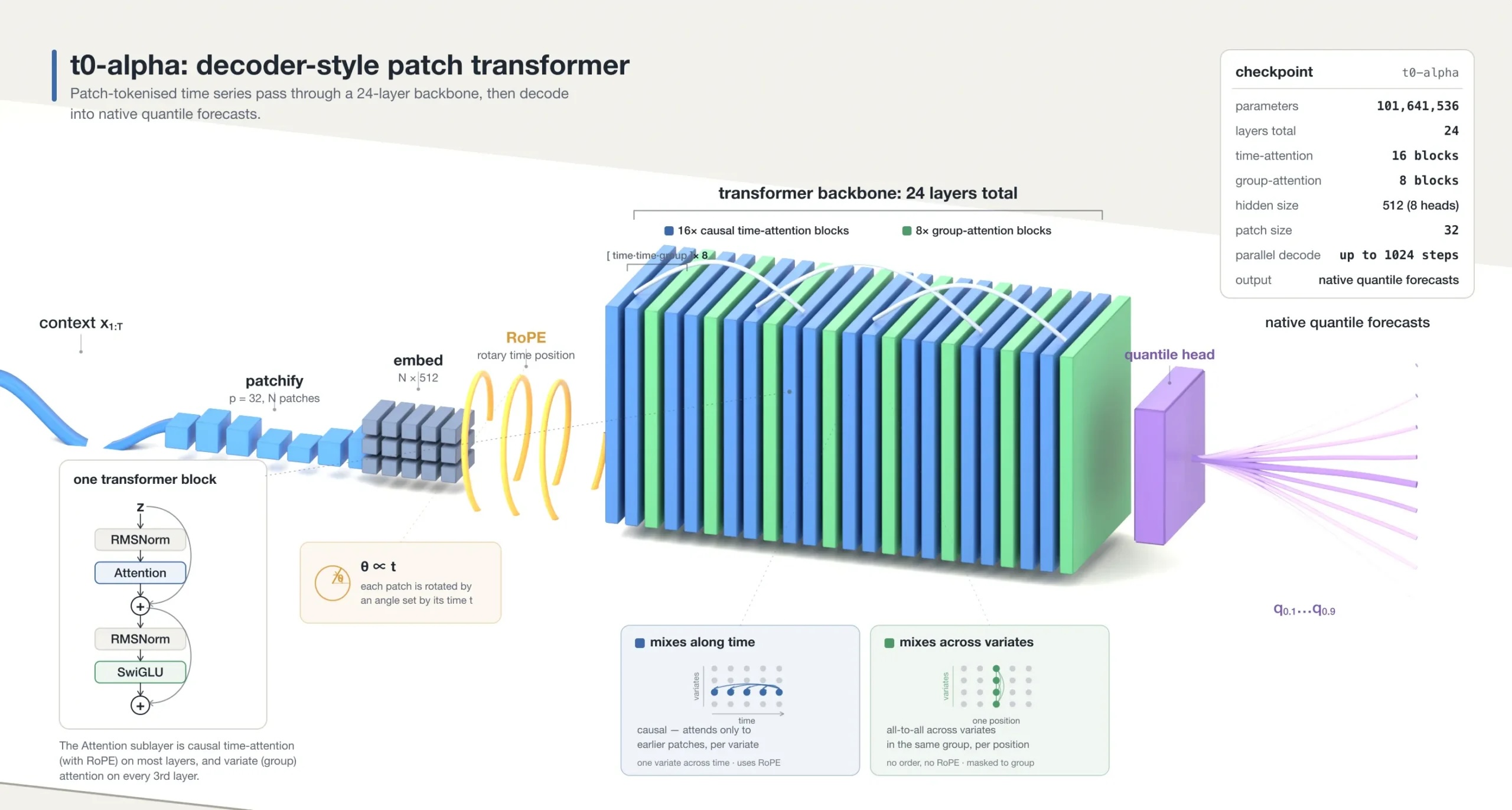
At its core, t0-alpha re-imagines how time-series data is processed. Instead of treating the entire series as a monolithic block, it breaks down raw time-series data into smaller, manageable segments. Specifically, the input series is divided into 32-step patches. These patches are then embedded, transforming them into a format that the transformer architecture can process effectively. This patching strategy is reminiscent of how LLMs process text, breaking sentences into tokens.

Architectural Innovations: Attention and Decoding
The processed patches then flow through a sophisticated network of attention mechanisms. t0-alpha employs both causal time-attention and group-attention layers. Causal time-attention ensures that the model only considers past information when making predictions, adhering to the fundamental principle of time-series forecasting – the future cannot influence the past. This is crucial for maintaining the integrity of the forecasting task.
Group-attention, on the other hand, allows the model to capture relationships not just within a single time series, but potentially across related series or different segments of the same series that might share underlying patterns. This can be particularly powerful for understanding complex systems where interdependencies exist. The combination of these attention mechanisms allows t0-alpha to learn intricate temporal dependencies and contextual information within the data.
Probabilistic Forecasting: Beyond Single Point Estimates
A key differentiator for t0-alpha is its output. Rather than predicting a single, definitive future value (a point forecast), t0-alpha is designed to predict future quantiles. This probabilistic approach provides a richer understanding of potential future outcomes. By forecasting quantiles, the model can generate prediction intervals, offering a range of likely values and their associated probabilities.
This probabilistic output is immensely valuable in real-world applications. For instance, in financial forecasting, understanding the range of potential stock prices, along with their likelihood, is far more informative than a single predicted price. Similarly, in energy demand forecasting, knowing the upper and lower bounds of demand helps in resource allocation and grid management. This shift from point forecasts to probabilistic forecasts aligns with the need for more nuanced and risk-aware decision-making in various industries.
t0-alpha's LLM Heritage
The architecture of t0-alpha draws inspiration from decoder-style transformers, a common design in LLMs like GPT. This lineage suggests that the powerful sequence modeling capabilities that have revolutionized natural language processing can be effectively adapted for sequential numerical data. The patching mechanism, embedding, and attention layers are all components that have proven successful in handling long sequences of tokens in LLMs.
By applying these architectural patterns to time-series data, t0-alpha aims to unlock similar gains in predictive accuracy and the ability to model complex temporal dynamics. The success of LLMs in understanding context and long-range dependencies in text provides a strong theoretical basis for their application in time-series analysis. The challenge lies in adapting these techniques to the unique characteristics of numerical sequential data, which t0-alpha appears to address through its specialized patching and attention strategies.
Potential Implications and Future Directions
t0-alpha represents a significant step in the convergence of LLM architectures and traditional forecasting methods. Its ability to handle complex temporal patterns and provide probabilistic outputs makes it a promising tool for a wide array of applications, from finance and energy to supply chain management and IoT sensor data analysis. The focus on decoder-style transformers for forecasting also opens up new avenues for research into generative time-series models.
While t0-alpha is a decoder-style patch transformer, its core innovations lie in how it preprocesses and models time-series data. The patching strategy, combined with causal time-attention and group-attention, allows it to capture intricate dependencies. Crucially, its probabilistic output via quantile forecasting offers a more comprehensive view of future uncertainty. If this approach proves scalable and accurate across diverse datasets, it could set a new standard for time-series forecasting, moving beyond single-point predictions to a more nuanced understanding of future possibilities.