Beyond the Buzzwords: What System Design Actually Means
Many beginners approach system design by memorizing a checklist of popular technologies: load balancers, Redis, Kafka, microservices, sharding, database replication. This is a common pitfall. Knowing these tools is merely a prerequisite, not the core skill. True system design is about deeply understanding the problem you're trying to solve. A system architecting for 1,000 users operates under vastly different constraints and requirements than one designed for 10 million. The fundamental principle is to first grasp the requirements, scale, constraints, potential failure points, and inherent trade-offs before ever selecting a specific technology. This foundational understanding dictates the architecture, not the other way around.
A Structured Thinking Process for Scalable Systems
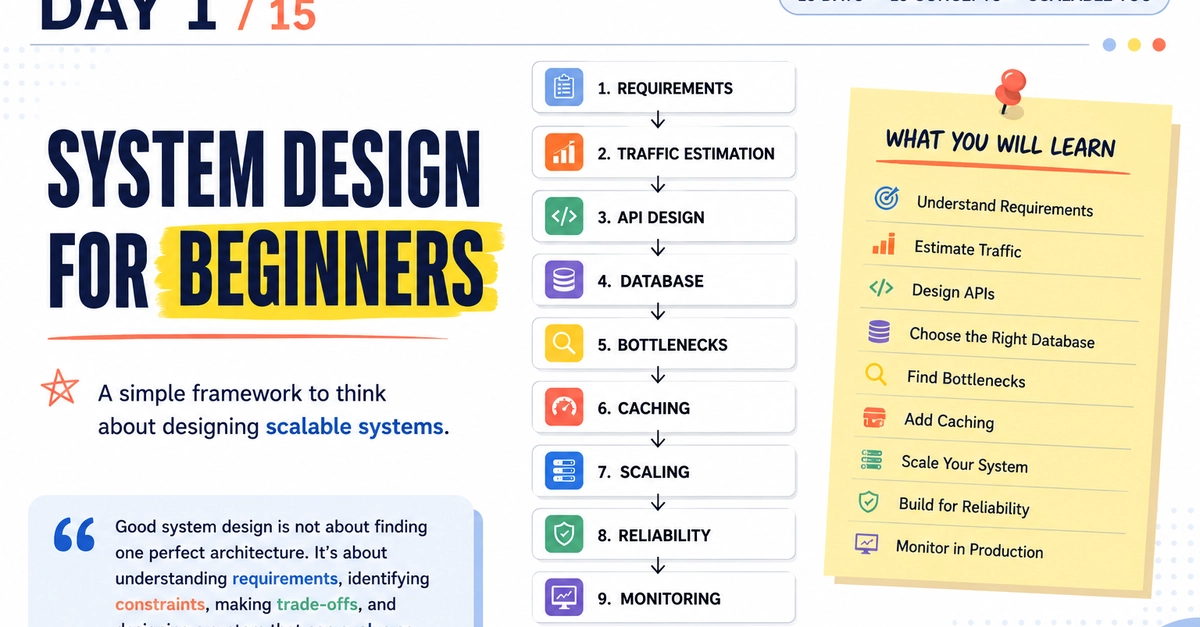
A pragmatic system design process can be broken down into a series of interconnected steps. This isn't a rigid dogma, but a logical flow to ensure critical aspects are considered. It begins with defining the core requirements.
1. Requirements Gathering
What exactly does the system need to do? This involves understanding both functional requirements (what the system *must* do) and non-functional requirements (how it must perform). Non-functional requirements are crucial for scalability and include aspects like latency, throughput, availability, consistency, and durability. For example, an e-commerce system needs high availability and durability for transactions, while a social media feed might prioritize low latency for real-time updates.
2. Estimating Traffic and Load
Once requirements are clear, estimate the expected user load. This includes the number of concurrent users, the rate of requests per second (RPS), and the read-to-write ratio. Consider peak loads (e.g., Black Friday sales for an e-commerce site) and steady-state traffic. This step is critical for determining the necessary infrastructure and potential bottlenecks. A system designed for 100 RPS will be vastly different from one needing to handle 100,000 RPS.
3. Designing the API
The Application Programming Interface (API) is the contract between different parts of your system and between your system and its clients. Design clean, efficient, and well-documented APIs. Consider RESTful principles, GraphQL, or gRPC based on your needs. For scalability, think about how APIs will handle large payloads, rate limiting, and versioning. A poorly designed API can become a significant bottleneck, regardless of how robust the backend is.
4. Database Selection and Design
The database is often the heart of a system and a common source of scaling issues. Choose the right database type (SQL vs. NoSQL) based on data structure, consistency requirements, and query patterns. For SQL databases, consider schema design, indexing strategies, and normalization/denormalization. For NoSQL, understand partitioning, consistency models, and access patterns. Replication and sharding are advanced techniques to consider here if initial load estimates suggest a single instance won't suffice.
5. Identifying and Addressing Bottlenecks
No system is perfect. Proactively identify potential bottlenecks. These can occur at any layer: network, CPU, memory, disk I/O, or within specific application code or database queries. Performance profiling and load testing are essential tools to uncover these hidden constraints. Once identified, prioritize them based on their impact.
6. Implementing Caching Strategies
Caching is a powerful technique to reduce latency and database load. Understand different caching layers: client-side, CDN, server-side (e.g., Redis, Memcached), and database caching. Implement appropriate cache invalidation strategies to ensure data consistency. A well-placed cache can dramatically improve performance and reduce the need for immediate scaling of core services.
7. Planning for Scaling
Scaling can be vertical (increasing resources of a single server) or horizontal (adding more servers). Horizontal scaling is generally preferred for high availability and cost-effectiveness in modern architectures. Consider strategies like stateless application servers, load balancing across instances, and partitioning data. Autoscaling, where the system automatically adjusts resources based on demand, is a key enabler for handling variable loads efficiently.
8. Ensuring Reliability and Fault Tolerance
Systems fail. Design for failure. Implement redundancy at critical components (servers, databases, network paths). Use techniques like retries, circuit breakers, and graceful degradation to handle transient failures. Aim for high availability by minimizing single points of failure. Understand the trade-offs between consistency, availability, and partition tolerance (CAP theorem) when designing distributed systems.
9. Setting Up Monitoring and Alerting
You cannot manage what you cannot measure. Implement comprehensive monitoring for key metrics: system health (CPU, memory, disk), application performance (latency, error rates), and business metrics. Set up alerts for critical thresholds to proactively address issues before they impact users. Logging is also essential for debugging and auditing. Effective monitoring provides the feedback loop needed to iterate on the design and identify new bottlenecks as the system evolves.
Trade-offs: The Unavoidable Reality
Every design decision involves trade-offs. Want higher consistency? You might sacrifice availability or latency. Need to support more complex queries? Your data model might become less scalable. The art of system design lies in understanding these trade-offs and making informed decisions aligned with the specific requirements and constraints of the problem at hand. There is no one-size-fits-all solution. What nobody has adequately addressed yet is how to systematically teach junior engineers to *feel* these trade-offs intuitively, rather than just reciting them.
By following a structured thinking process that prioritizes understanding the problem and its constraints over simply adopting popular technologies, you can build systems that are not only scalable but also robust, maintainable, and cost-effective.