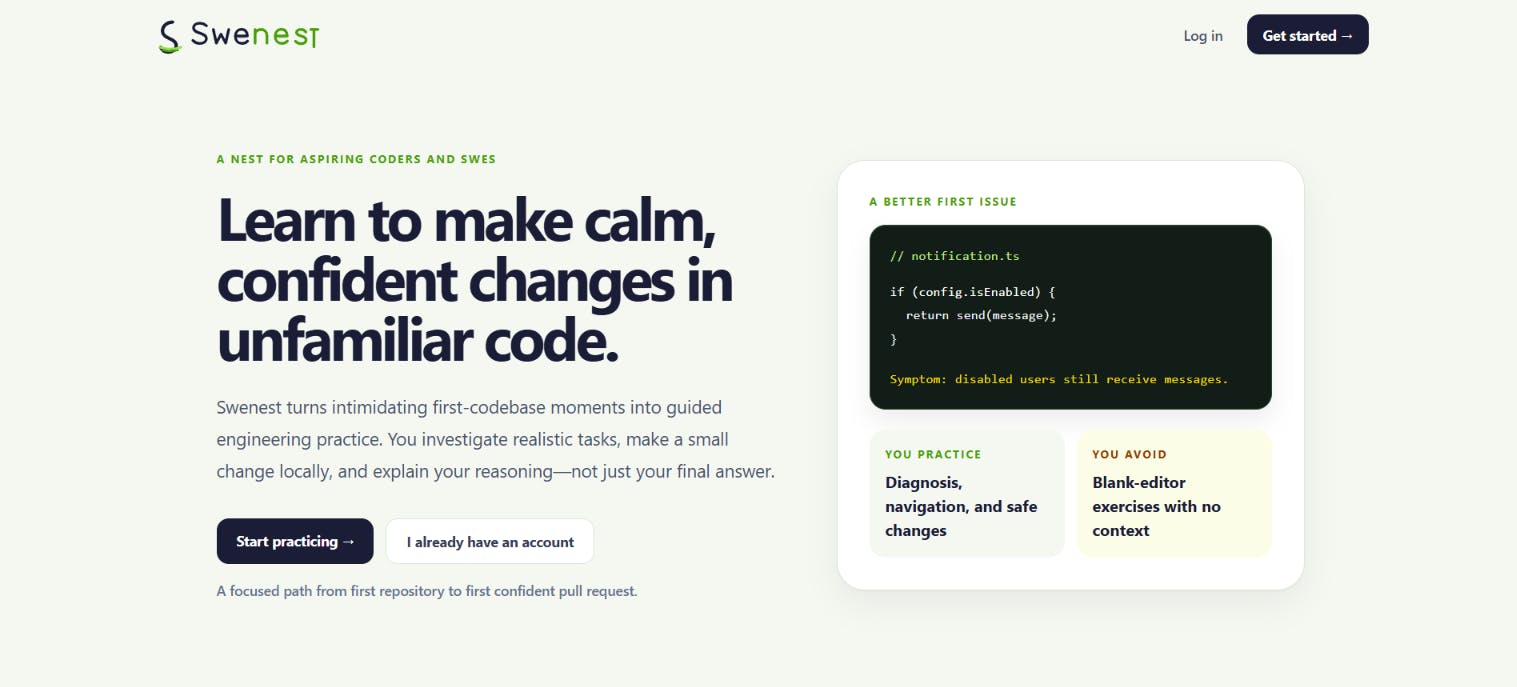
Navigating Code in the Real World
The landscape of software development is vast and often overwhelming. While countless resources exist for learning programming languages and algorithms, a significant gap remains in teaching developers how to effectively navigate and contribute to complex, real-world codebases. This is the problem Swenest aims to solve with its newly launched platform.
Swenest positions itself as a solution for developers who have moved beyond basic tutorials and are ready to tackle the challenges of production code. The platform focuses on practical skills, such as understanding existing code structures, identifying areas for improvement, and collaborating within established projects. It’s designed to equip developers with the intuition and techniques needed to contribute meaningfully to projects they haven't personally built from the ground up.
Think of it less like a textbook on syntax and more like a guided tour through a bustling city's infrastructure. You learn not just the names of buildings, but how the roads connect them, where the power comes from, and how to find your way around efficiently. Swenest seeks to provide that same level of practical, contextual understanding for software projects.
Bridging the Theory-Practice Divide
Many developers find themselves proficient in writing code in isolated environments but struggle when faced with large, legacy codebases. These projects often have intricate dependencies, undocumented quirks, and established patterns that are not immediately obvious. Swenest’s approach centers on demystifying these environments. The platform likely offers curated modules, interactive exercises, and case studies that simulate common real-world scenarios.
The core challenge Swenest addresses is the steep learning curve associated with entering an existing project. Developers often spend weeks or months just trying to understand the architecture, tooling, and contribution workflows. By providing structured guidance, Swenest intends to significantly shorten this onboarding period, allowing developers to become productive contributors much faster. This could involve teaching developers how to effectively use debugging tools, interpret code reviews, understand CI/CD pipelines, and identify potential refactoring opportunities.
Target Audience and Value Proposition
Swenest is targeting a broad spectrum of developers, from recent graduates looking to land their first role in a professional software team to experienced engineers transitioning to new companies or open-source projects. The platform’s value proposition lies in its ability to accelerate skill development in areas that are crucial for career advancement but often undertaught in traditional educational settings.
For junior developers, Swenest offers a pathway to gain confidence and competence in handling production code, making them more attractive candidates to employers. For senior developers, it can serve as a refresher or a way to standardize their approach to code comprehension and contribution, especially when moving between different tech stacks or team methodologies. The platform’s focus on practical, actionable skills suggests it could also be valuable for engineering managers looking to upskill their teams or for companies seeking to improve their internal developer onboarding processes.
The Future of Code Comprehension
The launch of Swenest highlights a growing recognition within the developer community that technical proficiency extends beyond writing new code. The ability to understand, maintain, and improve existing systems is just as, if not more, critical for the long-term health and success of software projects. As software systems become increasingly complex and interconnected, tools and platforms that facilitate deeper code comprehension will become indispensable.
What remains to be seen is how Swenest will adapt to the ever-evolving nature of software development. New frameworks, languages, and architectural patterns emerge constantly. The platform’s success will depend on its ability to stay current and provide relevant, practical guidance that reflects the bleeding edge of development practices while still grounding developers in timeless principles of code navigation and understanding. Its ability to foster a community around shared learning experiences could also be a significant factor in its long-term impact.