The Boilerplate Problem
Developers frequently encounter the need to build the same types of data-driven interfaces: tables with editing forms, validation, pagination, charts, and API integrations. This repetitive task consumes significant time, often involving hundreds of lines of boilerplate code. While hosted solutions like Retool and Appsmith offer visual building experiences, they typically lock users into their proprietary platforms. The absence of a true 'eject to code' feature means that when a project outgrows these platforms or requires deeper customization, migrating away is a complex, often impossible, undertaking.
This friction has led to the development of SvGrid Studio, a new visual data-app builder designed to generate self-hostable SvelteKit projects. The core promise is to automate the creation of common data-centric screens, delivering clean, ownership-ready SvelteKit source code to the developer.
How SvGrid Studio Works
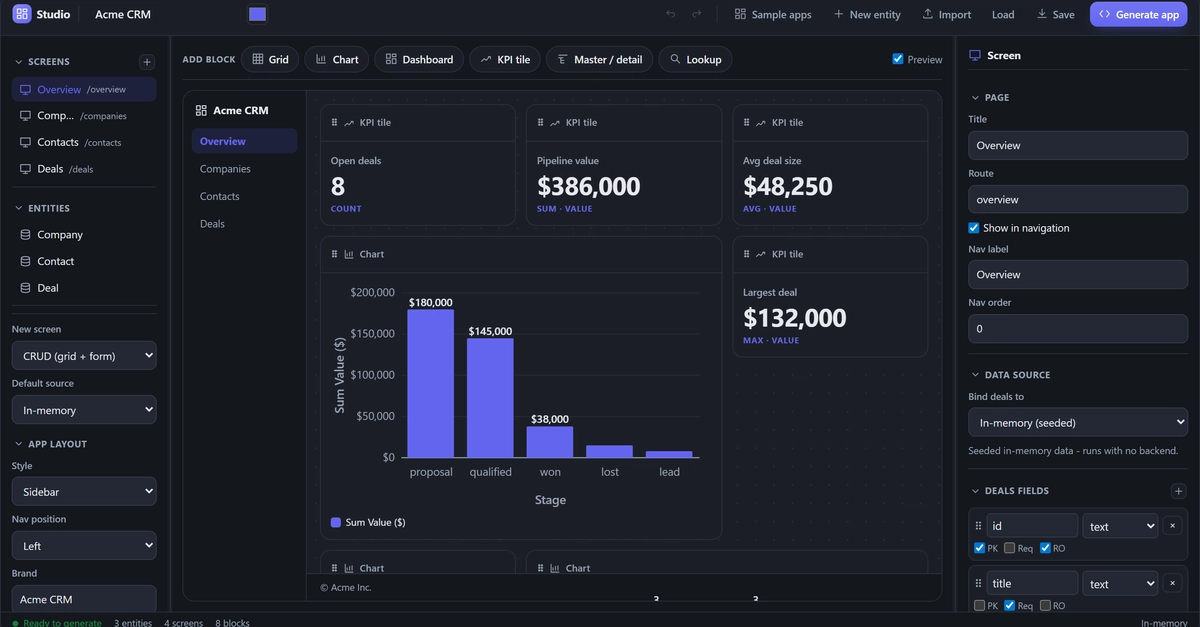
SvGrid Studio approaches application generation from a schema definition. Users define their data structure, then construct screens using a library of pre-built blocks. These blocks include common UI components such as grids for displaying tabular data, forms for editing individual records, charts for data visualization, dashboard layouts, KPI (Key Performance Indicator) displays, and master-detail views. Each block can be connected to a specified data source. Once the desired screens are composed visually, the user clicks 'Generate app'. The tool then outputs a complete, runnable SvelteKit project.
The emphasis is on providing developers with actual source code. Unlike platforms that generate code within a sandboxed environment, SvGrid Studio aims to deliver a standard SvelteKit project that can be independently hosted, modified, and scaled. This grants users full control and ownership over their applications, eliminating the vendor lock-in associated with traditional low-code/no-code solutions for internal tools.
Key Features and Benefits
The primary benefit of SvGrid Studio lies in its ability to drastically reduce the development time for standard admin interfaces and data dashboards. By abstracting away the repetitive boilerplate, developers can focus on business logic and unique features rather than reinventing common UI patterns.
The generated SvelteKit projects are intended to be clean and idiomatic. This means developers receive code that adheres to SvelteKit best practices, making it easier to understand, maintain, and extend. The output is not obfuscated or heavily framework-dependent in a proprietary way; it's standard SvelteKit, allowing for seamless integration with other tools and libraries within the Svelte ecosystem.
For businesses, this approach offers a compelling alternative to both manual coding and restrictive hosted builders. It provides a fast path to creating internal tools or data-facing applications without compromising on long-term flexibility or data sovereignty. The ability to host the application anywhere the developer chooses—whether on-premises, a private cloud, or a public cloud provider—is a significant advantage.
Target Use Cases
SvGrid Studio is particularly well-suited for:
- Internal Admin Panels: Quickly building interfaces for managing users, orders, inventory, or any business-critical data.
- Data Dashboards: Creating visual summaries and KPI tracking for operational monitoring.
- CRUD Applications: Rapid development of Create, Read, Update, Delete interfaces for various data entities.
- Prototyping Data-Intensive Features: Rapidly iterating on the front-end for features that require significant data interaction.
The tool aims to serve developers who need to build these types of applications quickly but still require the flexibility and control that comes with owning their codebase. It bridges the gap between the speed of visual builders and the power of custom code.
The SvelteKit Advantage
Choosing SvelteKit as the output framework is strategic. SvelteKit is known for its performance, developer experience, and flexibility, offering features like server-side rendering (SSR), static site generation (SSG), API routes, and a file-system-based router. By generating SvelteKit projects, SvGrid Studio leverages these built-in capabilities, providing a robust foundation for the generated applications. Developers familiar with Svelte or SvelteKit will find the generated code intuitive and easy to work with. The framework's performance characteristics are also beneficial for data-intensive applications, ensuring a responsive user experience.
Future Considerations
While SvGrid Studio addresses the common pain point of boilerplate code for data apps, the long-term success will depend on several factors. The quality and maintainability of the generated SvelteKit code are paramount. Developers need to trust that the output is not just functional but also well-structured and easy to refactor. Furthermore, the breadth of 'blocks' and data source integrations will determine its utility across a wider range of applications. As the tool evolves, the ability to customize generated components and handle more complex application architectures will be critical. The question remains: how will SvGrid Studio handle increasingly complex state management scenarios or custom component integrations beyond its core block library?