Supabase's Unintended Data Deletion Vulnerability
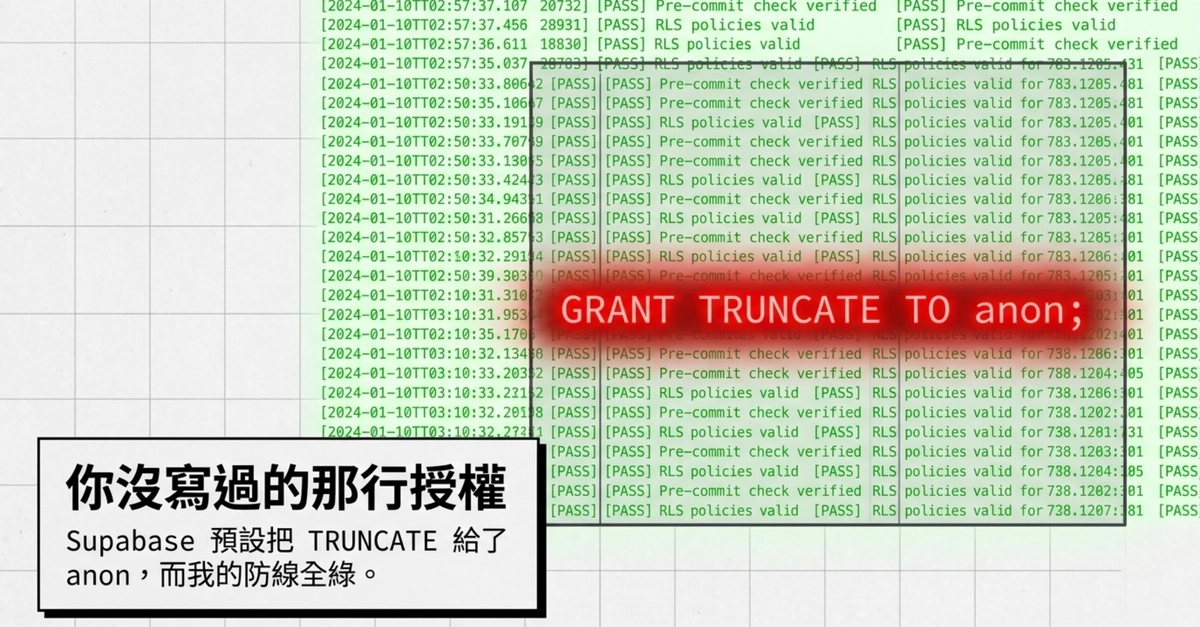
A significant security misconfiguration on Supabase, a popular open-source Firebase alternative, has left developers scrambling to audit their databases. The vulnerability, discovered by a developer who wishes to remain anonymous, involved the unintended granting of TRUNCATE privileges to the anon role on 96 tables. This means any unauthenticated user could potentially delete all data from these tables without any logging or authorization checks.
The discovery highlights a critical blind spot in database security, especially for platforms that simplify backend development. Supabase's appeal lies in its ease of use and rapid development capabilities, often by abstracting away complex database configurations. However, this abstraction appears to have inadvertently introduced a dangerous default setting.
The developer who found the issue stated, "I never wrote that line, and every check I own was green." This indicates the problematic configuration was not a result of user error but an inherent default within the Supabase setup or a specific version. The anon role in Supabase is designed for unauthenticated access, typically used for read operations or simple data submissions. Granting it destructive permissions like TRUNCATE is a severe misstep.
TRUNCATE is a powerful SQL command that removes all rows from a table rapidly. Unlike a DELETE statement, it typically does not fire row-level triggers and is often faster for clearing entire tables. Granting this privilege to an anonymous user essentially provides a backdoor for data destruction. Imagine a public restroom where anyone can not only enter but also has the master key to flush all the toilets simultaneously – that's the level of uncontrolled access here.

Auditing and Mitigation Steps
The immediate fallout for developers using Supabase is the urgent need to audit their database permissions. The developer who identified the issue provided a SQL query to check for such grants:
SELECT grantee, privilege_type, count(*) AS n
FROM information_schema.role_table_grants
WHERE table_schema = 'public'
GROUP BY grantee, privilege_type;
This query, when run in the Supabase SQL editor, can reveal which roles have which privileges on tables within the public schema. The critical part is to look for the anon role having TRUNCATE privileges. If found, these grants need to be revoked immediately.
Revoking the privilege can be done via SQL as well. For instance, to revoke TRUNCATE from the anon role on a specific table named my_sensitive_table, a developer would execute:
REVOKE TRUNCATE ON TABLE my_sensitive_table FROM anon;
If the issue affected multiple tables, this command would need to be repeated for each vulnerable table, or a more dynamic script could be employed to revoke the privilege across all identified tables.
The Broader Implications for Supabase Users
This incident raises serious questions about Supabase's default security posture and its internal auditing processes. While the platform aims to democratize backend development, such vulnerabilities can erode trust, especially among security-conscious developers and organizations handling sensitive data. The fact that 96 tables were affected suggests this was not an isolated incident but potentially a systemic issue in how default permissions were managed or propagated.
The surprise here is not that a default configuration could be flawed, but the sheer scale—96 tables—and the nature of the privilege granted (TRUNCATE to anon). This is akin to a car manufacturer accidentally shipping vehicles with the emergency brake disengaged by default. It bypasses fundamental security assumptions developers make when adopting a platform.
What remains unaddressed is the exact root cause within Supabase's infrastructure or deployment pipeline that led to these default grants. Was it a recent update? A misconfiguration in their CI/CD? Or a long-standing oversight? Understanding this will be crucial for Supabase to implement robust preventative measures and assure its user base that such an incident won't recur.
For developers, this serves as a stark reminder that relying on managed services, even those focused on developer experience, does not absolve them of the responsibility for security. Continuous auditing of permissions, understanding the underlying infrastructure's security model, and implementing custom checks are still paramount. If you run a project on Supabase, you should consider running the audit query provided by the discoverer *today* and ensure your anon role has no destructive capabilities.
Looking Ahead: Trust and Security in PaaS
Platforms like Supabase are built on a foundation of trust. Users delegate significant control over their data and infrastructure to the service provider. When that trust is shaken by security oversights, the impact can be substantial. Competitors offering more traditional, albeit more complex, database solutions might see this as an opportunity to highlight their robust security controls and customizable permission models.
Supabase's response will be critical. Transparency about the cause, swift action to rectify the issue, and clear communication about future security practices will be necessary to rebuild confidence. For now, the onus is on developers to perform their due diligence and secure their applications against this, and potentially other, unforeseen misconfigurations.