
The Challenge: Bridging Speech and 3D Animation with AI
An ambitious open-source project aims to democratize 3D character animation by converting spoken words into expressive, animated characters. A third-year engineering student is developing an AI pipeline that takes audio input and outputs a fully animated 3D model, seeking community feedback before committing further development time. The core challenge lies in creating a robust, commercially viable pipeline that moves beyond research prototypes.
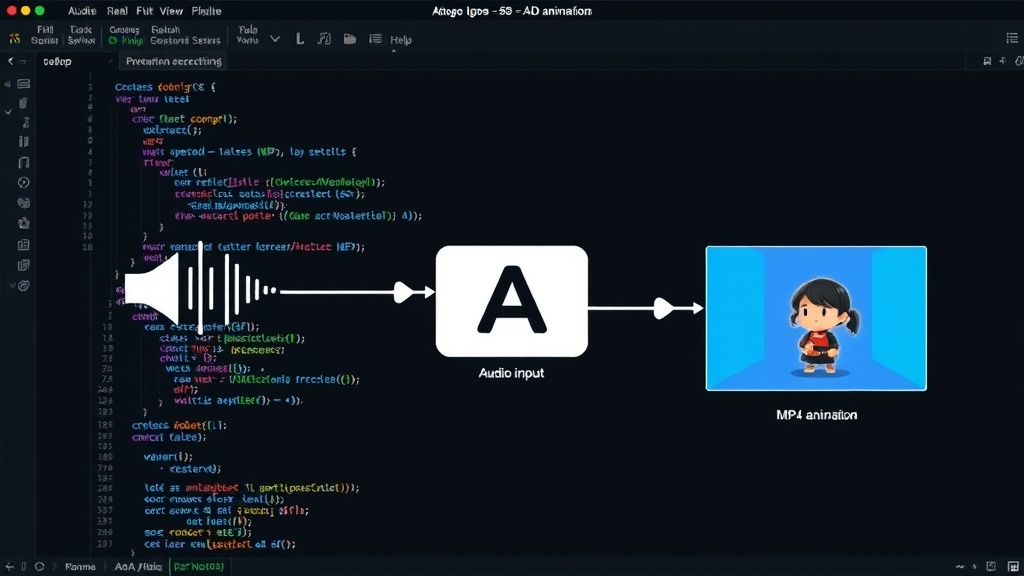
The current prototype outlines a clear workflow. It begins with raw audio, which is then processed by EMAGE to generate body motion. This motion is initially represented using SMPL (Skinned Multi-Person Linear Model), a research-focused model. The critical next step, and a key area for development, involves retargeting this SMPL motion onto commercially usable character rigs. This includes formats like VRM, commonly used in virtual reality and VTubing, and custom rigs within Blender, a popular open-source 3D creation suite. The ultimate goal is to render the final animation as an MP4 video file.
Current Progress and Future Direction
The project has achieved initial success in generating body motion from audio using EMAGE and animating this motion within Blender. This demonstrates a functional proof-of-concept. However, the reliance on SMPL as an internal representation presents a hurdle. SMPL, while powerful for research, is not licensed for unrestricted commercial use. This means the generated motion, in its raw SMPL form, cannot be directly integrated into commercial projects. The student's long-term vision explicitly addresses this by planning a motion retargeting module. This module will be crucial for translating the research-grade SMPL motion into a format compatible with industry-standard or custom character rigs. This retargeting step is where the project aims to bridge the gap between academic research and practical application.
The goal is not to distribute SMPL models themselves, but to leverage the motion data generated by the pipeline. The focus is on creating an end-to-end system capable of producing expressive animations from speech. This requires careful consideration of the retargeting process to ensure that the nuances of the generated motion are preserved when applied to different character skeletons. Different character rigs have varying bone structures, proportions, and degrees of freedom, making motion retargeting a complex problem in computer graphics and animation.
Technical Considerations and Community Input
The project highlights several key technical areas that would benefit from community input. The choice of EMAGE for speech-to-motion conversion is a starting point, but exploring alternative or complementary models for generating more nuanced facial expressions and lip-syncing could enhance the final output. The SMPL retargeting is perhaps the most critical component for commercial viability. Developers familiar with motion capture data processing, character rigging in Blender, and VRM standards would be invaluable. Understanding the performance implications of retargeting, including potential loss of detail or introduction of artifacts, is also important.
The student is explicitly asking for honest feedback. This suggests a desire to address potential pitfalls early. For instance, the fidelity of the retargeting process is paramount. If the retargeted motion appears unnatural or fails to capture the expressiveness of the original generated motion, the pipeline's utility diminishes significantly. Feedback could also focus on the user experience of the pipeline itself. Is it easy to integrate? Are the outputs predictable? What are the computational requirements?
The decision to build an open-source pipeline is significant. It invites collaboration and allows the project to benefit from the collective expertise of the AI and 3D animation communities. This approach can accelerate development and identify use cases that the original developer might not have considered. The success of such a project often hinges on its ability to attract contributors and users who can provide ongoing support, bug fixes, and feature enhancements. The student's request for feedback is the first step in building this community around the project.
The pipeline's architecture, while logical, presents a series of interconnected challenges. Each stage—audio processing, motion generation, motion representation, retargeting, and rendering—requires specialized knowledge. EMAGE provides a powerful starting point for speech-driven motion, but its limitations in terms of expressiveness or specific motion types (e.g., fine motor control, exaggerated gestures) might become apparent as the project matures. The transition from SMPL to commercial rigs is the most significant technical and licensing hurdle. A robust retargeting solution needs to account for differences in skeleton topology, joint limits, and skinning weights. Libraries and techniques for this already exist, but integrating them seamlessly into a pipeline that prioritizes both quality and speed is non-trivial.
The open-source nature of the project is its strongest asset for growth and adoption. By making the pipeline accessible, the developer can tap into a global pool of talent. This is particularly relevant in the AI and graphics fields, where rapid innovation means that staying current requires constant learning and adaptation. A collaborative approach allows for the rapid iteration necessary to address the complexities of generating realistic and expressive 3D character animations from speech. The project is essentially building a foundational tool, and community input will shape its evolution, ensuring it meets the practical needs of creators and developers.