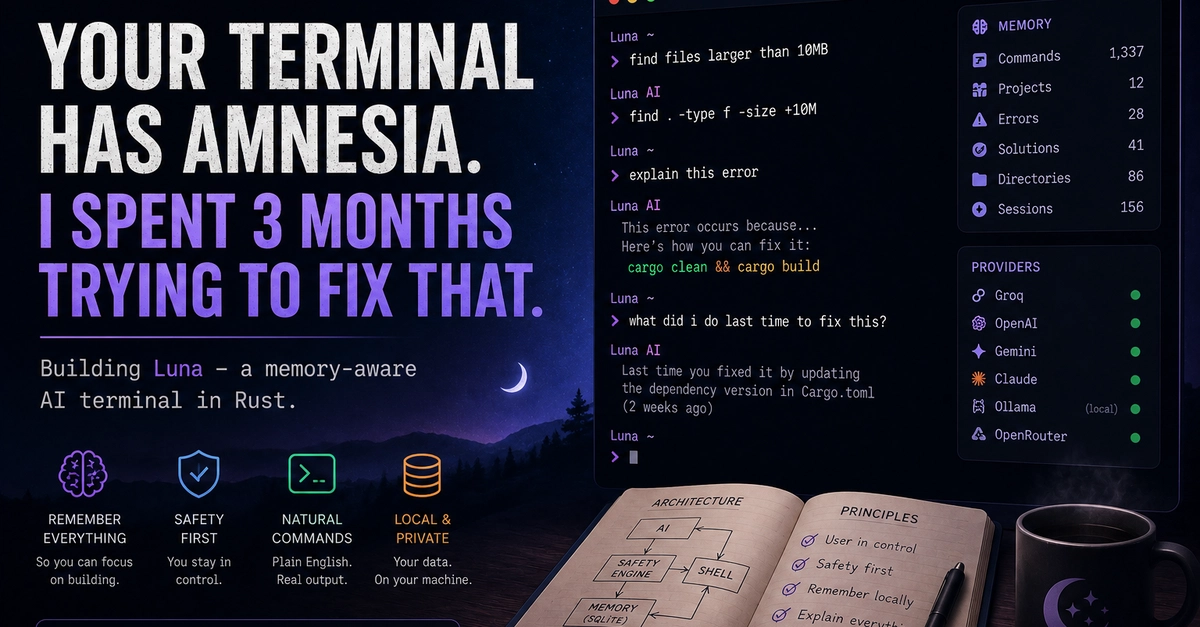
The Problem: A Terminal Without Memory
Every developer knows the frustration. You spend hours debugging a complex issue, finally finding the command that works, only to close your terminal. The next day, it's a blank slate. Your terminal, the very engine of software creation, suffers from profound amnesia. It forgets the intricate commands, the specific project context, your preferred package manager (like pnpm over npm), and the sheer effort poured into solving a problem. Each session begins anew, forcing you to retrace steps and lose valuable time. This isn't just an inconvenience; it's a productivity drain that forces developers to become the sole custodians of their digital memory.
This widespread issue, experienced by countless developers, prompted Computer Science student Akhil Wasim to seek a solution. As a student, Wasim spends a significant portion of his day within the terminal, not out of preference, but necessity. Software development, at its core, happens there. The realization that his own memory was the only persistent record of his terminal's activity led him to a critical question: what if the terminal itself could remember?
From Frustration to Luna: The Genesis of a Solution
Luna didn't begin as an ambitious AI project. It started as a deeply personal frustration, a common pain point for anyone who spends significant time in a command-line interface. Wasim, like many others, found himself constantly recreating mental models of past sessions. He realized that the terminal's lack of persistent memory was a significant bottleneck in the development workflow. This observation sparked the idea for Luna: a tool designed to imbue the terminal with a form of long-term memory.
The initial development focused on capturing and recalling command history beyond the standard shell history files. This involved more than just storing a list of commands; it required understanding the context in which those commands were executed. Wasim began exploring ways to associate commands with projects, specific error messages, and even the outcomes of those commands. The goal was to create a system that didn't just recall what you typed, but why you typed it and what happened as a result.
How Luna Works: AI-Powered Contextual Recall
Luna operates by leveraging AI to understand and recall terminal activity. Instead of merely logging commands, it analyzes them, noting their order, their relationship to each other, and the broader context of the user's work. This allows Luna to go beyond simple command history. It can reconstruct the thought process behind a debugging session, identify patterns in command usage, and even suggest commands based on past successful interventions in similar situations.
The system works by continuously observing the terminal session. When a command is executed, Luna captures not only the command itself but also information about the current directory, active processes, and any output or error messages generated. This data is then processed using natural language processing (NLP) and machine learning models. These models learn to identify significant events, such as successful command executions, failed attempts, or the resolution of specific errors. Think of Luna less like a simple command log and more like an intelligent assistant that takes meticulous notes on your behalf, cross-referencing them to provide relevant context when you need it most.
For instance, if a developer encounters a persistent `segmentation fault` while compiling a Rust project, Luna would not only remember the specific compiler flags used but also the surrounding commands, the error messages, and potentially even links to relevant Stack Overflow threads or documentation that were accessed during the debugging process. When the developer revisits the project days later, Luna could proactively surface this information, saving them from starting the debugging process from scratch. This contextual recall is what differentiates Luna from traditional shell history or simple command logging tools.
The Impact on Developer Workflow
The implications for developer productivity are substantial. By eliminating the need to constantly re-learn or re-discover past actions, Luna frees up cognitive load. Developers can focus more on problem-solving and creative tasks, rather than on administrative memory recall. The tool promises to reduce the time spent on common, yet time-consuming, tasks like re-establishing project environments, recalling obscure command-line arguments, or undoing mistakes.
Luna's ability to remember project-specific configurations and preferred toolchains also streamlines the onboarding process for new projects or when switching between different tasks. A developer returning to a project after a period away can quickly get up to speed by reviewing Luna's contextual history. This persistent memory acts as a powerful knowledge base, capturing the implicit knowledge gained through hours of hands-on work. For teams, Luna could potentially serve as a shared memory, documenting solutions and best practices discovered by individual members, fostering a more collaborative and efficient development environment.
Future Directions and Open Questions
While Luna represents a significant step forward in addressing terminal amnesia, its development is ongoing. Future iterations could explore deeper integration with IDEs, more sophisticated predictive command suggestions, and enhanced collaboration features. The potential for Luna to learn individual developer habits and preferences offers a path towards hyper-personalized terminal experiences.
However, questions remain about the scalability of its AI models, particularly for developers working on extremely large or complex projects with vast command histories. The privacy implications of an AI that monitors and stores detailed terminal activity also warrant careful consideration. What happens to the vast amount of sensitive information potentially logged, and how can users ensure their data remains secure and private? Furthermore, as AI tools become more integrated into core development workflows, understanding the balance between AI assistance and the fundamental skills of command-line mastery will be crucial. Will tools like Luna augment developer skills, or could over-reliance lead to a degradation of core competencies?