The Context Bottleneck in AI Development
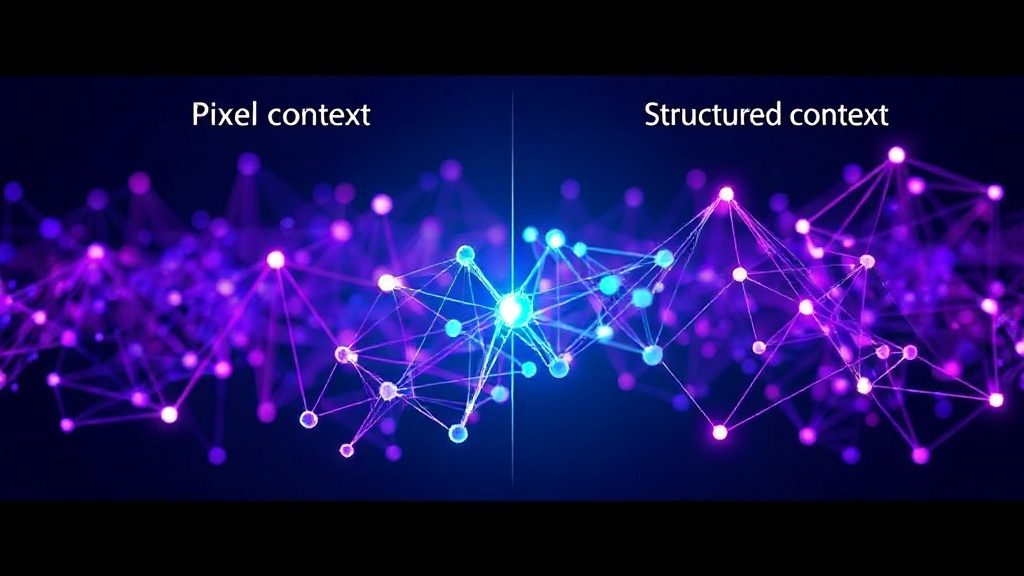
The rapid advancement of AI models has shifted the primary constraint in AI-assisted development. It's no longer the model's capability, but the quality of context provided to it. For workflows translating design into code, particularly from tools like Figma, the nature of this context is paramount. We're seeing a divergence between 'pixel context' – essentially screenshots – and 'structured context' – semantically rich, machine-readable data.
The industry is currently leaning heavily on pixel context. This approach, while intuitive for humans, presents significant limitations for AI agents. A rendered image, or a screenshot, is a visual representation. It captures appearance but lacks inherent understanding of the underlying design system, component hierarchy, or interactive states. This forces the AI to infer meaning from pixels, a process prone to errors and ambiguity.
Understanding Pixel Context
Pixel context, derived from screenshots or rendered images, is what most current Figma-to-code tools rely on. These tools analyze the visual output of a design. Think of it like trying to describe a complex architectural blueprint solely by looking at a photograph of the finished building. You can see the facade, the windows, the general shape, but you miss the structural beams, the electrical wiring diagrams, the plumbing schematics, and the precise material specifications.
When an AI agent receives only pixel context, it has to perform a heavy lifting of 'reverse engineering' the design. It must identify distinct UI elements, infer their types (button, input field, card), determine their relationships (parent-child, sibling), and guess their styling properties (colors, fonts, spacing) by analyzing pixel arrangements and color differences. This process is inherently lossy. Subtle details, design system rules, and interactive states can be easily misinterpreted or missed entirely. The AI is essentially trying to solve a visual puzzle with incomplete information, leading to code that is often brittle, difficult to maintain, and doesn't adhere to the original design's intent or underlying structure.
The Power of Structured Context
Structured context, on the other hand, provides AI agents with direct access to the underlying semantic and structural information of a design. Tools like figmascope export this type of data. Instead of a flat image, it provides typed information, tokens, and explicit relationships between design elements. This is akin to providing the AI with the actual CAD files and specifications for the building, not just a photograph.
Structured context includes details such as:
- Component Hierarchy: A clear understanding of which elements are nested within others, forming a logical tree structure.
- Element Types: Explicitly defined types for each element (e.g., `Button`, `TextInput`, `Card`, `LayoutGrid`).
- Styling Tokens: Access to defined design tokens for colors, typography, spacing, and shadows, ensuring consistency and adherence to design systems.
- Semantic Relationships: Information about how elements relate to each other beyond visual proximity, such as grouping or functional dependencies.
- Interactive States: Data that can describe different states of a component (e.g., hover, active, disabled).
When an AI agent receives structured context, it doesn't need to guess. It has direct, unambiguous data. This allows for significantly higher quality code generation. The agent can directly map design tokens to CSS variables, instantiate components based on their defined types, and maintain the intended hierarchy and responsiveness. The quality ceiling for AI-generated code is raised dramatically because the input is no longer a visual approximation but a direct representation of the design's architecture.
Why Structured Context Wins
The difference between pixel and structured context is not merely a matter of format; it's a fundamental difference in the information conveyed and the AI's ability to process it. Pixel context is inherently ambiguous and requires a human-like interpretation that current AI models struggle to perform reliably at scale. It's like trying to teach someone a language by only showing them pictures of words – they might learn some associations, but they'll never grasp the grammar or syntax.
Structured context, conversely, is machine-native. It speaks the language of code and data structures. The loss characteristics are far lower because the information is explicit. This means AI agents can generate code that is not only visually accurate but also semantically correct, maintainable, and aligned with development best practices. For workflows aiming to automate UI development from design tools, embracing structured context is not just an optimization; it's a prerequisite for achieving truly intelligent and reliable code generation.
The Future of AI-Assisted Development
As AI coding agents evolve, the emphasis on high-fidelity, structured input will only increase. Relying on pixel context is akin to using a low-resolution map to navigate a complex city – you might get some directions, but you're likely to get lost. Tools that move beyond pixel-level analysis and embrace structured data exports will unlock the true potential of AI in translating design intent into production-ready code. Developers and teams looking to leverage AI for UI development should prioritize solutions that offer robust structured context outputs, as this is where the real gains in quality and efficiency lie.