
The Core Distinction: Determinism vs. Emergence
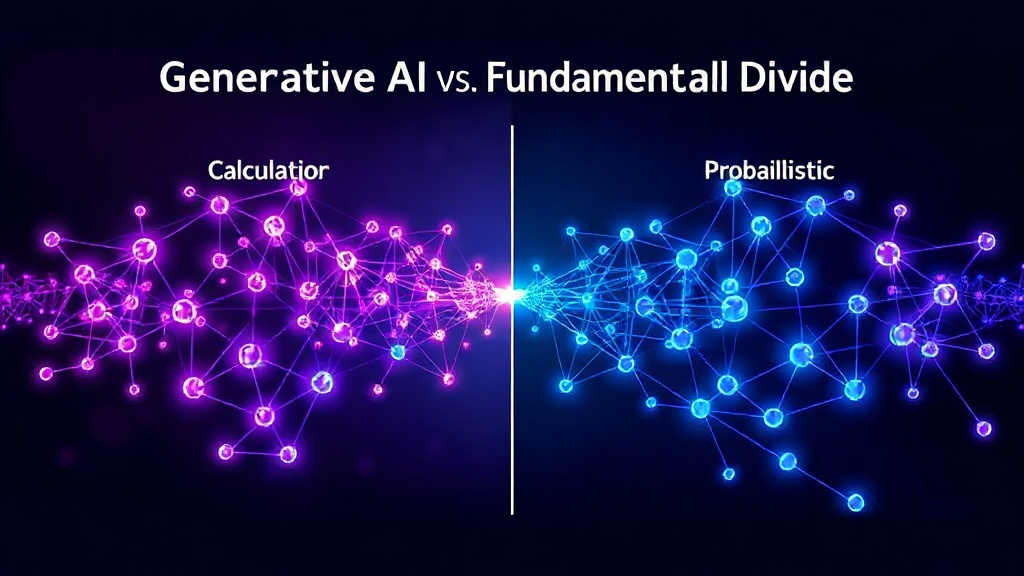
The difference between a calculator and a generative AI model, while seemingly obvious, highlights a fundamental shift in how we approach computation and problem-solving. A calculator operates on deterministic principles. Given the same inputs and the same operation, it will always produce the exact same output. This predictability is its strength, making it reliable for precise mathematical tasks. For instance, 2 + 2 will always yield 4 on any standard calculator, regardless of when or where it is used.
Generative AI, on the other hand, operates on probabilistic principles. Models like Claude, GPT, or Stable Diffusion are trained on vast datasets and learn complex patterns. When presented with a prompt, they don't retrieve a pre-programmed answer. Instead, they generate a response by predicting the most likely sequence of tokens (words, pixels, code snippets, etc.) based on their training. This means that even with the identical prompt, a generative AI model can produce different outputs each time. This emergent property is what allows them to create novel text, images, music, and code, rather than simply computing a result.
Beyond Simple Computation: The Nature of Generative Output
Consider the task of writing a poem. A calculator cannot write a poem. It has no concept of metaphor, meter, or emotion. Its function is strictly confined to numerical operations. A generative AI, however, can not only write a poem but can also be instructed to write it in a specific style, about a particular subject, or with a certain emotional tone. This capability stems from its ability to understand and manipulate abstract concepts and patterns learned from human-generated text.
The underlying architecture of these systems reflects this difference. Calculators rely on fixed algorithms and logic gates. Generative AI models, typically based on neural networks, involve billions of parameters that are adjusted during training. These parameters encode the learned patterns, allowing the model to generalize and create new content. It's akin to the difference between a meticulously crafted instruction manual and an artist who has studied countless works and can now create their own original pieces.
Implications for Problem Solving and Creativity
This distinction has profound implications. For tasks requiring absolute precision and verifiable accuracy, calculators and traditional software remain indispensable. Financial calculations, scientific simulations, and engineering computations demand the deterministic nature of these tools. Trying to use a generative AI for these tasks without careful validation would be akin to asking a poet to balance your checkbook – the tool is not designed for the job and the results could be unreliable, if not outright wrong.
Conversely, generative AI excels in domains where creativity, nuance, and novel content generation are paramount. Drafting emails, brainstorming ideas, creating marketing copy, generating code snippets, or designing visual assets are all areas where generative AI can significantly augment human capabilities. It acts as a creative partner or an advanced assistant, offering suggestions and producing content that would be time-consuming or impossible for humans to create from scratch alone.
The Perception Gap: Why This Matters
The confusion often arises because both systems take input and produce output. However, the nature of that output and the process by which it is created are fundamentally different. A calculator is a tool for executing predefined operations. A generative AI is a tool for synthesizing new information based on learned patterns. This distinction is crucial for understanding the capabilities and limitations of each technology, especially as AI becomes more integrated into our daily lives.
One might think of a calculator as a highly specialized chef who can only follow a single recipe perfectly every time. A generative AI, however, is more like a culinary student who has tasted thousands of dishes and can now invent new recipes, sometimes brilliant, sometimes forgettable, but always new. The value of generative AI lies not in its ability to repeat facts or perform calculations, but in its capacity to generate plausible and often useful new data based on its training. This is why understanding the probabilistic nature of generative AI is key to its effective and responsible deployment. It is not a black box of magic, but a complex system of learned statistical relationships that can be leveraged for a wide range of creative and productive tasks, fundamentally different from the rigid logic of a calculator.