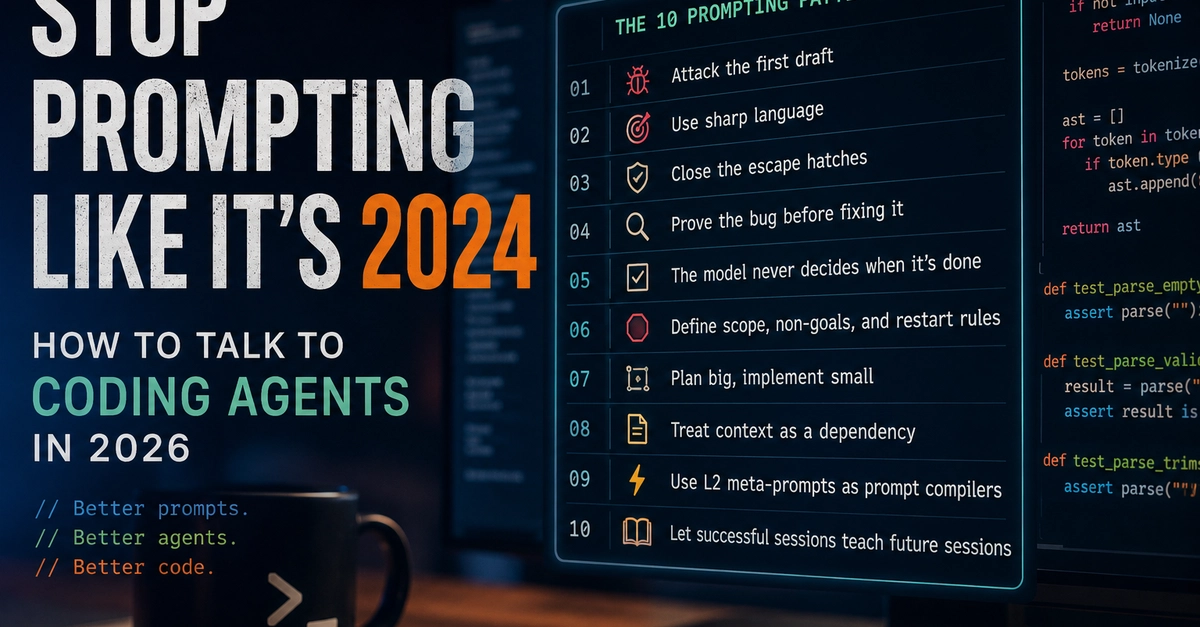
Embrace the 'First Draft' Mentality
The days of crafting intricate, single-shot prompts hoping for perfect output are over. As LLMs evolve, our prompting strategies must too. The core shift is moving from seeking confirmation to demanding critical evaluation. Instead of asking, "Is this implementation correct?", frame the task as a collaborative, critical review. Present the LLM's output as a "first draft" and instruct it to "review it critically," assuming mistakes exist. This primes the model to actively seek and identify flaws rather than passively confirming correctness. The goal is to make the LLM prove its work by finding concrete failures and demonstrating them with tests. This transforms the interaction from a simple Q&A into a rigorous debugging and validation process.

Deconstruct Complex Tasks
Large language models excel at breaking down problems, but they need clear guidance. For complex tasks, don't dump everything into one prompt. Instead, deconstruct the problem into smaller, manageable steps. Each step should build upon the previous one, with clear inputs and outputs defined. For instance, if you need to refactor a large codebase, the first prompt might focus on identifying specific areas for improvement based on predefined criteria. The next prompt could then ask the LLM to generate refactored code for a single identified module, followed by a prompt to write unit tests for that specific refactored module. This step-by-step approach reduces ambiguity and allows for easier verification at each stage. Think of it like assembling IKEA furniture: you wouldn't try to build the whole thing at once; you follow the numbered steps, ensuring each piece fits before moving to the next.
Define Constraints Explicitly
Ambiguity is the enemy of effective LLM interaction. When defining a task, be exhaustive with your constraints. This includes specifying not only what the output should be, but also what it should not be. For code generation, this means detailing language versions, required libraries, performance targets, security considerations, and stylistic guidelines. For creative writing, it could mean defining tone, character limitations, plot points to avoid, or specific vocabulary to use or exclude. The more explicit you are about constraints, the less room there is for the model to misinterpret the request or take shortcuts that violate your requirements. This is crucial for tasks where adherence to specific rules is paramount, such as generating compliance-aware code or adhering to brand guidelines.
Leverage Few-Shot Learning with Examples
While LLMs are powerful zero-shot learners, providing a few well-chosen examples (few-shot learning) can dramatically improve output quality and consistency. These examples act as concrete demonstrations of the desired input-output relationship. When providing examples, ensure they are representative of the actual task and cover edge cases. For instance, if you're training an LLM to classify customer feedback, provide examples of positive, negative, and neutral feedback, along with corresponding labels. The quality and relevance of these examples are more important than their quantity. A few high-quality, targeted examples are far more effective than many generic ones. This pattern is especially useful for fine-tuning the model's understanding of nuanced tasks or domain-specific jargon.
Iterative Refinement and Feedback Loops
Prompting is not a one-and-done activity. Embrace an iterative process where you refine your prompts based on the LLM's output. If the output isn't satisfactory, don't just try a slightly different prompt. Analyze why it failed. Was the instruction ambiguous? Were constraints missing? Did the model misunderstand a term? Use this analysis to construct a more precise prompt for the next iteration. Incorporate feedback mechanisms directly into your workflow. For example, after the LLM generates code, you might prompt it to explain its choices, identify potential bugs, or suggest improvements. This creates a feedback loop that not only refines the current output but also implicitly teaches the model about your preferences and requirements for future interactions.
Structure for Verifiability
Design your prompts so that the LLM's output is inherently easy to verify. For code, this means asking for explicit test cases alongside the generated code. For data analysis, request that the LLM explain its reasoning and cite the data points it used. When the LLM must produce a verifiable output, it is incentivized to be more accurate and thorough. This pattern moves away from subjective assessments of output quality towards objective, quantifiable measures. If the LLM generates a summary, prompt it to include key statistics or references that can be independently checked. This makes the LLM's contribution more transparent and trustworthy.
Guardrails and Negative Constraints
Just as important as telling the LLM what to do is telling it what not to do. Implement "guardrails" by explicitly stating negative constraints. This prevents the LLM from generating undesirable content, making common mistakes, or going off-topic. For instance, in a customer service bot scenario, you might instruct the LLM: "Do not provide medical advice," or "Do not disclose PII." For code generation, this could be: "Avoid using deprecated functions," or "Do not introduce external dependencies without explicit mention." These negative constraints act as safety nets, ensuring the output remains within acceptable boundaries and reducing the likelihood of problematic responses.
Role-Playing with Specific Personas
Assigning a specific role or persona to the LLM can significantly shape its output and make it more relevant to the task. Instead of a generic prompt, start with: "Act as a senior software engineer specializing in Python security..." or "You are a marketing copywriter with expertise in B2B SaaS..." This frames the LLM's knowledge base and response style. The more detailed and relevant the persona, the better the LLM can tailor its response to the specific context and requirements of the task. This is not about making the model "smarter" in a general sense, but about directing its existing capabilities towards a specific, expert perspective.
Emphasize Concrete Actions, Not Abstract Concepts
LLMs often struggle with abstract instructions. Translate abstract goals into concrete, actionable steps. For example, instead of asking the LLM to "improve user engagement," ask it to "generate three A/B test ideas for increasing click-through rates on the homepage" or "identify the top five user friction points in the current checkout flow based on the provided user feedback data." By focusing on specific, measurable actions, you guide the LLM towards producing tangible results that can be directly implemented or evaluated, rather than vague suggestions.
Systematic Testing and Evaluation
Treat LLM interactions like any other software development task: with rigorous testing. Develop a suite of test cases that cover various scenarios, including happy paths, edge cases, and failure conditions. When you receive output from the LLM, systematically run these tests. If the output fails, use the failure analysis to refine your prompt or the LLM's instructions. This systematic approach ensures that the LLM's performance is not just a matter of luck but is consistently meeting your defined quality standards. This is particularly important for production systems where reliability and predictable behavior are critical.