
The Database Dilemma: Storage vs. Search
Many development teams treat their primary databases—whether PostgreSQL, MySQL, or even NoSQL variants like DynamoDB—as the single source of truth for all application data. This often extends to implementing search functionality directly within these databases. However, databases are fundamentally optimized for durable storage, transactional integrity, consistency, and recovery. Their design prioritizes reliable data persistence and ACID compliance. What they are not built for is sophisticated, language-aware search. This includes features like natural language understanding, synonym matching, typo tolerance, relevance ranking, and advanced vector capabilities for semantic similarity searches. Forcing a database to perform these tasks is akin to asking a librarian to also perform open-heart surgery: the tools and training are fundamentally different, and the results are suboptimal at best, and dangerous at worst.
This architectural mismatch leads to significant performance bottlenecks. When search queries become complex or data volumes grow, the database struggles. Indexing strategies designed for transactional consistency often fail to provide the speed and relevance required for a good user experience. Imagine trying to find a specific book in a library where the Dewey Decimal System is constantly being reorganized based on who last checked out a book. It’s inefficient and frustrating. The core issue is that database systems are built for structured queries and atomic operations, not for the fuzzy, probabilistic, and often iterative nature of information retrieval that modern applications demand.

Amazon OpenSearch Service: Purpose-Built for Search and Analytics
Amazon OpenSearch Service, a managed offering of OpenSearch (a fork of Elasticsearch), is engineered from the ground up for search and analytics. Its core strengths lie in its distributed architecture, inverted index data structures, and sophisticated algorithms designed for full-text search, log analytics, and real-time monitoring. Unlike traditional databases, OpenSearch excels at processing large volumes of unstructured or semi-structured text data quickly. It handles tasks such as fuzzy matching, relevancy scoring, and faceted search with sub-second latency, even across petabytes of data. This makes it the ideal choice for powering product catalogs, application logs, customer support tickets, and any other data where users need to find information efficiently and intuitively.
Furthermore, OpenSearch Service has evolved to incorporate advanced capabilities crucial for modern applications. Its deep vector capabilities enable hybrid search, a powerful approach that combines traditional keyword-based (lexical) search with semantic search powered by machine learning models. This allows applications to understand the *meaning* behind a query, not just the literal words. For instance, a search for "running shoes" could also surface results for "athletic footwear" or "jogging sneakers" based on semantic similarity, even if the exact terms aren't present. This level of understanding is virtually impossible to achieve efficiently within a transactional database. The service is also built for scale, capable of handling massive datasets and high query loads, which is essential for applications experiencing rapid growth.
The Synchronization Challenge: Keeping Data Consistent
The primary hurdle in adopting a multi-system architecture—one database for transactions and another for search—has historically been data synchronization. When data changes in the primary database (e.g., a product price update, inventory level change, or user profile modification), that change must be reflected in the search index almost instantaneously. Building and maintaining a reliable, low-latency data pipeline to achieve this synchronization is notoriously difficult. Common approaches often involve custom ETL (Extract, Transform, Load) scripts, message queues, or change data capture (CDC) mechanisms, all of which can be complex to implement, prone to failure, and require significant engineering effort to keep running smoothly.
These custom pipelines are often fragile. A failure in the pipeline can lead to stale search results, frustrating users and potentially impacting business operations. For example, if a product is marked as out of stock in PostgreSQL, but that update fails to propagate to OpenSearch, customers might still be able to add it to their cart, leading to a poor post-purchase experience. The complexity of managing these pipelines, ensuring idempotency, handling errors, and monitoring their health consumes valuable developer time and resources that could otherwise be spent on building core product features. This synchronization problem is the silent killer of many otherwise well-architected systems that attempt to serve both transactional and search needs from a single, ill-suited source.
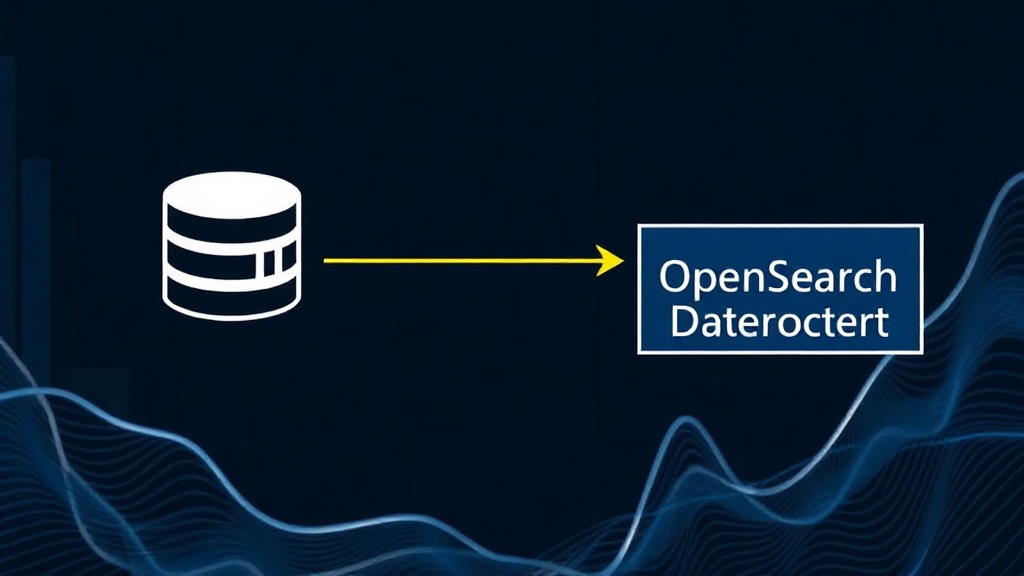
Amazon OpenSearch Ingestion: Zero-ETL Integrations Simplify Sync
To address the critical synchronization challenge, Amazon has introduced Amazon OpenSearch Ingestion and its zero-ETL integrations. This service aims to automate and simplify the process of keeping data consistent between transactional databases and OpenSearch Service. By leveraging these integrations, developers can achieve near real-time synchronization without the need to build and manage complex custom pipelines. The system is designed to automatically capture changes from supported sources, transform them as necessary, and load them into OpenSearch Service with minimal configuration.
This shift to zero-ETL integrations signifies a move towards a more seamless and integrated data architecture. Instead of treating the search index as a separate, manually managed entity, it becomes a tightly coupled, automatically updated component of the overall data ecosystem. For applications that require both robust transactional capabilities and a high-performance search experience, this can dramatically reduce operational overhead and accelerate development velocity. The goal is to allow teams to focus on what matters most: building great user experiences, rather than wrestling with data synchronization plumbing. This makes running a hybrid architecture—one that leverages the strengths of both transactional databases and specialized search services—a more practical and achievable reality for a wider range of applications.
The Path Forward: Separate Strengths for Optimal Performance
The fundamental takeaway is that attempting to make a transactional database perform complex search operations is a compromise that rarely pays off. Databases are optimized for durability and consistency; search services like Amazon OpenSearch Service are optimized for speed, relevance, and scale in information retrieval. By acknowledging these distinct strengths and adopting an architecture that utilizes specialized services for each job, organizations can achieve significantly better performance and user experiences.
The introduction of services like Amazon OpenSearch Ingestion, which streamline the synchronization process, removes the primary barrier to this best-practice approach. If your application demands both fast, relevant search and reliable transactional writes, the optimal solution is to run both systems. Your transactional data should reside in a database built for transactions, while your search index should be powered by a service purpose-built for search. This separation of concerns, coupled with automated synchronization, is the key to unlocking high performance in modern, data-intensive applications.