The Illusion of Trust: Why Traditional Status Pages Fail
Status pages are the digital handshake between a service provider and its users. They are the single source of truth for system availability. Yet, the very nature of their creation often undermines their purpose. A company's status page is a dashboard it controls, a narrative it authors. This inherent control creates a fundamental conflict: the desire to present a flawless service versus the reality of operational hiccups. When a status page allows for subjective editing of its uptime metrics or selectively omits incidents, it transforms from a tool of transparency into a potential instrument of deception.
The core issue lies in how trust is built. A status page that can be manipulated to look better than reality ceases to be a reliable indicator of service health. The critical question for any user evaluating a status page is straightforward: can someone hide a real outage on it? The answer, for many traditional implementations, is a resounding yes. This isn't about malicious intent; it's about the inherent design that prioritizes curated communication over objective measurement.
Two Layers, One Editable, One Not
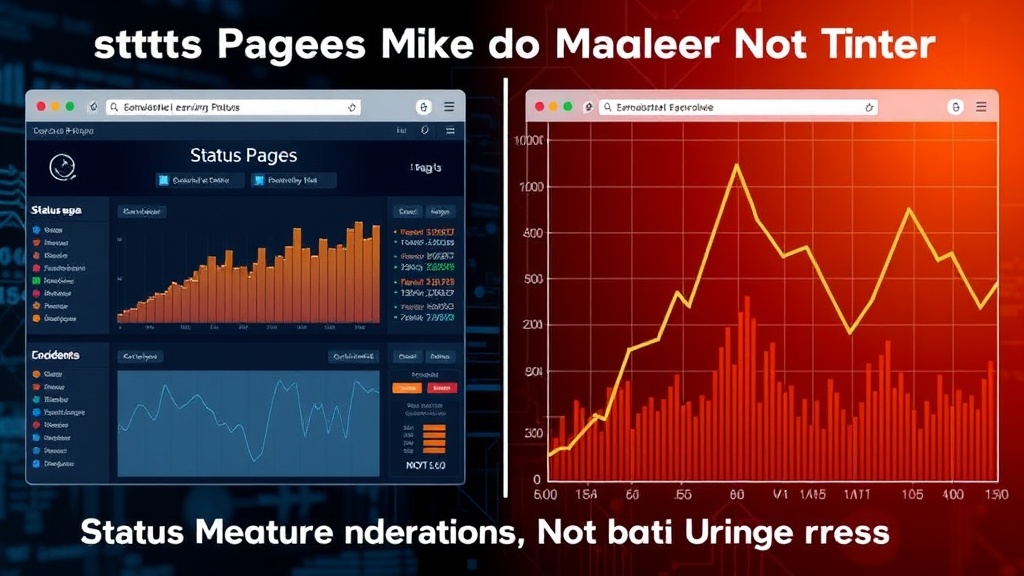
A truly trustworthy status page operates on two distinct layers, and only one of these should be under the direct editorial control of the company. The first layer is the measured data. This encompasses the objective, real-time indicators of service health: the green and red timelines, the historical uptime percentages (e.g., 90-day rolling averages), and the actual availability metrics. This data is derived directly from automated, external checks that probe the service's functionality from an end-user's perspective. It answers the question: 'Is the service actually working right now, and how often has it been working over time?'
The second layer consists of incidents. These are the human-authored explanations detailing what went wrong, the steps being taken to resolve the issue, and when it was fixed. While crucial for communication, this layer is inherently subjective. A company can choose which incidents to report, how detailed their explanations are, and when to mark an incident as resolved. The danger arises when these two layers are presented indistinguishably, or worse, when the measured data itself is influenced by the incident reporting layer. Mixing these fundamentally different types of information erodes trust because users can no longer discern objective performance from curated communication.
Building Trust Through Verifiable Metrics
The key to a trustworthy status page is that its uptime metrics are built from real checks, not from incidents a person chose to publish. This means the uptime bar, the historical data, and the real-time status indicators must be populated by an independent monitoring system. This system should perform consistent, automated checks against critical endpoints of the service from multiple geographical locations. These checks are akin to having an objective auditor constantly verifying the service's availability.
When an incident occurs, the automated monitoring system should automatically flag the disruption. The human-authored incident report then serves to provide context and communication around this objectively detected event. The measured data should reflect the outage duration accurately, regardless of when or how the incident is described by the company. This separation ensures that even if a company is slow to publish an incident report, or chooses to downplay its severity, the underlying uptime statistics will still reflect the reality of the service's performance.
The Dangers of Subjective Reporting
Consider a scenario where a service experiences intermittent failures for several hours, but these failures are subtle and don't completely halt operations. A company might be tempted to omit this from their incident log, or to describe it as a minor performance degradation rather than an outage. However, an independent monitoring system would register these failures, impacting the calculated uptime percentage. If the status page relies on manual input or post-hoc incident reporting for its uptime figures, it can easily present a misleadingly positive picture.
This subjective reporting is particularly insidious because it exploits the user's assumption that the status page is a neutral, data-driven source. Users often glance at the overall uptime percentage or the green-light indicators without scrutinizing the incident logs. When the 'measured data' is, in fact, derived from or heavily influenced by the 'published incidents' layer, the entire premise of the status page as a reliable indicator collapses. It becomes a marketing tool, not a transparency mechanism.
What Does a Trustworthy Status Page Look Like?
A status page that earns and maintains user trust will have clear distinctions between objectively measured uptime and incident communication. The uptime metrics should be sourced directly from an external, automated monitoring service. This service should be visible, ideally with options for users to view raw data or understand the monitoring methodology. For instance, a user might be able to see the results of recent checks against specific service components.
The incident reporting, while essential, should be clearly separated. Each incident entry should ideally link back to the period of downtime registered by the automated monitoring. This provides a verifiable link between the narrative and the objective reality. Furthermore, the system should be designed such that it's technically impossible for a human editor to alter past uptime figures or to prevent an objectively detected outage from being reflected in the historical data. The system should be immutable in its core measurement function, allowing only for the addition of human context.
This approach ensures that when a user looks at the status page, they are seeing two things: first, the undeniable, measured performance of the service, and second, the company's explanation and commitment to resolving issues. The former provides the factual basis for trust; the latter provides the operational narrative. Without this clear separation and reliance on objective measurement, status pages remain a point of potential distrust, a dashboard that can be faked.