%22%20%2F%3E%0A%20%20%3C%2Fsvg%3E)
A Leap in Search Performance
A novel data structure, dubbed the Static Search Tree (SST), promises a dramatic performance improvement for searching static datasets. Benchmarks indicate it can be up to 40 times faster than traditional binary search. This leap is achieved by fundamentally rethinking how search trees are structured and accessed, specifically by eliminating the overhead associated with pointer indirection, a common bottleneck in many in-memory data structures.
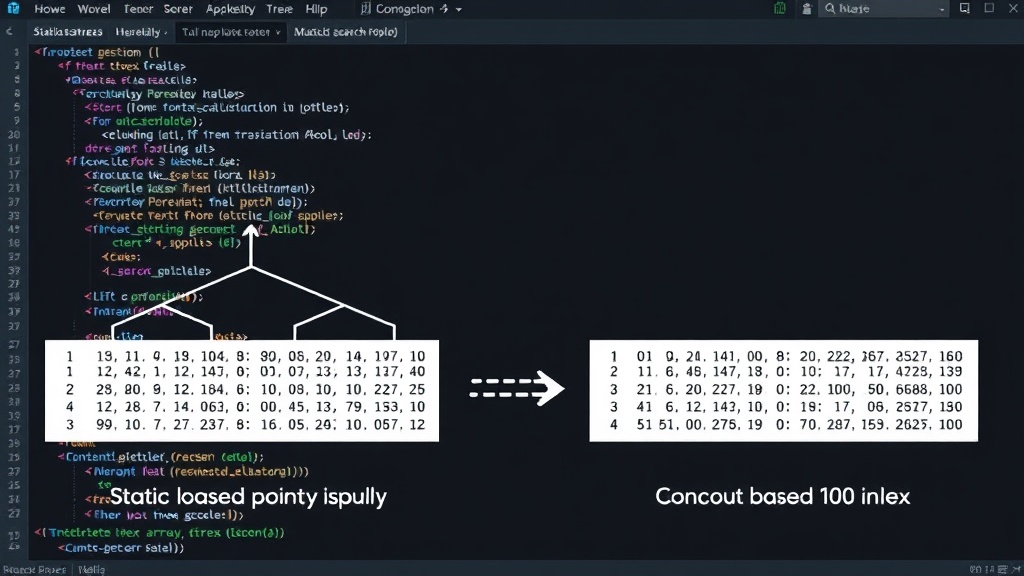
The core innovation lies in how the SST organizes data. Unlike binary search trees or B-trees, which rely on pointers to navigate between nodes, the SST uses a contiguous memory layout. This layout allows the tree structure to be implicitly encoded within the array itself, similar to how a binary heap is often implemented. When searching, instead of dereferencing a pointer to find the next node, the algorithm simply calculates the index of the next node based on its current position and the encoded structure. This avoids the cache misses and memory access penalties that plague pointer-based structures.
Consider a traditional binary search tree. Each node contains a value and two pointers, one to its left child and one to its right child. To traverse from a parent node to a child node, the CPU must fetch the memory address stored in the pointer and then fetch the data at that address. This two-step process, repeated at each level of the tree, can be slow, especially if the child node’s data is not already in the CPU’s cache. The SST, by contrast, stores nodes sequentially in an array. When moving from a parent at index `i` to its left child, the algorithm knows the left child is at index `2*i + 1` (or a similar predictable offset), and all the necessary data is likely contiguous in memory, leading to fewer cache misses and faster access.
Design Principles and Trade-offs
The Static Search Tree is designed for datasets that are known at build time and do not change. This constraint is crucial. Because the tree structure is baked into a contiguous array, any modification to the data — insertion, deletion, or even updating a value that changes its sort order — would require rebuilding the entire tree. This makes the SST unsuitable for dynamic databases or applications with frequent data churn. However, for scenarios where data is relatively stable, such as configuration files, lookup tables, or historical data archives, the performance benefits are substantial.
The construction of an SST involves an initial phase of building the tree structure and then serializing it into a compact array. This build process can be more computationally intensive than inserting elements one by one into a dynamic tree. However, once built, the search operations are exceptionally fast. The memory footprint is also often more compact than traditional balanced trees, as there is no overhead for storing explicit pointers or balancing information within each node.
The performance gains are not just theoretical. Early benchmarks show that for datasets ranging from a few thousand to millions of elements, the SST consistently outperforms highly optimized binary search implementations, particularly when the dataset size grows. While binary search on a sorted array still offers O(log n) complexity, its practical performance is often limited by memory access patterns and the overhead of array indexing. The SST, by optimizing memory layout and access patterns, effectively reduces the constant factors that dominate real-world execution time. The 40x figure cited is an aggregate across various test cases, with some specific workloads showing even higher improvements.
Implications for Developers and Systems
The development of the Static Search Tree opens new avenues for performance optimization in read-heavy applications. Developers working with large, static lookup tables, configuration systems, or embedded systems where memory and speed are at a premium can see significant benefits. Imagine a system that needs to perform millions of lookups per second based on a fixed set of parameters; an SST could provide the necessary speed without resorting to complex hashing schemes or specialized hardware.
However, the static nature is a critical consideration. If your application requires frequent updates, the cost of rebuilding the SST would quickly negate its search performance advantages. This makes it a specialized tool, not a general-purpose replacement for dynamic data structures like hash maps or balanced trees. The decision to adopt an SST requires a careful analysis of the data volatility and the read/write patterns of the application. For systems where data is loaded once and queried many times, the SST represents a compelling optimization strategy.
What remains to be seen is how widely this concept will be adopted and whether standardized libraries will emerge. Currently, implementations appear to be in early stages, often custom-built for specific research or performance-critical projects. The challenge for adoption will be demonstrating ease of use and providing robust, well-tested libraries that can integrate seamlessly into existing development workflows. The potential for significant speedups is clear, but the practical hurdles of integration and maintenance for static-only structures will dictate its ultimate impact.