The True Cost of SAML SSO Connections
Many Software-as-a-Service (SaaS) products offer Single Sign-On (SSO) as a premium feature, often leveraging Security Assertion Markup Language (SAML) for enterprise integrations. While convenient for users, the financial implications for the businesses providing and using these SSO features can be substantial and are often poorly understood. This analysis breaks down the actual dollar cost of SAML SSO, including the often-overlooked SCIM provisioning, across three prominent identity providers: Auth0, WorkOS, and Clerk.
The core argument against the traditional 'feature tax' is that many features, like SSO, are built on existing infrastructure. Enabling SAML or SCIM often involves toggling a boolean flag on already deployed systems rather than provisioning entirely new, costly resources. Yet, providers frequently charge significant premiums for these capabilities. This isn't just about the direct cost; it's about understanding the total financial footprint of integrating enterprise-grade identity management.
Deconstructing the Pricing: Base, SSO, and SCIM
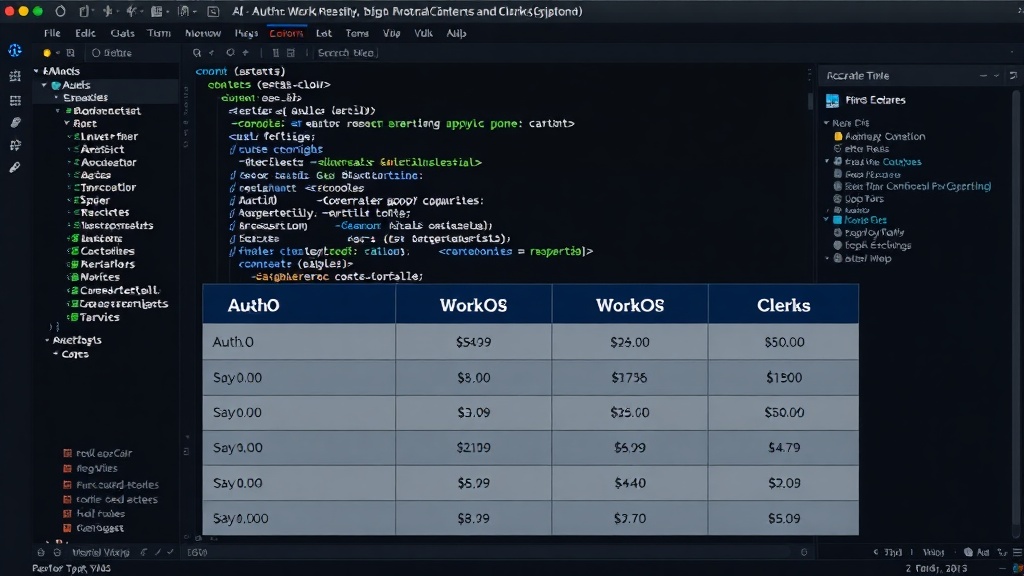
To quantify the 'SSO tax,' we must look at three distinct cost components:
- Platform Base Fee: This is the fundamental charge, typically based on Monthly Active Users (MAU). It's a fair charge, as more users generally equate to higher infrastructure and support costs.
- SSO Connection Fee: This is the direct charge for enabling SAML SSO functionality. It's often levied per connection or as a tiered feature unlock.
- SCIM Provisioning Fee: System for Cross-domain Identity Management (SCIM) automates user provisioning and de-provisioning. It's frequently bundled with SSO but can incur separate, sometimes higher, costs due to its complexity and automation capabilities.
We will examine how Auth0, WorkOS, and Clerk price these components, revealing the total cost of implementing SAML SSO and SCIM.
Auth0: Enterprise-Grade, Enterprise-Priced
Auth0, now part of Okta, is known for its comprehensive feature set and robust security. This enterprise focus comes with a corresponding price tag.
Platform Base: Auth0's pricing is often tiered, with higher MAU counts leading to higher per-user costs or requiring custom enterprise quotes. Their 'Enterprise' plan, where SSO is typically found, starts at a higher baseline than many competitors.
SSO Connection: SAML SSO is a core feature of Auth0's Enterprise plan. While not always a separate line item once on the Enterprise plan, the plan itself carries a significant premium over lower tiers that lack SSO. For businesses needing just SSO without the full suite of enterprise features, this can feel like paying for more than you need.
SCIM Provisioning: SCIM is also included within Auth0's Enterprise offering. However, the complexity and scale of SCIM deployments can push customers towards higher tiers or custom agreements. The cost is baked into the high base price of the Enterprise plan, making it difficult to isolate the exact SCIM cost, but it is substantial.
The surprising detail here is not Auth0's high pricing, but how tightly integrated SSO and SCIM are within their highest-tier plans, forcing customers to adopt a broad enterprise solution even if they only require specific identity management features.
WorkOS: The Developer-Centric Approach
WorkOS positions itself as a developer-first platform, aiming to simplify the integration of enterprise features like SSO and SCIM.
Platform Base: WorkOS offers a generous free tier for smaller usage, but scales rapidly. Their core pricing is often based on MAU, with distinct tiers for features.
SSO Connection: WorkOS explicitly charges for SSO connections. They often have a per-connection pricing model, or a feature unlock within specific plans. This allows for more granular cost control but can become expensive as the number of SSO integrations grows.
SCIM Provisioning: SCIM is a distinct, and often more expensive, offering from WorkOS. They typically charge a separate fee for SCIM capabilities, sometimes on a per-organization or per-SCIM-enabled-user basis. This transparency is valuable for understanding costs but highlights the premium placed on automated user management.
WorkOS's model is more transparent about the cost of each specific component, allowing developers to precisely calculate their SSO and SCIM expenditure. However, for organizations with many SSO integrations and robust SCIM needs, the aggregated costs can quickly rival or exceed those of more comprehensive platforms.
Clerk: Simplicity with a Focus on Developer Experience
Clerk aims to provide a streamlined developer experience, focusing on modern authentication flows, including SSO.
Platform Base: Clerk offers a competitive free tier and scales based on MAU. Their pricing structure is designed to be straightforward, with features clearly delineated across plans.
SSO Connection: SAML SSO is typically available on Clerk's 'Enterprise' or a higher-tier plan. Unlike some providers, Clerk might offer SSO as an add-on or a specific feature unlock within a plan, rather than requiring the jump to their absolute highest, most feature-rich tier. This can make it more accessible for businesses that specifically need SSO.
SCIM Provisioning: SCIM is often an advanced feature on Clerk's higher-tier plans or available as a separate add-on. Clerk's approach to SCIM is generally focused on ease of integration, but it comes with a price, reflecting the engineering effort to build and maintain reliable automated provisioning.
The clarity in Clerk's offerings means that if you need SSO and SCIM, you can often price it out directly. The 'tax' here is less about hidden fees and more about the cost of accessing these advanced enterprise features, which are necessarily positioned on higher-value plans.
The Aggregated 'SSO Tax'
When you combine the base platform costs with the specific charges for SSO connections and SCIM provisioning, the total price for enterprise-ready identity management can be striking. A company needing SAML SSO and SCIM for just a few key enterprise clients could be looking at hundreds or even thousands of dollars per month, depending on the provider and the number of users or connections involved. This is the 'SSO tax' in dollars: not just a feature unlock, but a significant operational expense.
If you run a product team that needs to offer SAML SSO to your customers, you now have a clearer picture of the direct financial commitment involved with Auth0, WorkOS, and Clerk. Benchmarking these costs against your projected customer adoption of SSO features is crucial for accurate forecasting and pricing strategy. The decision of which provider to use will depend heavily on your existing user base, your growth projections for SSO adoption, and your tolerance for bundled versus à la carte feature pricing.