The Core Architectural Divide: Serverless vs. Client-Server
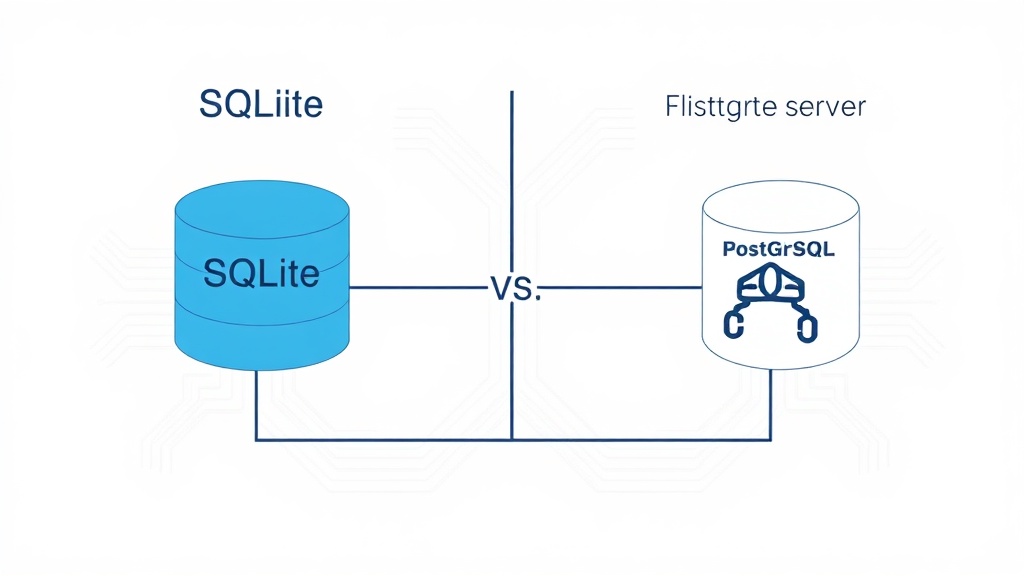
At first glance, writing raw SQL queries might feel identical whether you're interacting with SQLite or PostgreSQL. The syntax, for many common operations, shares significant overlap. However, beneath this surface similarity lies a profound architectural chasm. SQLite is a marvel of serverless design; the entire database exists as a single file, residing directly on your disk. This means zero setup, zero background processes, and zero network latency for data access. It's the digital equivalent of having a personal notepad that's always within reach and never needs to be opened or closed.
PostgreSQL, conversely, is a robust, full-fledged client-server database system. It operates as a dedicated background process, managing data storage, access control, and concurrency. To interact with PostgreSQL, applications must establish network connections, sending queries over the wire and receiving results. This client-server model, while introducing overhead, unlocks powerful capabilities for shared, concurrent access that SQLite simply cannot provide in its native form.
SQLite: The Lightweight Champion for Single-User Scenarios
SQLite's serverless nature makes it exceptionally well-suited for a specific class of problems. Its primary strengths lie in scenarios where a single user or process is the primary actor, and data integrity and speed are paramount within that confined context. Think of local development environments where developers need a persistent data store for their applications without the burden of managing a separate database server. It's the default choice for many command-line interface (CLI) tools that require local data persistence.
Mobile applications are another significant domain where SQLite excels. On-device data storage for iOS and Android apps often leverages SQLite. Its ability to be embedded directly within the application binary, coupled with its low resource footprint, makes it ideal for storing user preferences, offline data, and application state without requiring an internet connection or a separate server. The performance gains from bypassing network hops are substantial in these embedded contexts. This makes SQLite incredibly fast and lightweight for single-user scenarios, offering near-instantaneous data retrieval and modification.
However, this very simplicity becomes SQLite's Achilles' heel when concurrency demands increase. When multiple users or processes attempt to write to the same SQLite database file simultaneously, it runs into limitations. While SQLite employs file-level locking to prevent data corruption, this mechanism can become a bottleneck. A write operation often locks the entire database file, preventing other write operations until it completes. This can lead to applications freezing or becoming unresponsive under heavy concurrent write loads, making it unsuitable for web applications or services that need to serve many users concurrently.
PostgreSQL: The Robust Powerhouse for Concurrent Applications
PostgreSQL is engineered precisely to overcome the limitations of serverless databases in multi-user environments. Its client-server architecture allows it to manage concurrent access with sophisticated mechanisms. The most critical of these is advanced row-level locking. Unlike SQLite's file-level locks, PostgreSQL can lock individual rows being modified, allowing other connections to read or even write to different rows within the same table concurrently. This granular control is what enables PostgreSQL to handle thousands of simultaneous connections and transactions without grinding to a halt.
The implications for web applications are profound. Any service that involves multiple users interacting with a shared dataset – e-commerce sites, social media platforms, collaborative tools – relies on a database system like PostgreSQL. It ensures that when a user adds an item to their cart, updates their profile, or posts a comment, these operations are handled efficiently and reliably, even if thousands of other users are performing similar actions at the same moment. PostgreSQL's robust feature set extends beyond concurrency; it includes advanced data types, full-text search, complex query optimization, replication, and extensibility, making it a comprehensive solution for demanding enterprise-level applications.
When to Choose Which: A Tale of Two Worlds
The choice between SQLite and PostgreSQL is not about which database is inherently