Bridging Workload Identity: SPIFFE and Entra Agent ID
The architecture for integrating SPIFFE's workload identity with Microsoft Entra Agent ID has been conceptualized, and now, it has been brought to life with a working proof-of-concept (PoC). This demonstration bridges the gap between SPIFFE's ability to attest to workload authenticity and Entra Agent ID's role in managing governed agent identities. The core challenge lies in establishing a secure trust contract: SPIRE verifies the workload, while Entra determines the permissible agent identity. A federated identity credential serves as the crucial link, validating external JWTs through precise issuer, subject, and audience matching, a mechanism leveraged by Microsoft Entra workload identity federation.
The previous architectural discussion highlighted the potential trust gap. This article details the practical implementation and validation of that architecture, showcasing a functional demonstration of how a SPIFFE workload can authenticate as an Entra Agent ID. The goal is not to merge these systems but to enable a secure interaction where each system performs its intended function independently while trusting the other's attestations within a defined scope.
Implementing the Proof-of-Concept
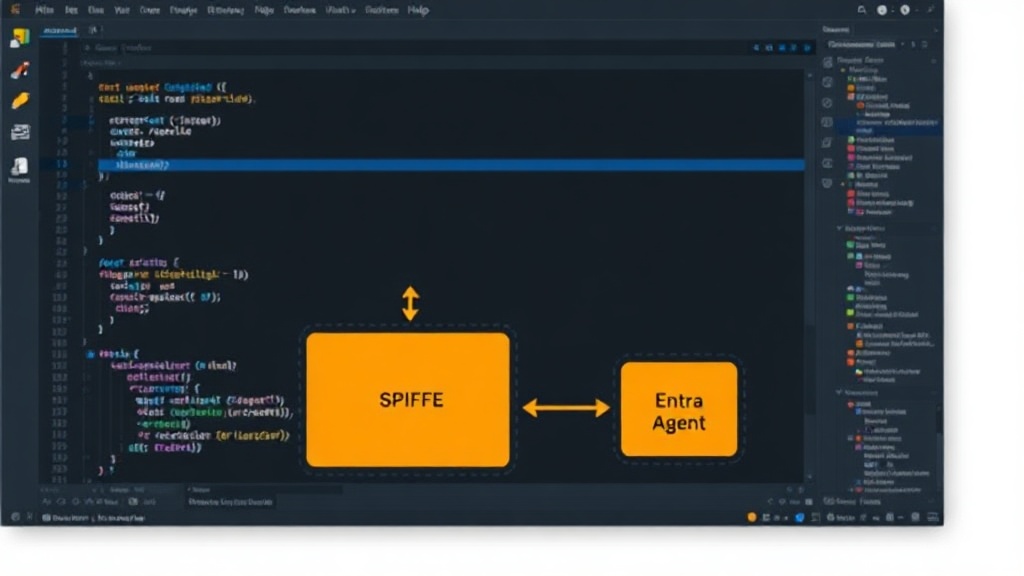
The proof-of-concept centers around demonstrating the flow of authentication from a SPIFFE workload identity to a Microsoft Entra Agent ID. This involves several key components and steps. First, a SPIFFE Runtime Environment (SPIRE) is set up to issue JSON Web Signature (JWS) tokens, referred to as JWT-SVIDs (Secure Verifiable Identity Documents), to workloads running within its managed environment. These JWT-SVIDs contain claims that attest to the identity and authenticity of the workload.
The next critical step is configuring Microsoft Entra ID to accept these JWT-SVIDs as a form of external identity. This is achieved through Microsoft Entra workload identity federation. A federated identity credential is created within Entra, linked to a specific application or service principal representing the workload. This credential defines the trust relationship by specifying the issuer (the SPIFFE authority), the subject (typically derived from the workload's SPIFFE ID), and the audience (the Entra application). When a workload presents its JWT-SVID, Entra validates these claims against the federated identity credential configuration.
The PoC specifically focuses on how the JWT-SVID, generated by SPIFFE, can be presented to Entra ID and successfully validated. This validation process confirms that the presented token originates from a trusted SPIFFE issuer and pertains to a known workload identity. Upon successful validation, the workload can then leverage the Entra Agent ID associated with the federated credential, enabling it to access resources protected by Entra ID. This effectively allows a workload, whose identity is managed by SPIFFE, to act with the permissions granted to an Entra Agent ID.
Technical Details and Trust Management
The technical implementation of this PoC requires careful configuration of both SPIFFE/SPIRE and Microsoft Entra ID. For SPIFFE, this involves setting up appropriate trust domains and registration authorities to issue verifiable credentials. The JWT-SVIDs must be correctly formatted, including the necessary claims that Entra ID will use for validation. Key among these are the issuer URL, which must match the configured issuer in Entra, and the subject, which should map to the intended Entra identity.
In Entra ID, the primary configuration involves creating a federated identity credential for the application or service principal that the workload will impersonate. This credential acts as the bridge. The 'issuer' field in the federated credential must precisely match the issuer URL of the SPIFFE authority. The 'subject identifier' can be configured to match a specific claim within the incoming JWT-SVID, allowing for granular control over which SPIFFE identities can use the credential. The 'audience' claim in the JWT-SVID should align with the identifier of the Entra application receiving the token.
The 'trust gap' mentioned in prior discussions refers to the boundary where SPIFFE's attestation of workload execution ends, and Entra's authorization of agent identity begins. The PoC demonstrates that this boundary can be managed through the precise matching of claims in the JWT-SVID with the configuration of the federated identity credential. It's crucial to understand that SPIFFE does not authenticate *to* Entra in the traditional sense; rather, it provides a verifiable attestation that Entra then uses to grant access based on a pre-established trust relationship. This approach maintains the separation of concerns, with SPIFFE focused on workload identity and Entra on governed access.
Implications and Future Directions
This working PoC has significant implications for organizations looking to adopt a zero-trust security model that spans both cloud-native workloads and enterprise identity management systems. By enabling SPIFFE-managed workloads to authenticate using Entra Agent IDs, organizations can consolidate identity management and access control policies within Entra ID, even for applications deployed in diverse environments managed by SPIFFE.
For developers, this means that applications can be built with a consistent identity abstraction layer provided by SPIFFE, while seamlessly integrating with Microsoft's robust identity and access management ecosystem. This reduces the complexity of managing multiple identity systems and simplifies the process of granting granular permissions to workloads.
The success of this PoC opens avenues for further exploration. One key area is the automation of the federated identity credential creation and management process. As more workloads adopt this pattern, automating the provisioning and de-provisioning of these credentials based on SPIFFE's workload registration would be essential for scalability and security. Additionally, investigating the performance implications of this authentication flow and optimizing the JWT validation process within Entra ID will be critical for production deployments.
Another direction involves exploring advanced trust models. While this PoC focuses on a direct issuer-subject match, future work could explore more sophisticated attestation mechanisms or the use of different types of verifiable credentials issued by SPIFFE authorities to Entra ID. The broader goal is to create a flexible and secure framework for workload identity that can adapt to evolving security requirements and cloud-native architectures.