The Problem: Why Traditional Budget Trackers Fail
Most budget management applications act like passive digital receipts. You spend money, manually log expenses hours later, and only realize you've overspent when your bank balance hits zero. This reactive approach leaves users perpetually behind, struggling to manage their finances effectively. The core issue lies in their fundamental design: they are retrospective, offering insights into what has already happened rather than intervening in the present.
We built Spendwise to flip this paradigm on its head. Instead of just tracking past expenses, Spendwise acts as an active financial guard—evaluating transactions in real-time, providing an emergency safety buffer, and automating periodic budget rollovers. This shifts the focus from historical analysis to proactive financial management, empowering users to stay within their means before they overspend.
The Technology Stack for Real-Time Financial Guarding
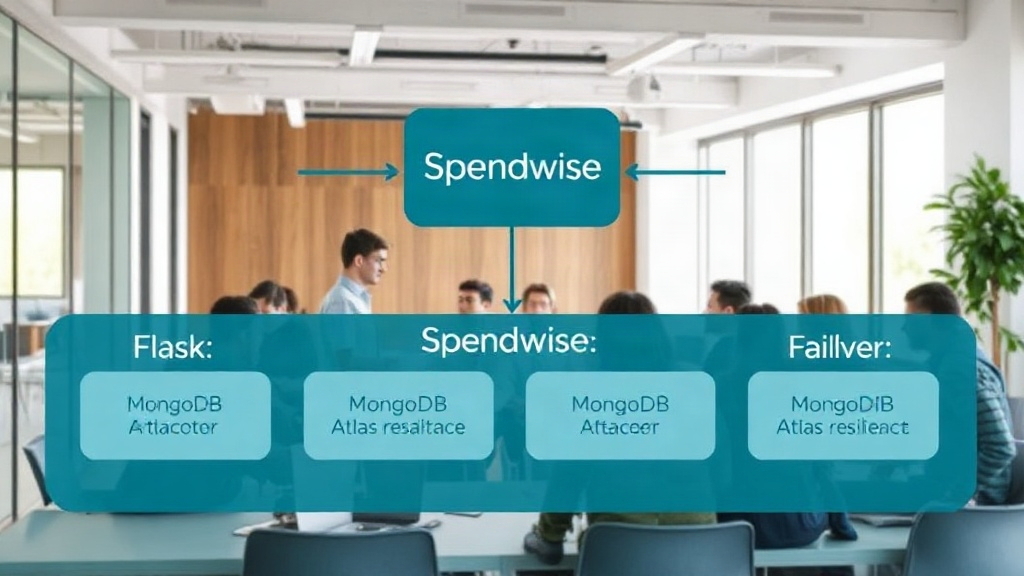
To deliver instantaneous UI feedback and 100% backend reliability, we engineered Spendwise using a modular, decoupled architecture. This design ensures that each component can operate and scale independently, contributing to the overall robustness and responsiveness of the application.
At the heart of Spendwise is the Python web framework, Flask. Flask provides a lightweight yet powerful foundation for building the backend services. Its flexibility allows for rapid development and easy integration of various modules, crucial for a dynamic application like Spendwise.
Database Resilience with MongoDB Atlas
For data persistence and retrieval, Spendwise leverages MongoDB Atlas. This cloud-based NoSQL database offers a highly scalable and available solution, essential for handling the real-time transaction data that Spendwise processes. Atlas provides features like automated backups, multi-region deployments, and advanced security protocols, ensuring that user financial data is both secure and consistently accessible.
The choice of MongoDB is particularly well-suited for the application's needs. Its document-oriented nature allows for flexible schema design, accommodating the varied types of financial transactions and user data. Furthermore, MongoDB's performance characteristics are optimized for the high-throughput, low-latency operations required for real-time transaction evaluation.
Ensuring Failover Resilience
A critical aspect of any financial application is its uptime and reliability. Spendwise incorporates failover resilience to guarantee continuous operation. This is achieved through a multi-layered approach:
- Redundant Server Deployments: Multiple instances of the backend application are deployed across different availability zones. If one instance fails, others can seamlessly take over.
- Database High Availability: MongoDB Atlas itself provides built-in high availability features, ensuring that database operations continue uninterrupted even in the event of hardware failures or network disruptions.
- Load Balancing: Sophisticated load balancing distributes incoming traffic across available application instances, preventing overload and ensuring consistent performance.
- Health Monitoring: Continuous monitoring of all system components allows for the early detection of issues, enabling automated failover before users are impacted.
This focus on failover resilience means that Spendwise can operate as a true financial guard, always available to evaluate transactions and alert users to potential overspending, even during unexpected system events. This is a stark contrast to traditional apps that might go offline or become unresponsive when needed most.
The Intelligent Spending Guard
The intelligence of Spendwise lies in its real-time transaction evaluation. Unlike passive trackers that require manual input and batch processing, Spendwise integrates with financial data streams to analyze each transaction as it occurs. This allows for:
- Immediate Budget Impact Assessment: When a transaction is initiated, Spendwise assesses its impact on the user's predefined budget categories.
- Proactive Alerts: If a transaction would push a user over their budget limit, or if it falls into a high-risk spending pattern, Spendwise can trigger an immediate alert. This might be a subtle notification or a more urgent warning, depending on user preferences and the severity of the potential overspend.
- Emergency Safety Buffer: Spendwise includes a configurable emergency buffer. This acts as a last line of defense, allowing for a small, predefined amount of overspending before critical alerts are triggered, providing a small window for users to correct course.
- Automated Budget Rollovers: At the end of a budget period, Spendwise can automatically roll over unused funds to the next period or reallocate them according to user-defined rules, simplifying budget management.
This real-time, intelligent approach transforms budgeting from a chore into an active, supportive process. It’s akin to having a vigilant security guard for your finances, not just a logbook of past events.
Future Directions and User Experience
The current architecture provides a robust foundation. Future development will focus on enhancing the AI capabilities for more nuanced spending pattern analysis, personalized financial advice, and predictive budgeting. The user experience will remain paramount, with a continued emphasis on a clean, intuitive interface that makes complex financial management accessible to everyone.
By combining a robust technology stack with an innovative, proactive financial management philosophy, Spendwise aims to redefine what users expect from personal finance applications.