The Ticketmaster Paradox: Who Pays the Piper?
The distinction between a user and a customer is often blurred, but understanding this difference is critical for product success. A prime example comes from the economics of Ticketmaster. While millions of fans use Ticketmaster to buy tickets, the company's strategic focus wasn't solely on appeasing these end-users. Instead, Ticketmaster heavily courted and collaborated with venues. These venues, the actual clients paying for the ticketing service and its infrastructure, became the primary customer. This venue-first strategy allowed Ticketmaster to build a dominant market position, influencing everything from pricing to access, often to the chagrin of the ticket-buying public.
This insight, highlighted in discussions about Ticketmaster's business model, offers a potent lesson for anyone building technology. It suggests that the entity that derives the most value, or conversely, the entity that holds the purse strings, might not be the one directly interacting with the product on a daily basis.
Applying the Lesson to Game Development Collaboration
Consider the challenge of improving collaboration and managing merge conflicts specifically within game development. Game development teams, whether they are student projects, indie studios, or larger AAA outfits, often grapple with complex codebases and intricate asset pipelines. Merge conflicts in game development can be particularly thorny due to the nature of the assets involved – binary files like 3D models, textures, and audio files, which are notoriously difficult to merge automatically compared to text-based code.
When conceptualizing a solution for this problem, one might initially think of the direct beneficiaries: the individual game developers who spend hours resolving these conflicts. They are the primary users of any tool designed to streamline this process. They experience the pain point directly, losing valuable development time and becoming frustrated.
However, who is the true *customer*? This depends on the context of the team structure and the purchasing power within that structure. For student game development teams, the situation is often straightforward. Students are typically working on projects for educational purposes, and the decision-making power, or at least the influence over tool adoption, might lie with a lead student, a project manager, or even an instructor overseeing the course or project. In this scenario, the students are the users, but the instructor or lead might be the one evaluating and approving the adoption of a new tool, even if they don't use it daily themselves.
Identifying the Payer: Beyond the User Interface
For small indie studios, the lines can become even more nuanced. The team lead or studio head is often both a user and the primary decision-maker, blurring the customer/user distinction. Yet, even here, external factors can shift the dynamic. If the studio is funded by a publisher, the publisher might exert influence over toolchains or development practices, effectively becoming a de facto customer whose requirements must be met, even if they never interact with the merge conflict resolution tool directly.
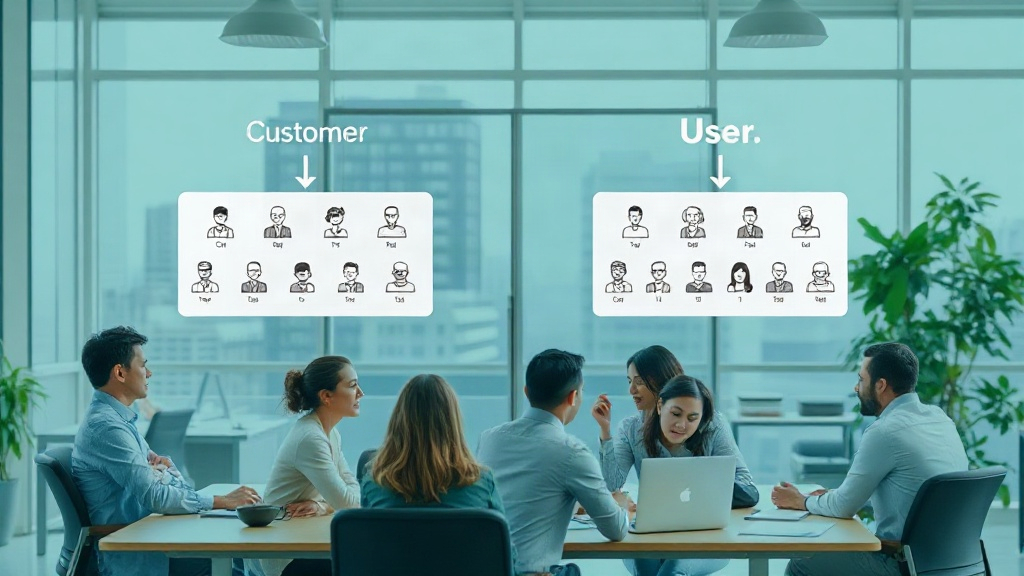
The core insight from the Ticketmaster model is that one must identify not only who uses the product but also who benefits most from its existence, who pays for it, and who has the authority to adopt or reject it. These can be entirely different entities. For a tool aimed at improving game development collaboration:
- Users: Individual game developers, artists, designers.
- Potential Customers (Decision-Makers/Payers): Team leads, project managers, instructors, studio heads, publishers, educational institutions.
Focusing solely on the needs and workflows of the individual developer (the user) might lead to a solution that is technically excellent but fails to gain traction because it doesn't address the strategic concerns, budget constraints, or administrative requirements of the actual customer.
Designing for the Real Customer
If the customer is an instructor, the solution might need to include features for progress tracking, grading integration, or demonstration capabilities. If the customer is a studio head, the solution might need to emphasize ROI, team productivity metrics, or integration with existing enterprise software. If the customer is a publisher, the solution might need to align with specific compliance or reporting standards.
The surprise here is how often product teams default to optimizing for the most visible user, neglecting the more complex, often indirect, relationship with the entity that ultimately enables the product's success through purchase or adoption. This is not to say the user's experience is unimportant; it is foundational. But the design, marketing, and sales strategies must be tailored to the entity that holds the power to make the product a reality within an organization or market.
The Unanswered Question: Scalability of Customer Identification
What remains to be seen is how this distinction scales for platforms that aim to serve a broad spectrum of users, from individual hobbyists to large enterprises. Can a single product effectively cater to the immediate needs of a student developer while simultaneously addressing the strategic purchasing criteria of a corporate client or the content moderation concerns of a platform owner? The challenge lies in creating a product that is flexible enough to provide value at multiple levels of the organizational or economic hierarchy, without becoming overly complex or diluted in its core offering.
Ultimately, understanding the multifaceted nature of the customer—who uses it, who pays for it, and who champions it—is not just a matter of business strategy; it's a fundamental aspect of building products that resonate, gain adoption, and achieve sustained success in any market, especially in the rapidly evolving landscape of software development tools.