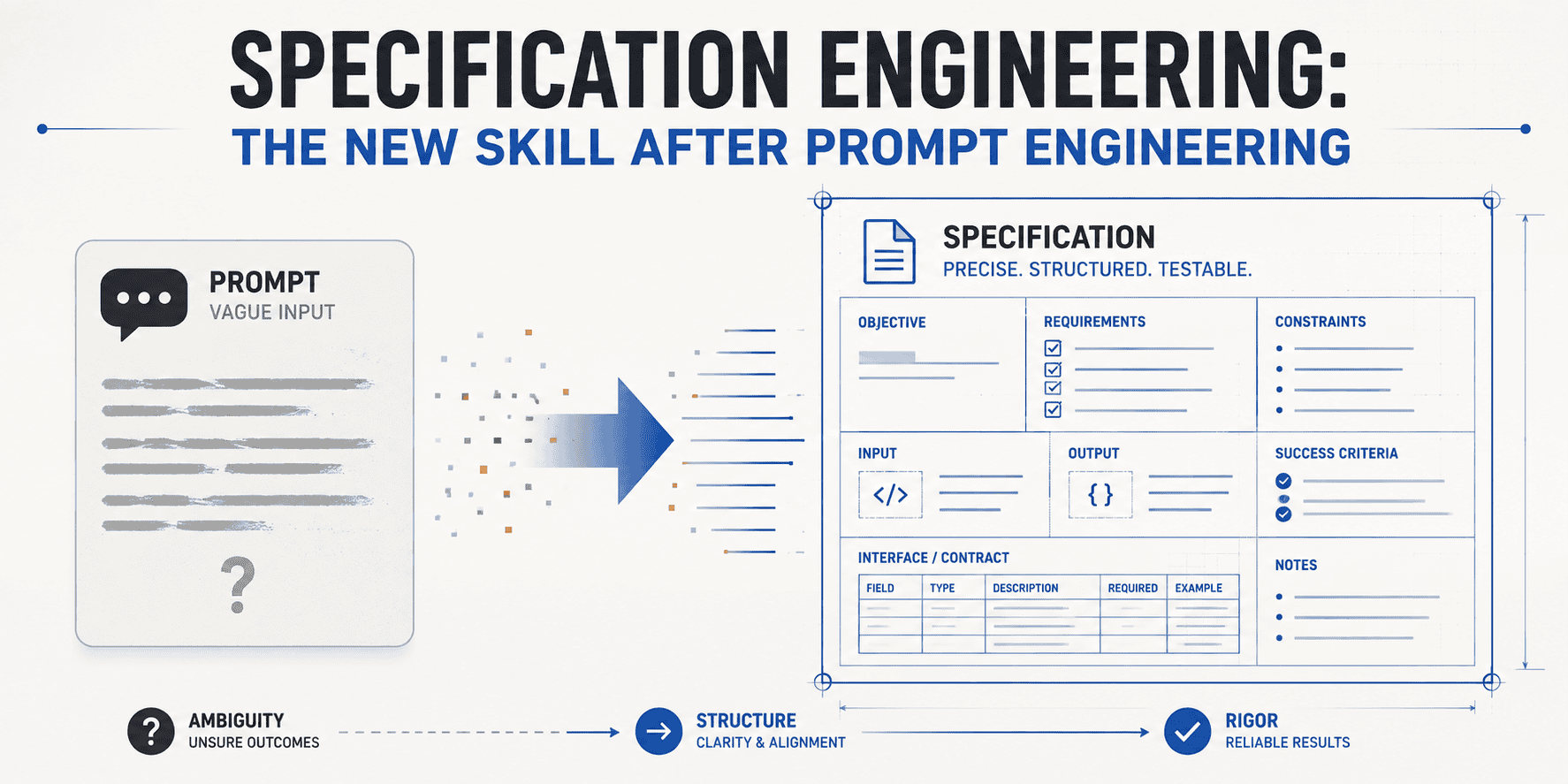
The Evolution from Prompt to Specification
Prompt engineering has dominated the conversation around interacting with artificial intelligence models for the past few years. It’s the skill of crafting precise, effective prompts to elicit desired responses from AI. Think of it like learning to ask your incredibly knowledgeable, but sometimes literal, personal assistant exactly the right question to get the information you need. This has been essential for everything from generating creative text to analyzing complex data sets. However, as AI systems become more sophisticated and integrated into professional workflows, a new, more rigorous skill is emerging: specification engineering.
While prompt engineering focuses on the input – the question or instruction – specification engineering shifts the focus to the output and the process. It's about defining, with granular detail, the exact requirements, constraints, and desired outcomes of an AI-driven task. If prompt engineering is asking for a specific meal, specification engineering is providing the chef with a detailed recipe, ingredient list, dietary restrictions, and presentation guidelines. This moves beyond a single query to establishing a framework for AI-generated work.
The core difference lies in the level of detail and intent. Prompt engineering is often iterative and exploratory, refining queries until the output is satisfactory. Specification engineering, on the other hand, aims to be definitive upfront. It’s less about discovery and more about design and control. This is particularly critical in professional contexts where AI is not just a novelty but a tool for production, analysis, or even core business functions.
Why Specification Engineering is Necessary Now
The rapid advancement of AI models, particularly large language models (LLMs), has outpaced our ability to consistently integrate them into predictable, reliable workflows. While prompts can yield impressive results, they often lack the structure needed for repeatable, scalable, and auditable outcomes. This is where specification engineering becomes indispensable. It addresses the inherent variability and potential for hallucination in AI outputs by imposing a clear structure and set of expectations.
Consider the difference between asking an LLM to “write a marketing email for a new product” versus providing a detailed specification. The latter would include target audience demographics, key product features to highlight, desired tone of voice, call-to-action requirements, legal disclaimers, and formatting constraints. This level of detail ensures the AI’s output aligns not just with a general request, but with specific business objectives and brand guidelines. It transforms the AI from a creative collaborator into a precise executor of defined tasks.
This shift is driven by the increasing demand for AI to perform complex, multi-step tasks, or to produce outputs that must adhere to strict standards. For instance, generating code that must pass specific security audits, drafting legal documents that require precise terminology, or creating synthetic data that perfectly mirrors real-world distributions all necessitate a level of control that simple prompting cannot provide. Specification engineering offers that control.
The surprising detail here is not the emergence of a new skill, but the speed at which it is becoming essential. What was once a niche concern for advanced AI deployment is rapidly becoming a foundational requirement for anyone looking to leverage AI beyond casual use. The AI itself isn't changing as much as our expectations and the complexity of the tasks we assign it.
Key Components of Specification Engineering
Specification engineering involves several key elements:
- Objective Definition: Clearly articulating the ultimate goal of the AI’s task, including measurable success criteria.
- Constraint Identification: Defining boundaries and limitations, such as budget, time, acceptable formats, data privacy regulations, or ethical guidelines.
- Output Schema Design: Detailing the structure, format, and content of the desired output. This could be a JSON schema for data, a specific document structure, or a defined set of parameters for a generated asset.
- Process Flow Mapping: Outlining any intermediate steps, decision points, or dependencies required to achieve the final output. This is crucial for complex, multi-stage AI operations.
- Validation Protocols: Establishing methods for verifying that the AI's output meets the specified requirements. This includes defining test cases, metrics, and human review processes.
- Error Handling: Specifying how the AI system should respond to ambiguous inputs, unexpected data, or failures to meet criteria.
This structured approach moves AI interaction from a conversational model to an engineering discipline. It requires a blend of technical understanding, domain expertise, and a systematic mindset. The goal is to reduce ambiguity and increase the predictability and reliability of AI-generated results.
Referenced Sources
- verified