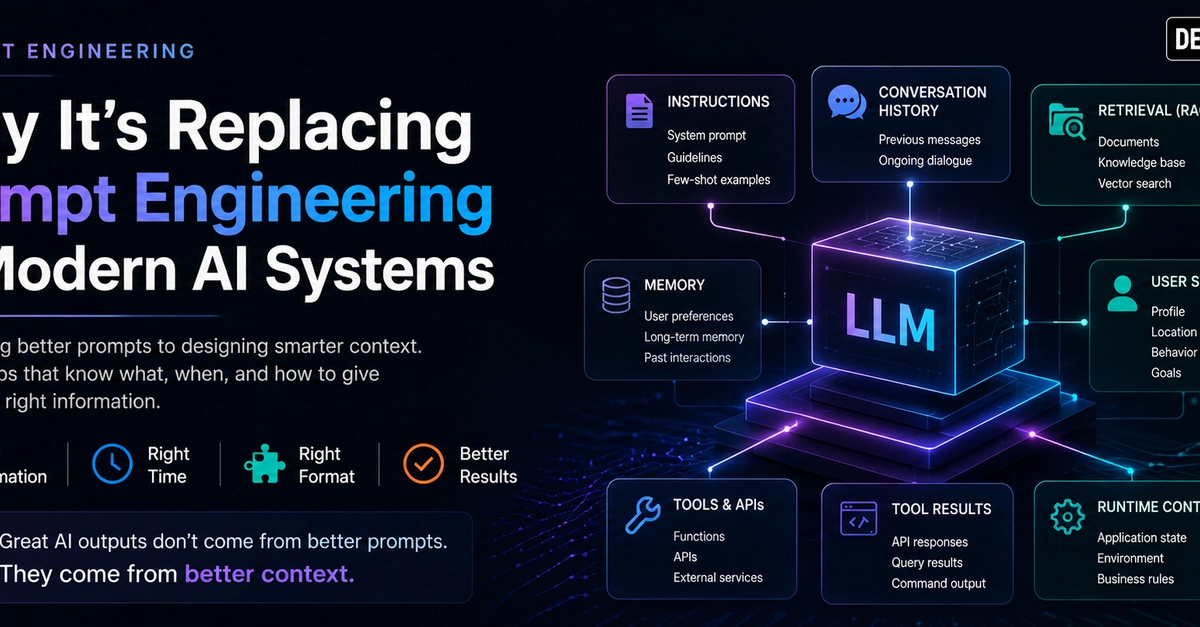
The Evolution Beyond Simple Prompts
For years, developers building with large language models (LLMs) focused on a single question: "What prompt should I give the model?" This era saw extensive experimentation with system prompts, role instructions, few-shot examples, and various formatting techniques. The premise was simple: a better prompt could transform inconsistent outputs into remarkably useful ones. This approach proved effective for straightforward tasks like summarization or email generation.
However, the landscape of AI applications is rapidly evolving. Modern AI systems are no longer confined to single-turn, simple requests. Instead, we are witnessing the rise of complex AI agents capable of intricate operations. These agents can search databases, interact with APIs, maintain conversational memory, process extensive documents, leverage external tools, execute code, and orchestrate multi-step workflows. In this more advanced environment, crafting a perfect prompt is only one piece of a much larger puzzle.
The critical challenge shifts from simply instructing the model to managing the information it needs at any given moment. This is the domain of context engineering.
What is Context Engineering?
Context engineering is the discipline of strategically providing relevant information to an AI model to guide its behavior and improve its performance, especially in complex, multi-step tasks. Unlike prompt engineering, which primarily focuses on the direct instructions given to the LLM, context engineering is concerned with the entire information environment surrounding the model's decision-making process. This includes not just the immediate prompt but also historical data, retrieved documents, tool outputs, user profiles, and any other relevant data that can inform the AI's actions.
Think of it less like giving a chef a single recipe instruction and more like preparing the entire mise en place for a complex banquet. The chef still needs the recipe (the prompt), but their success hinges on having all the correct ingredients, prepped and ready, in the right order, at the right time. Context engineering is about assembling that perfect pantry and ensuring the chef (the LLM) can access what it needs, when it needs it, to execute the meal flawlessly.
Why Context Engineering is Essential for Modern AI
The limitations of prompt engineering become apparent when AI applications move beyond simple query-response systems. Consider an AI agent designed to manage customer support tickets. This agent needs to:
- Access the customer's ticket history.
- Consult a knowledge base for relevant solutions.
- Understand the current conversation context.
- Potentially interact with other internal systems (e.g., billing, shipping).
- Formulate a coherent and helpful response.
A single, static prompt cannot effectively encapsulate all this dynamic information. The agent requires a mechanism to dynamically fetch, filter, and present the most pertinent data for each interaction. This is where context engineering shines. It involves designing systems that can:
- Retrieve relevant information: Employing techniques like Retrieval Augmented Generation (RAG) to pull data from vector databases or external sources.
- Manage conversational history: Ensuring the model remembers past turns in a conversation without exceeding its context window limits.
- Integrate tool outputs: Feeding the results of API calls or code execution back into the model's decision loop.
- Filter and prioritize information: Deciding which pieces of context are most critical for the current step of the task.
This dynamic management of information allows AI agents to exhibit more sophisticated reasoning, maintain coherence over longer interactions, and perform tasks that require access to and synthesis of diverse data sources. It moves AI from being a sophisticated text generator to a capable agent performing complex workflows.
The Technical Underpinnings of Context Engineering
Context engineering is not a single technique but an umbrella term encompassing several strategies and architectural patterns. Key components include:
- Retrieval Augmented Generation (RAG): This is perhaps the most prominent technique. RAG systems first retrieve relevant documents or data snippets from an external knowledge base (often stored in a vector database) based on the user's query. This retrieved information is then added to the prompt before being sent to the LLM. This provides the model with factual, up-to-date information it wasn't trained on, significantly reducing hallucinations and improving accuracy.
- Memory Management: For conversational AI, maintaining state and remembering previous interactions is crucial. Context engineering involves strategies for summarizing past conversations, selectively retaining key information, and managing the context window effectively to avoid information overload or loss. Techniques range from simple sliding windows to more advanced summarization models.
- Tool Use and Function Calling: Modern LLMs can be equipped with tools (APIs, databases, code interpreters). Context engineering ensures that the LLM knows which tools are available, when to use them, and how to interpret their outputs. This involves structuring the context to include tool descriptions and dynamically incorporating tool results into subsequent reasoning steps.
- State Management in Agents: For multi-step agents, tracking the progress of a task, the intermediate results, and the overall plan is vital. Context engineering provides the framework for managing this state, ensuring the agent can pick up where it left off, adapt to new information, and complete complex sequences of actions.
The surprising detail here is not that LLMs can do more, but that the engineering effort has shifted from fine-tuning the *input instruction* to orchestrating the *information flow* around the model. It requires a different mindset, moving from crafting the perfect sentence to designing a robust data pipeline and decision-making framework.
The Future: Towards Autonomous Agents
As AI systems become more autonomous, the importance of context engineering will only grow. Developers will increasingly focus on building the infrastructure that enables AI agents to intelligently access, process, and act upon vast amounts of information. This shift signifies a maturation of the field, moving beyond superficial prompt tweaking to deep system design that empowers AI to solve real-world, complex problems.
The move from prompt engineering to context engineering is a natural progression. It reflects the increasing complexity and capability of AI applications, demanding more sophisticated methods for information management. As AI agents become more integral to our workflows, mastering the art and science of context engineering will be paramount for building effective, reliable, and intelligent systems.