The ReAct Agent's 'Reasoning Tax' Problem
Building AI applications in production often leads to what developers call the "Agent Wall." This wall is built from ReAct (Reasoning and Acting) agents, which are configured with numerous tools – search, extract, route, format – and extensive system prompts. While initially appearing magical, this approach quickly reveals its downsides: high latency and escalating token bills.
The core issue is that current agents function as interpreters, re-deriving routines and embedding tool schemas and reasoning histories for every single request. This process is inherently slow, consumes an excessive number of tokens, and is prone to errors like hallucinating tool calls, dropping constraints, or getting stuck in infinite reasoning loops. In production, these occasional failures can become critical, leading to wasted time and resources.
The problem isn't with the ReAct pattern itself, but rather with its application. Developers are forcing Large Language Models (LLMs) to orchestrate low-level, predictable logic that is far more efficiently handled by deterministic code. This creates what many now refer to as a "reasoning tax" – the added cost and fragility introduced by using LLMs for tasks that don't require their complex reasoning capabilities.
Consider a typical ReAct agent tasked with extracting specific information from a document. The agent might first use a tool to search for relevant keywords, then another to parse the retrieved text, and finally, a formatting tool to structure the output. Each of these steps involves the LLM interpreting the request, selecting the appropriate tool, generating the tool call, waiting for the tool's output, and then processing that output to decide the next step. This iterative process, repeated for every piece of information, becomes incredibly inefficient and expensive. The LLM is effectively acting as a clumsy, token-hungry orchestrator for a series of operations that could be codified directly.
Sparsi's Deterministic Approach
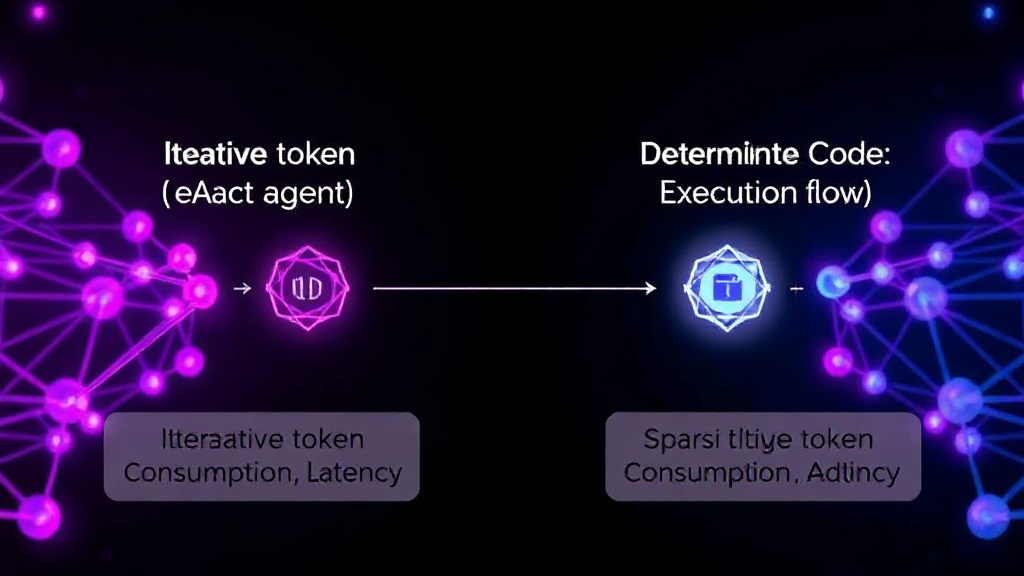
Sparsi emerges as a solution to this pervasive problem by advocating for a shift from LLM-driven orchestration to deterministic code. The platform allows developers to define agent workflows not as prompts for an LLM, but as explicit, structured code. This means that predictable, repeatable logic – such as data fetching, formatting, or simple conditional routing – is executed by standard programming constructs rather than being re-interpreted by an LLM on every request.
This approach drastically reduces the need for LLM intervention in routine tasks. Instead of an LLM parsing a massive prompt and tool schema to decide which of ten tools to call, deterministic code directly invokes the necessary functions. This bypasses the LLM's interpretation overhead entirely for these deterministic steps. The LLM's role is then reserved for tasks that genuinely require its advanced reasoning, such as complex decision-making, natural language understanding, or creative generation, rather than mundane orchestration.
The benefits are manifold. Firstly, cost reduction is significant. By minimizing LLM calls and token usage for predictable operations, developers can slash their operational expenses. Each ReAct loop, with its embedded context and reasoning, can consume hundreds or thousands of tokens. Replacing these loops with a single, efficient code execution can save an order of magnitude in token costs.
Secondly, reliability and performance see a substantial uplift. Deterministic code, by its nature, is predictable and less prone to errors like hallucination or getting stuck in loops. Tool calls are guaranteed to be executed as written, constraints are reliably enforced, and the execution path is consistent. This leads to lower latency and a more stable application, crucial for production environments where errors can have serious consequences.
What This Means for Production AI
The shift championed by Sparsi represents a pragmatic evolution in building production-ready AI applications. It acknowledges that while LLMs are powerful, they are not the optimal tool for every job. Applying LLMs to tasks that can be solved with deterministic code is akin to using a sledgehammer to crack a nut – it's inefficient, costly, and increases the risk of collateral damage.
For developers, this means rethinking agent architecture. Instead of building monolithic ReAct agents that attempt to manage every aspect of an application's logic, the new paradigm encourages a hybrid approach. Developers can use Sparsi to define the deterministic backbone of their application, handling the routine, predictable operations. This leaves the LLM free to act as a specialized reasoning engine, called upon only when its unique capabilities are truly necessary. This could involve, for example, an LLM interpreting a user's complex natural language query to decide which deterministic workflow to initiate, or summarizing the results from multiple deterministic workflows.
This hybrid model is not entirely novel, drawing parallels to established software engineering principles where complex systems are decomposed into microservices or modules, each handling specific responsibilities. In this AI context, deterministic code modules handle the predictable, while LLM-powered modules handle the unpredictable or reasoning-intensive tasks. The surprising detail here is not the cost savings, but how fundamentally this shifts the role of the LLM from an all-purpose interpreter to a specialized reasoning component within a larger, more robust system.
As AI applications mature and move from experimental prototypes to critical production systems, the focus inevitably shifts to efficiency, reliability, and cost-effectiveness. The "Agent Wall" represents the growing pains of early adoption. Sparsi and similar approaches signal a move towards more mature, sustainable AI development practices, where the right tool – be it a deterministic algorithm or an LLM – is used for the right job. The challenge ahead is for developers to effectively identify and delineate which parts of their application logic are best suited for deterministic code and which truly benefit from LLM reasoning, thereby building AI systems that are both powerful and practical.