The Spark 4.2 Vector Search Update: A Nuanced Picture
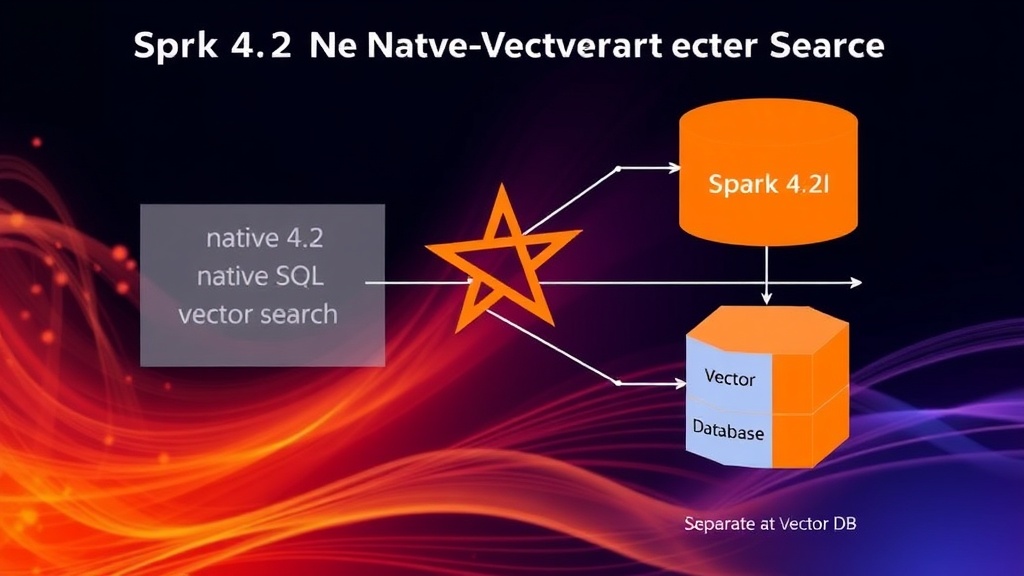
The announcement that Apache Spark 4.2 now includes native vector search capabilities has sparked a wave of discussion: is this the end of dedicated vector databases? The short answer, as is often the case with complex technology, is: it depends. Spark 4.2's integration of vector search directly into SQL is a significant development, offering compelling advantages for certain workloads. However, it does not represent a wholesale replacement for specialized vector databases, particularly when low-latency, real-time retrieval is paramount.
For organizations already leveraging Spark as their primary data processing engine, and whose use cases primarily involve batch processing, analytical queries, or similarity searches on existing datasets, Spark 4.2 offers a streamlined, integrated solution. This means eliminating an entire component from the technology stack, reducing operational overhead and simplifying data pipelines. Imagine your existing data lake, now capable of performing vector similarity searches without needing a separate, specialized system. This consolidation is a powerful proposition.
However, the landscape shifts dramatically when real-time, interactive applications come into play. Chatbots, real-time recommendation engines, and interactive search interfaces demand extremely low latency – often measured in milliseconds. While Spark 4.2 can perform vector operations, its architecture is fundamentally optimized for distributed batch processing, not for serving individual, high-frequency queries with sub-second response times. In these scenarios, the overhead of Spark's distributed nature, even with optimizations, can become a bottleneck. This is where dedicated vector databases, built from the ground up for rapid nearest-neighbor searches, continue to hold their ground.
What Spark 4.2 Actually Delivers
Spark 4.2’s vector search capabilities are integrated directly into its SQL engine, eliminating the need for external libraries or separate processing units. This native integration means developers can leverage familiar SQL syntax to perform complex vector operations. Key additions include:
- Vector Distance and Similarity Functions: Native support for calculating distances (e.g., Euclidean, Cosine) and similarities between vector embeddings directly within SQL queries.
- Vector Normalization: Functions to normalize vectors, a crucial step for many similarity metrics, ensuring consistent comparisons.
- Vector Aggregation: Capabilities to perform aggregations such as sum and average on vector columns, enabling analytical operations across large sets of embeddings.
- Efficient Indexing: While the specifics of the underlying indexing algorithms are not detailed in the initial announcements, Spark's distributed nature suggests optimizations for handling large volumes of vector data.
This suite of features allows for the creation of data pipelines where vector embeddings are generated, stored, and queried within the same Spark environment. For instance, a data scientist could compute embeddings for a corpus of documents, store them in a Spark DataFrame, and then immediately run analytical queries to find clusters or perform batch similarity searches, all within a single, unified workflow.
When Spark 4.2 Excels: Batch and Analytics
The primary strength of Spark 4.2's vector search lies in its suitability for batch processing and analytical workloads. Consider scenarios such as:
- Large-Scale Similarity Analysis: Identifying duplicate content, finding similar documents in a vast corpus, or performing batch recommendation generation on historical user data.
- Data Preprocessing and Feature Engineering: Generating and analyzing vector embeddings as part of a larger ETL pipeline, where the results are consumed by downstream batch models or reports.
- Exploratory Data Analysis: Investigating patterns and relationships within vector data without the need to move data to a specialized system.
In these contexts, Spark's distributed processing power, combined with its new vector functions, can offer significant performance benefits and operational simplicity. The ability to perform these operations directly in SQL means that teams already proficient in Spark can adopt vector search capabilities without a steep learning curve or the integration challenges associated with managing a separate database system.
Where Dedicated Vector Databases Still Shine
Despite the advancements in Spark, dedicated vector databases remain indispensable for use cases demanding real-time, low-latency retrieval. These databases are architected to optimize for fast nearest-neighbor searches, a requirement for interactive applications. Examples include:
- Real-time Chatbots and Virtual Assistants: Answering user queries instantly requires retrieving relevant information from a vector index in milliseconds.
- Live Recommendation Systems: Providing personalized recommendations to users as they interact with an application, such as e-commerce sites or content platforms.
- Interactive Search Interfaces: Powering search boxes that return immediate results as a user types, offering a fluid and responsive experience.
These applications often involve millions of concurrent queries, each requiring a rapid response. The architectural trade-offs made by dedicated vector databases – such as specialized indexing structures (e.g., HNSW, IVF) and in-memory processing – are specifically designed to meet these stringent performance requirements. Spark, while powerful for distributed computation, typically incurs higher latency for individual requests due to its distributed nature and task scheduling overhead.
The Verdict: A Powerful Addition, Not a Universal Replacement
Apache Spark 4.2’s native vector search is a powerful enhancement that democratizes vector capabilities for a significant segment of data processing and analytics. It simplifies workflows and reduces infrastructure complexity for batch-oriented tasks. However, for applications requiring sub-second, real-time responses, the specialized performance characteristics of dedicated vector databases remain critical. The choice hinges on the specific workload's latency requirements and the existing data infrastructure. Developers and architects must carefully assess their use cases to determine whether Spark 4.2's integrated solution meets their needs or if a dedicated vector database is still the optimal choice.