The Uncomfortable Truth: Testing Your Own AI Readiness
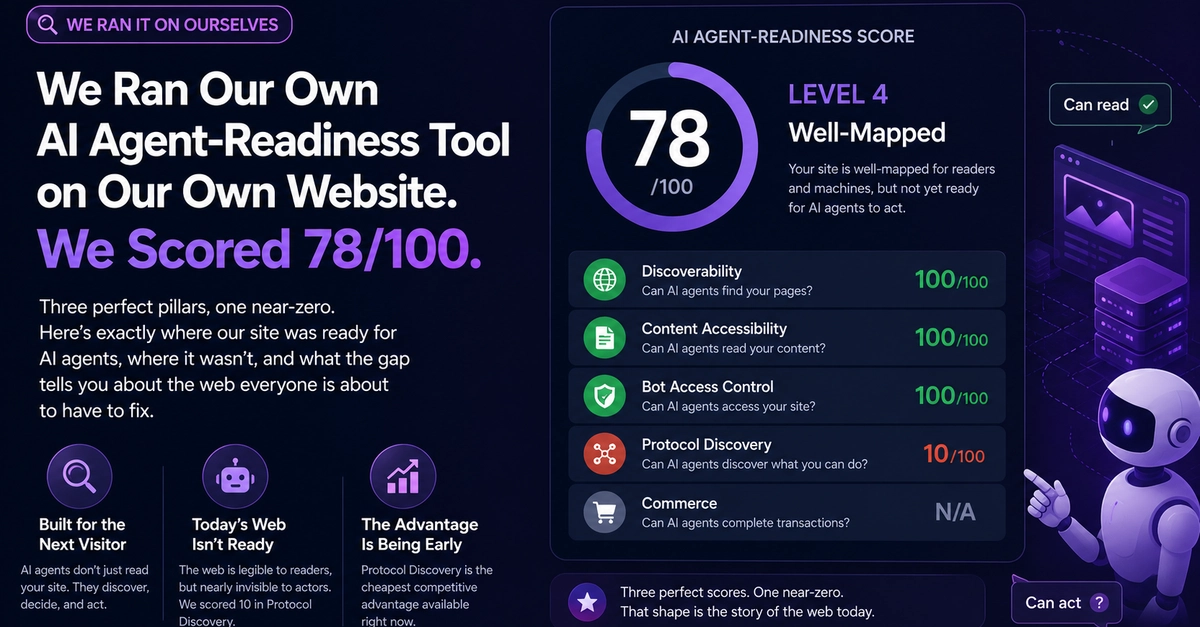
Every developer and product manager faces the moment of truth: testing the tools you build on your own systems. For Sourceable, this meant running their newly developed AI agent-readiness scanner against their own website, besourceable.com. The result? A score of 78 out of 100, a designation of Level 4 "Well-Mapped." While a respectable score, the distribution of points across the five key pillars revealed more about the current state of web AI integration than the overall number itself.
The AI agent-readiness scanner evaluates a website's ability to be effectively navigated and utilized by autonomous AI agents. This involves assessing how easily an agent can discover information, access content, understand its structure, interact with dynamic elements, and ultimately perform tasks. A score of 78 indicates a good foundation, but significant gaps remain, highlighting a common challenge for many online properties as they prepare for an agent-driven internet.
Deconstructing the Score: Five Pillars of AI Readiness
Sourceable's scanner breaks down AI readiness into five critical pillars, each scored out of 20 points for a total of 100. The website's performance across these pillars provides a granular view of its current state of AI integration:
Discoverability (100/100)
This pillar measures how easily an AI agent can find the website and understand its overall structure and purpose. A perfect score here means the website's sitemaps, robots.txt files, and meta tags are all correctly configured, providing clear signals to AI crawlers. This is foundational for any AI agent attempting to index or interact with the site. It suggests that Sourceable has a strong grasp of SEO best practices, which are directly transferable to AI discoverability.
Content Accessibility (100/100)
Achieving full marks in Content Accessibility signifies that the website's content is readily available and parseable by AI agents. This includes well-structured HTML, clear text content, and avoidance of overly complex formatting that might confuse an AI. It implies that the content is not locked behind obscure JavaScript interactions or proprietary formats that an agent would struggle to interpret. For developers, this means prioritizing semantic HTML and ensuring text content is easily extractable.
Semantic Understanding (100/100)
A perfect score in Semantic Understanding indicates that the website uses clear semantic markup and provides context that AI agents can leverage. This involves using appropriate HTML5 tags (like `
Interactive Elements (20/100)
This is where Sourceable's score took a significant hit. The scanner assesses how well AI agents can interact with dynamic elements on the page, such as forms, buttons, and interactive widgets. A score of 20 out of 100 suggests that many of these elements are not easily controllable by an AI. This could be due to non-standard JavaScript implementations, complex user flows, or a lack of clear programmatic interfaces for these elements. For developers, this highlights the need to build UIs with AI interaction in mind, perhaps by providing accessible APIs or standardized event handling for interactive components.
State Management (0/100)
The most critical failing is in State Management, where Sourceable scored a near-zero. This pillar evaluates an AI agent's ability to understand and manage the state of the website – for instance, tracking items in a shopping cart, remembering user preferences across sessions, or understanding the current step in a multi-part process. A score of zero implies that the website offers virtually no clear mechanisms for an AI to track or influence its state. This is a significant barrier for any AI agent tasked with performing multi-step processes or personalized interactions. It suggests that the website's internal state is not exposed in a machine-readable format, making it opaque to autonomous agents.
The Implications for the AI-Driven Web
The stark contrast between the perfect scores in Discoverability, Content Accessibility, and Semantic Understanding, and the abysmal scores in Interactive Elements and State Management, paints a clear picture of the current web's readiness for sophisticated AI agents. While content is largely discoverable and understandable, the ability for agents to *act* on that content or maintain context through complex interactions is severely lacking.
This isn't just a problem for Sourceable; it's a microcosm of the broader web. Many websites are built with human users in mind, relying on visual cues and intuitive (human) interaction patterns. AI agents, however, require explicit, machine-readable signals for interaction and state tracking. They don't