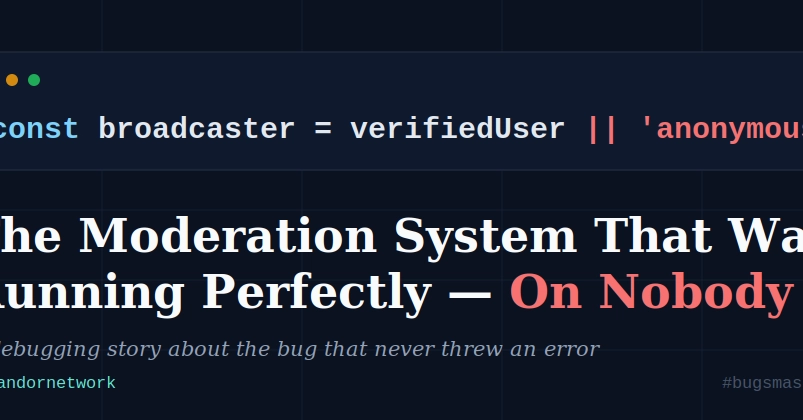
The Invisible Flaw
A solo founder, building a social platform where content moderation is the entire value proposition, discovered a bug that left no trace. The system, designed to transcribe livestreams in real time and fan them out to AI analyzers for extremism and crisis detection, appeared to function perfectly during development and even in initial testing. The broadcaster's identity, passed via a standard JWT, correctly attributed streams to their owners. Yet, the crucial function—the actual processing of live content—never occurred.
This isn't a story about a crash or a system outage. There were no error logs, no user complaints, and no visible symptom of failure. Livestreams continued to play, and the analyzer modules fired as expected. The critical detail, the one that makes this bug both insidious and a masterclass in silent failure, is that the system was effectively running on nobody. The entire moderation pipeline, the core reason for the platform's existence, was processing data that never actually existed in the live environment it was meant to serve.
The setup involved real-time transcription of livestreams, with the transcribed text then being fed into various AI analyzers. Each stream's metadata, including the broadcaster's identity, was meticulously tracked. This identity information, crucial for attributing moderation actions and potentially for user-specific policies, flowed through a JSON Web Token (JWT). When a client logged in, they received a token, which then accompanied their broadcast session. This token was intended to ensure that the screening pipeline could correctly attribute everything it analyzed. This is a common and robust pattern for managing authenticated sessions and data flow in such systems.
The problem wasn't in the transcription, the AI analyzers, or the JWT authentication. It was in the pipe connecting these components. The data, seemingly flowing and processed, was never actually the *live* data. Imagine a sophisticated factory where all the lights are on, the machines are whirring, and the conveyor belts are moving, but the raw materials never enter the production line. The output is always zero, but the factory itself looks operational.
The founder, building Candor, a platform centered on content screening, described the system's apparent health: "Screening worked — I could see the analyzers firing. Everything looked healthy." This perception of health is what allowed the bug to fester undetected. The key differentiator here is not the sophistication of the AI, but the complete lack of any observable failure point. It’s the digital equivalent of a perfectly silent alarm system that never actually sounds.
Tracing the Phantom Data
The root cause, when finally uncovered, was remarkably simple yet profound. The system was configured to process data streams, but the mechanism that actually *initiated* the processing of live, incoming data was never properly engaged. It was like having a powerful engine that was never given the ignition key. The analyzers were ready, the transcription service was running, but the trigger to feed the transcribed text from live sessions into the moderation pipeline was missing or incorrectly configured.
This meant that while the founder could observe the *components* of the system working – seeing logs indicating analyzers were active, seeing the transcription service producing output – the actual connection between the live broadcast and the moderation analysis was broken. The data was being processed, but it was either test data that was manually fed, or perhaps internal state changes that mimicked data processing, rather than the actual, live content from broadcasters.
The surprise here is not that a bug existed, but that a bug could exist in such a critical system without any outward manifestation of failure. In most software development, a broken core feature would lead to errors, performance degradation, or outright crashes. Here, the system was so well-architected in its *observable* behavior that it fooled even its creator. The problem wasn't a failure to process; it was a failure to process the *correct* data, leading to an effective processing of *no* data. It’s a subtle but vital distinction that highlights the challenges of building complex, real-time systems.
Consider it less like a broken faucet that drips water, and more like a faucet that looks perfectly functional, turns on and off with the handle, but is inexplicably connected to a dry pipe. All the physical actions are correct, but the fundamental purpose is unmet.
The Human Element and the Path Forward
This situation underscores a critical challenge for solo founders and small teams: the lack of a diverse range of perspectives and testing scenarios. While the founder meticulously tested the system, the tests likely focused on individual component functionality and integration under controlled conditions. The scenario where the entire pipeline *appears* to work but processes phantom data is a complex edge case that might be missed without broader team input or more adversarial testing methodologies.
The discovery of this bug, despite its silent nature, is a testament to the founder's dedication to building a robust platform. The bug was submitted as part of DEV's Summer Bug Smash: Smash Stories, powered by Sentry, highlighting a community effort to identify and share such critical findings. The act of submitting and detailing the bug, even one that caused no immediate user harm, contributes to a collective understanding of potential failure modes in complex systems.
What this incident doesn't address is the broader psychological impact on a founder who has built what they believed to be a functional core system, only to discover it was effectively inert. The confidence derived from seeing analyzers