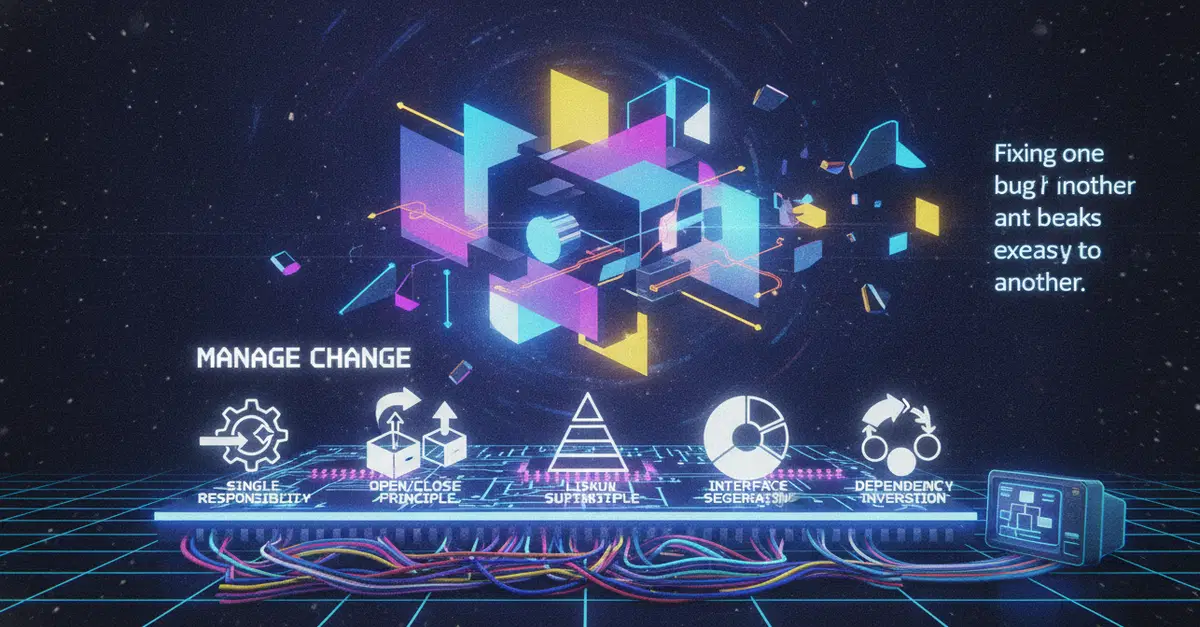
Introduction
Software development is a constant battle against entropy. Requirements change, bugs surface unexpectedly, and what seemed elegant yesterday becomes a tangled mess today. Object-Oriented Programming (OOP) offers a path toward cleaner, more manageable code, but it's not a silver bullet. Without a guiding philosophy, OOP implementations can still buckle under the pressure of evolving needs, leading to brittle codebases where fixing one issue breaks another.
This is where the SOLID principles come into play. Developed by Robert C. Martin (Uncle Bob), SOLID is not a new paradigm but a set of five design principles that, when applied consistently within an OOP context, significantly improve the maintainability, scalability, and extensibility of software systems. They provide a blueprint for designing software that not only works today but can gracefully adapt to the inevitable changes of tomorrow. Think of SOLID less as a strict set of rules and more as a set of best practices that help you build software like a skilled architect builds a skyscraper – with a deep understanding of load-bearing structures and future expansion in mind.
A Quick Recap of OOP
Before diving into SOLID, a brief refresher on core OOP concepts is useful. OOP centers around the idea of 'objects' which bundle data (attributes) and behavior (methods) together. Key pillars include:
- Encapsulation: Hiding the internal state and requiring all interaction to be performed through an object's methods. This protects the object's integrity.
- Abstraction: Simplifying complex reality by modeling classes appropriate to the problem and working at the most essential level. It hides complex implementation details.
- Inheritance: A mechanism where new classes (child classes) inherit properties and methods from existing classes (parent classes). This promotes code reuse.
- Polymorphism: The ability of an object to take on many forms. In practice, it means that a single interface can be used for a general class of actions, and different specific classes can implement these actions in different ways.
These concepts lay the groundwork for modular and reusable code. However, naive application of OOP can lead to problems. For instance, deep inheritance hierarchies can become rigid and difficult to modify. Changes to a base class can cascade unpredictably through many subclasses.
Why OOP Alone Is Not Enough
While OOP provides powerful tools, it doesn't inherently dictate how to structure your classes and their relationships for long-term maintainability. Developers can create tightly coupled classes, deeply nested inheritance, and monolithic objects that violate the spirit of modularity. The result is code that is:
- Brittle: Small changes in one part of the system cause widespread failures.
- Difficult to Test: Dependencies make it hard to isolate components for unit testing.
- Hard to Extend: Adding new functionality often requires modifying existing, working code, increasing the risk of introducing bugs.
- Rigid: The system resists change.
SOLID principles address these shortcomings by providing specific guidelines on how to organize object-oriented designs to be more flexible and understandable.
What is SOLID?
SOLID is an acronym representing five fundamental design principles:
- Single Responsibility Principle (SRP)
- Open/Closed Principle (OCP)
- Liskov Substitution Principle (LSP)
- Interface Segregation Principle (ISP)
- Dependency Inversion Principle (DIP)
Applying these principles leads to software that is easier to understand, more flexible, and more maintainable. They encourage developers to think critically about class responsibilities, relationships, and dependencies.
1. Single Responsibility Principle (SRP)
A class should have only one reason to change.
This means a class should have a single, well-defined responsibility. If a class is responsible for multiple things – say, handling user authentication and sending email notifications – it has two reasons to change. If the email sending logic needs an update, you modify that class. If the authentication logic needs an update, you modify the same class. This increases the chance of side effects. By separating these concerns into distinct classes, changes to one responsibility do not affect the other.
Consider a `User` class that also handles database persistence. If the database technology changes, the `User` class must also change. A better approach would be to have a `User` class representing the user data and a separate `UserRepository` class responsible for database operations.
2. Open/Closed Principle (OCP)
Software entities (classes, modules, functions, etc.) should be open for extension, but closed for modification.
This principle encourages you to design your classes so that you can add new functionality without altering existing code. This is often achieved through abstraction and polymorphism. For example, instead of having a large `if-else` or `switch` statement that handles different types of reports, you can create an abstract `Report` class and concrete subclasses for each report type (e.g., `PDFReport`, `CSVReport`). When a new report type is needed, you create a new subclass without touching the existing report generation logic.
The "So What?" Perspective
Developers should adopt SOLID principles to build more robust and maintainable OOP systems. Focus on single responsibilities per class (SRP) and design for extension via abstraction and polymorphism (OCP) to avoid modifying existing code. Understand that inheritance can lead to brittle hierarchies; favor composition where appropriate. Adhere to LSP to ensure substitutability of derived classes and ISP to avoid bloated interfaces.
While SOLID principles don't directly address security vulnerabilities like buffer overflows, they promote code that is easier to audit and refactor. Well-defined responsibilities (SRP) make it simpler to identify and isolate security-sensitive components. The Open/Closed Principle (OCP) can facilitate patching vulnerabilities by allowing new security logic to be added without modifying core, potentially vulnerable, code. This reduces the risk of introducing new bugs when fixing security issues.
Adopting SOLID principles leads to software that is less costly to maintain and quicker to adapt to market shifts. Reduced bug rates and faster feature iteration cycles translate directly to higher developer productivity and customer satisfaction. This architectural resilience can be a significant competitive advantage, allowing startups to pivot or scale more effectively without being burdened by technical debt.
For creators building applications, SOLID principles mean less time wrestling with code that breaks unexpectedly. Cleaner, more modular codebases allow for faster experimentation and iteration on features. When requirements change, as they inevitably do, a SOLID-compliant architecture allows creators to implement new ideas or adjust existing ones with confidence, minimizing disruption and maximizing creative output.
In data-intensive applications, SOLID principles can help manage complexity. SRP ensures that data processing, model training, and result visualization are handled by distinct components, making them easier to update or swap out. OCP allows for adding new data sources or analytical models without altering existing pipelines. DIP can help decouple data access layers from specific databases or storage solutions, improving flexibility.
Sources synthesised
- 11% Match