The Cost of Ignorance: Why Rewrites Fail
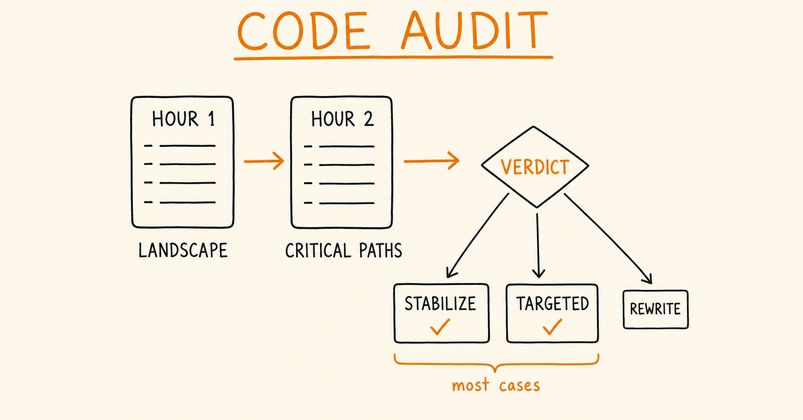
Founders often approach consultants with a seemingly simple request: "Our system is a mess, we need a rewrite. Give us an estimate." This is a red flag. A genuine technical partner doesn't provide a number after a brief chat. They demand time – at least two hours – to audit the existing codebase.
This isn't about negotiation. It's about accuracy. An estimate without an audit is a gamble. Either the consultant inflates the price to account for unknown risks, or they underestimate critical issues, leading to project derailment. Neither scenario benefits the client.
More fundamentally, most "rescue" projects don't require a complete rewrite. They need targeted fixes for the most problematic areas. The previous development efforts, which often include functional and well-architected components, should be preserved. A stabilization strategy is typically far more cost-effective and delivers a working system much faster than a full rewrite. The key is a thorough technical due diligence process.
Essential Audit Areas for Technical Due Diligence
A comprehensive technical audit before a software rewrite should focus on several critical areas. Each offers insights into the current state, potential risks, and the feasibility of alternative solutions.
Codebase Health and Complexity
This is the primary focus. We need to understand the code's structure, readability, and maintainability. Key questions include:
- Code Quality: Is the code clean, well-commented, and follow established patterns? Are there excessive code smells (e.g., long methods, large classes, duplicated code)?
- Architecture: Does the architecture support current and future business needs? Is it monolithic, microservices, or something else? Are there clear separation of concerns?
- Dependencies: What external libraries and frameworks are used? Are they up-to-date? Are there licensing issues or security vulnerabilities associated with them?
- Technical Debt: How much accumulated technical debt exists? Can it be quantified? What is the impact of this debt on development velocity and stability?
Testing and Quality Assurance
The state of testing is a direct indicator of system stability and the risk associated with changes.
- Test Coverage: What is the extent of unit, integration, and end-to-end tests? Is the coverage adequate for critical business logic?
- Test Effectiveness: Do the tests actually catch bugs? Are they reliable, or are they prone to flakiness?
- CI/CD Pipeline: Is there an automated build, test, and deployment process? How robust and efficient is it?
Infrastructure and Operations
The underlying infrastructure significantly impacts performance, scalability, and reliability.
- Deployment Process: How are applications deployed? Is it manual, automated, or semi-automated? What is the downtime during deployments?
- Scalability: Can the system handle peak loads? Are there performance bottlenecks?
- Monitoring and Logging: Are there adequate tools for monitoring system health, performance, and errors? Is logging comprehensive and structured?
- Security Posture: What are the current security practices? Are there known vulnerabilities in the infrastructure or application layer?
Team Expertise and Processes
The human element is crucial. The team's familiarity with the codebase and established processes dictates the success of any remediation effort.
- Team Knowledge: How well does the current team understand the codebase and its quirks? Is knowledge siloed?
- Development Process: What is the team's workflow? Are agile methodologies followed effectively?
- Documentation: Is there sufficient and up-to-date documentation for the system, architecture, and operational procedures?
Stabilization vs. Rewrite: Making the Call
The goal of the audit is to gather data to make an informed decision between a full rewrite and a targeted stabilization effort. A rewrite is a significant undertaking, akin to building a new house from scratch. It's expensive, time-consuming, and carries substantial risk. Stabilization, on the other hand, is more like renovating an existing house: identifying the foundation issues, fixing the leaky roof, and updating the electrical system while keeping the structure intact.
Consider these factors when deciding:
- Severity of Issues: Are the problems systemic, affecting core functionality and scalability, or are they localized bugs and performance bottlenecks?
- Business Criticality: How much of the existing system is functioning correctly and delivering business value? Can critical parts be salvaged?
- Cost and Timeline: A rewrite can take years and cost millions. Stabilization can often be completed in months, at a fraction of the cost.
- Risk Tolerance: Rewrites introduce new risks, from architectural missteps to team burnout. Stabilization carries the risk of not fully addressing underlying issues if not done meticulously.
The surprising detail here is not the complexity of the audit itself, but how often founders skip it entirely, opting for the perceived simplicity of a rewrite. This often stems from a lack of technical leadership or an underestimation of the existing system's salvageable value.
When a Rewrite is Truly Necessary
Despite the preference for stabilization, there are scenarios where a rewrite is the only viable path forward. These typically involve fundamental architectural flaws that cannot be remediated incrementally, or when the existing technology stack is obsolete and unsupported, posing significant security risks or preventing integration with modern systems.
Even in these cases, a phased approach to the rewrite, leveraging learnings from the audit, is far more effective than a big-bang replacement. The audit provides the blueprint for the new system, ensuring that the mistakes of the past are not repeated.
If you're a founder facing this decision, demand a technical audit. It's not an unnecessary delay; it's the most critical step in ensuring your software's future. The insights gained will determine whether you embark on an expensive, high-risk rewrite or a more pragmatic, cost-effective stabilization effort.