The Deceptive Simplicity of String Length
If you’ve ever built an application that posts to social media, you’ve likely encountered character limits. They seem straightforward: a string has a length, and you check if it’s below the threshold. But as developers building a cross-platform publishing API discovered, the simple .length property in JavaScript is a dangerously misleading metric when dealing with modern social networks. The reality is far more complex, with different platforms measuring content in fundamentally different ways. This discrepancy leads to posts that appear valid in development but are rejected by the API, sometimes hours after being scheduled, causing significant user frustration and broken workflows.
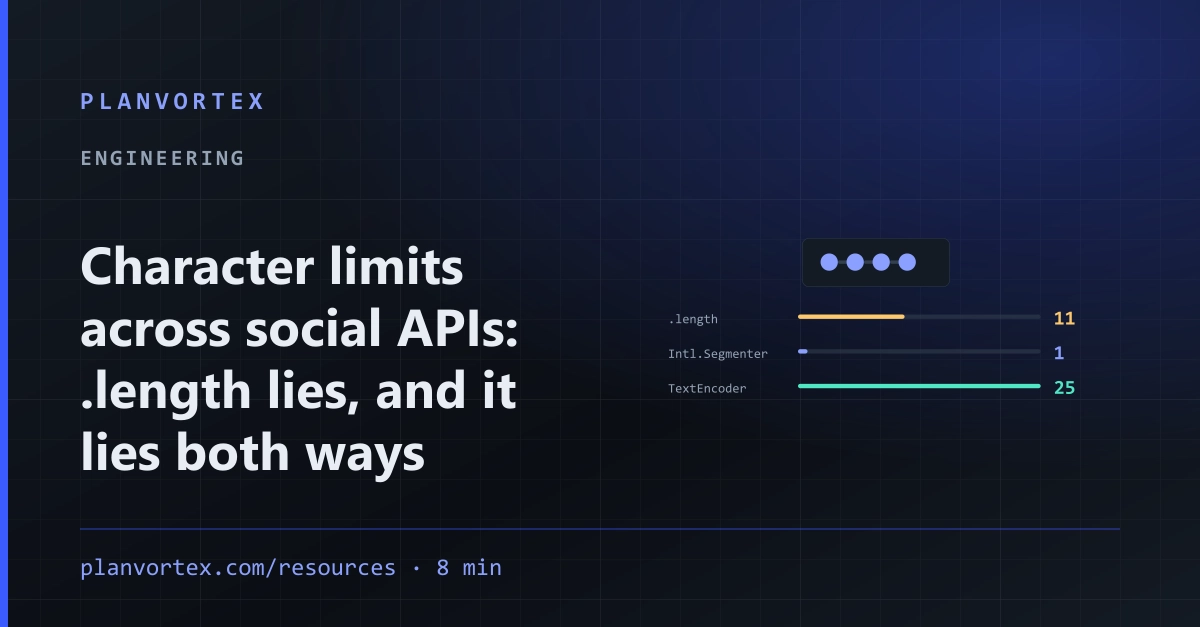
The core of the problem lies in the disconnect between what a user sees as a single character and how a computer, or more specifically, a social media API, interprets that same content. A single emoji, like the family emoji "👨👩👧👦", might render as one visual element on screen. However, under the hood, it can be composed of multiple Unicode code points (seven in this case) and can consume a significant number of bytes when encoded for transmission (25 bytes in UTF-8). Social media platforms leverage these underlying technical realities, rather than the superficial visual count, to enforce their limits.
This insight comes from direct experience: after building a publishing API that integrated with thirteen different social networks, the team found that relying on documentation alone was insufficient. They had to query the actual APIs to determine their real-world character counting mechanisms. The numbers obtained from these live API interactions painted a starkly different picture than what was advertised.
Three Units, One String
Discussions around character limits inevitably circle back to the units of measurement. For social media APIs, three primary units are relevant:
- Visual Characters (Grapheme Clusters): This is what the end-user perceives as a single character. It includes letters, numbers, punctuation, and complex emoji sequences that form a single visual unit.
- Unicode Code Points: These are the fundamental building blocks of Unicode. Many characters, especially advanced emojis or characters with modifiers, are represented by multiple code points. For example, skin tone modifiers or ZWJ (Zero Width Joiner) sequences can increase the code point count of what appears to be a single character.
- Bytes (UTF-8 Encoding): This is the measure of how much space the string occupies in memory or during transmission, typically using UTF-8 encoding. Basic ASCII characters take up 1 byte, while more complex characters and symbols can consume 2 to 4 bytes each.
A fourth unit, the JavaScript .length property, often appears relevant but is deceptive. In JavaScript, .length typically returns the number of UTF-16 code units. For most common characters, this aligns with the number of Unicode code points. However, for characters that require more than one UTF-16 code unit (surrogate pairs), .length will overcount. This is particularly problematic for characters outside the Basic Multilingual Plane (BMP), which includes many emojis and less common symbols.
The critical takeaway is that each social network may prioritize one of these units, or a combination, when enforcing its content length policies. A platform might count visual characters, code points, or byte size. Some might even have different limits for different types of content within a single post.
The API's Real-World Measurement
The practical implications of these differing measurement strategies are significant for developers. When building a unified publishing tool, the challenge is to create a system that can accurately predict how a given piece of content will be treated by each target platform. Simply checking content.length against a documented limit is insufficient because:
- Underestimation: If an API counts byte length and your content contains many multi-byte characters (like complex emojis), your post might exceed the limit even if
.lengthsuggests it’s fine. This leads to unexpected API rejections. - Overestimation: Conversely, if an API counts visual characters or code points, and your content uses many single-byte characters, you might be artificially limiting your posts based on a
.lengththat is higher than the API’s actual constraint. This results in posts that could have been longer being truncated unnecessarily. - Scheduled Post Failures: The most frustrating scenario is when a post is accepted by the API at the time of submission but later fails during the scheduled publishing window. This can happen if the API’s validation logic changes or if the character counting mechanism is applied differently at the time of execution versus submission.
The team behind the publishing API found that the stated limits in official documentation were often inaccurate or incomplete. The only reliable method was to perform live tests against each platform’s API endpoints. This involved submitting content of varying lengths and character compositions to observe the actual acceptance or rejection responses. This empirical approach is essential for any application that needs to reliably post to multiple social networks.
Navigating the Quagmire
For developers, this means implementing robust, platform-specific validation logic. It’s not enough to have a single function that checks string length. Instead, a comprehensive publishing API must:
- Maintain a Database of Actual Limits: This database should store the empirically verified limits for each platform, specifying whether the limit is based on characters, code points, or bytes.
- Implement Platform-Specific Encoding and Counting: Before submitting content, the API must correctly encode the string (e.g., to UTF-8) and then count its length according to the specific rules of the target platform.
- Provide Real-time User Feedback: The user interface should offer a dynamic character count that updates based on the selected platform, giving users an accurate preview of whether their post will be accepted.
- Handle Edge Cases and API Quirks: Be prepared for unexpected behavior, such as different limits for text versus links, or varying character counts for media attachments.
The surprise here is not that APIs have limits, but how deeply inconsistent and technically nuanced those limits are. The simple .length property is a false friend, a relic of a less complex text-handling era that doesn't map cleanly onto the sophisticated, Unicode-rich, and byte-conscious world of modern social media platforms. If you manage a team building such integrations, you need to treat character limits as a complex, multi-dimensional problem, not a simple string property check.
What Comes Next?
The fundamental question that remains is whether social media platforms will ever standardize their character counting mechanisms. Given the historical divergence and the technical underpinnings of each platform’s infrastructure, a unified approach seems unlikely in the short term. This leaves developers in a perpetual state of reverse-engineering and adaptation. For users of these publishing tools, the expectation should be for intelligent, platform-aware feedback, rather than a generic character count. The burden of understanding these nuances has fallen squarely on the shoulders of the developers building the tools, and it’s a task that requires diligence and a healthy skepticism of simple metrics.