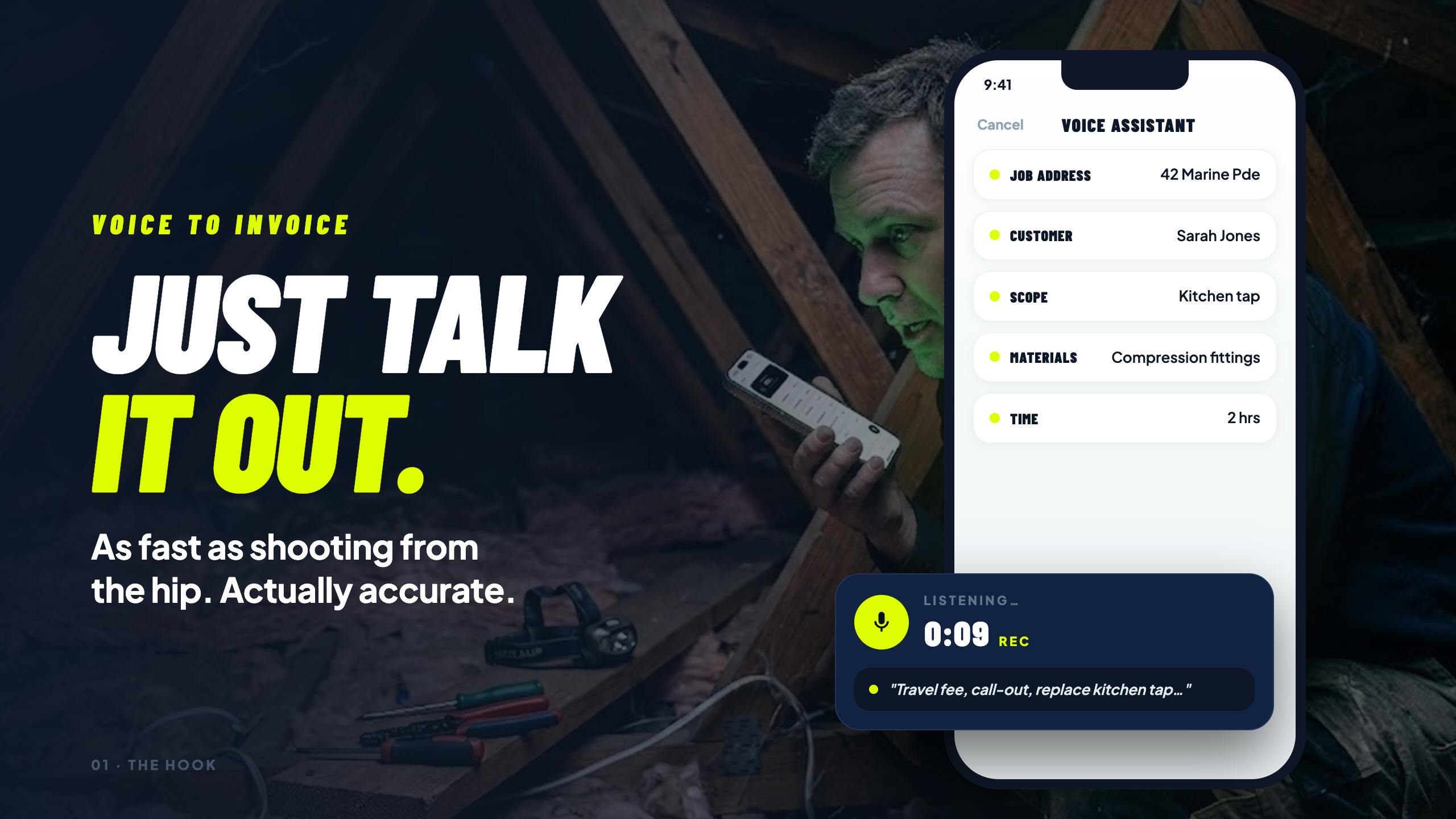
From Speech to Sales: The SMASH Voice to Invoice Proposition
In the fast-paced world of sales and small business operations, efficiency is paramount. Every second saved on administrative tasks is a second gained for closing deals or serving clients. SMASH Voice to Invoice emerges as a new contender in this arena, promising to drastically cut down the time it takes to create and dispatch quotes. The core proposition is simple: speak your quote details, and the tool handles the rest, transforming spoken words into a professional, sendable invoice or quote.
This approach directly targets a common bottleneck for freelancers, small business owners, and sales professionals. Traditionally, generating a quote involves opening accounting software or a document, manually typing in client details, item descriptions, quantities, prices, and then formatting it for professional delivery. This process, while standard, can be tedious and time-consuming, especially for on-the-go interactions or when dealing with numerous small sales. SMASH aims to bypass this entirely, leveraging voice recognition technology to capture the essential information.
How SMASH Voice to Invoice Works
The mechanics behind SMASH Voice to Invoice are designed for speed and simplicity. Users initiate the process by speaking into their device. The application listens and transcribes the spoken content, intelligently parsing out key information required for a quote. This includes client names, contact details, descriptions of services or products, quantities, and pricing. The system is built to understand natural language, meaning users don't need to adhere to rigid command structures.
Once the necessary details are captured, SMASH Voice to Invoice compiles them into a formatted quote or invoice. Users can then review, edit if necessary, and send the document directly to their client. The platform aims to integrate seamlessly into existing workflows, reducing the friction associated with traditional quoting processes. The speed advantage is significant; what might take several minutes of typing can potentially be accomplished in seconds of dictation.
Target Audience and Use Cases
The primary beneficiaries of SMASH Voice to Invoice are likely to be independent contractors, freelancers, consultants, and small business owners who juggle multiple roles. For these individuals, time is often their most valuable asset. The ability to quickly generate a quote immediately after a client conversation, without needing to sit down at a computer, offers a tangible competitive advantage. Imagine finishing a client meeting and, while walking to your car, dictating the quote details and having it ready to send before you even reach your desk.
Beyond solo operators, sales teams in smaller enterprises could also find value. Sales representatives often need to provide quotes rapidly to keep momentum. SMASH could empower them to generate initial quotes on the spot, providing a prompt response to potential customers. This immediacy can be a deciding factor in winning new business. Furthermore, for individuals who find extensive typing cumbersome or prefer verbal communication, the tool offers an accessible alternative to traditional invoicing software.
Potential Benefits and Limitations
The most apparent benefit of SMASH Voice to Invoice is the dramatic reduction in time spent on administrative tasks. This increased efficiency can lead to faster payment cycles and improved cash flow for small businesses. The intuitive, voice-first interface lowers the barrier to entry, making quote generation accessible to a broader range of users, including those less comfortable with complex software. The conversational nature of the input may also lead to more detailed and accurate quote descriptions, as users can naturally elaborate on services or products.
However, the effectiveness of such a tool hinges critically on the accuracy of its voice recognition and natural language processing. Misinterpretations of spoken words, especially concerning numbers, prices, or specific product names, could lead to errors in the generated quotes. Users might still need to meticulously review and edit the output, potentially negating some of the time savings. The sophistication of the platform in handling complex pricing structures, taxes, discounts, and custom terms will also be a key determinant of its utility. For highly technical products or services with intricate specifications, voice dictation might prove less precise than detailed written input.
The Future of Voice-Assisted Business Administration
SMASH Voice to Invoice represents a step towards a more integrated voice-first approach in business operations. As voice recognition technology continues to advance, tools like this could become standard. The ability to manage more aspects of business administration through spoken commands – from scheduling appointments to tracking expenses and sending invoices – holds the potential to fundamentally change how small businesses operate. The challenge for SMASH, and similar ventures, will be to achieve near-perfect accuracy and to offer a robust feature set that competes with established, albeit more labor-intensive, solutions. The success of SMASH Voice to Invoice will likely depend on its ability to prove that speaking a quote is not just faster, but also as reliable and professional as typing one.