The Rise of Specialized AI Agents
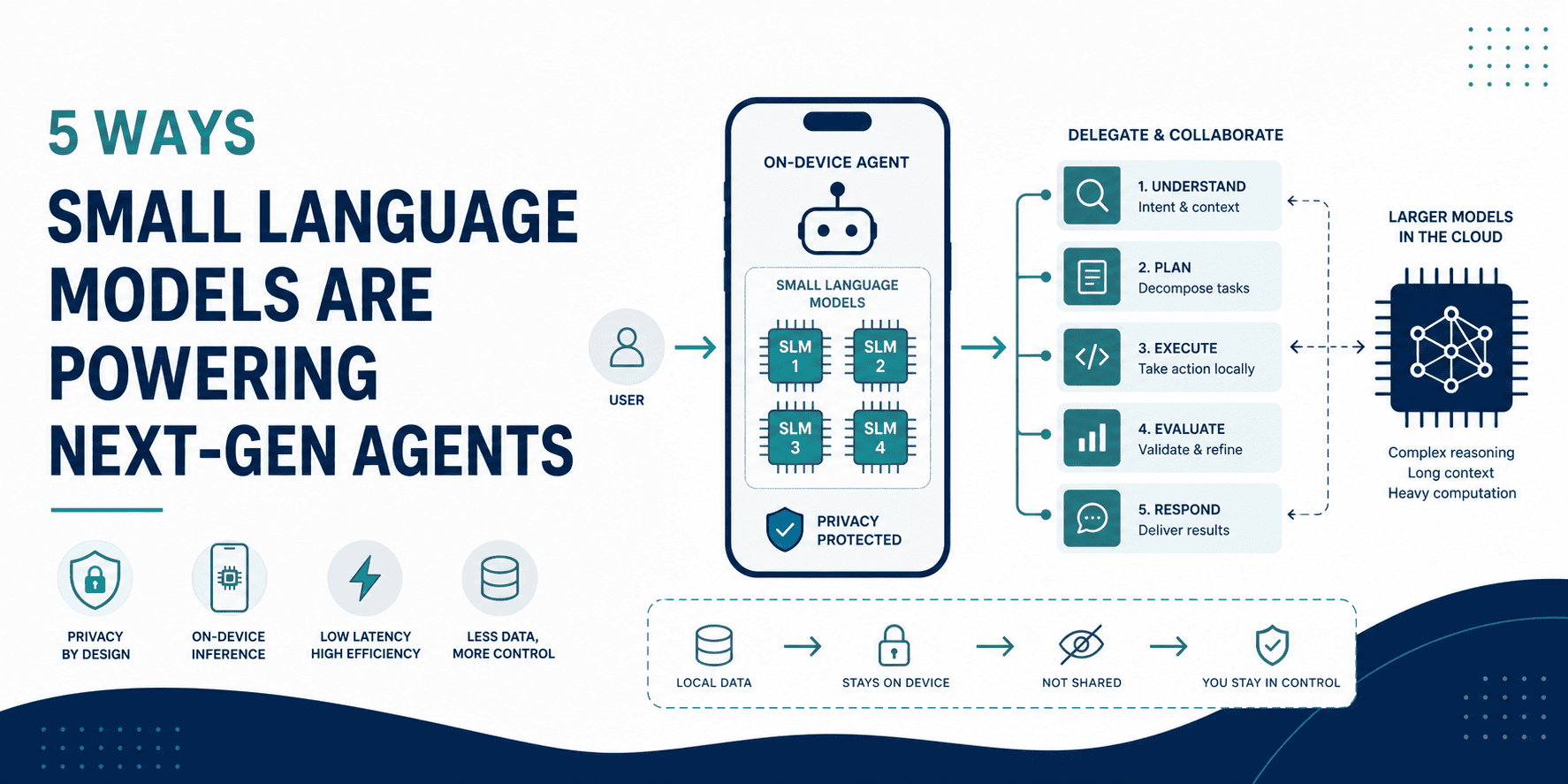
The pursuit of more capable and efficient AI agents is accelerating, and a quiet revolution is underway: the ascent of Small Language Models (SLMs). While large language models (LLMs) like GPT-4 capture headlines with their broad capabilities, SLMs are proving to be the workhorses powering the next generation of specialized AI agents. These leaner, more focused models offer a compelling alternative, providing significant power without the massive computational cost, latency, and deployment complexity associated with their larger counterparts. This shift is not about replacing LLMs entirely, but about recognizing where their specialized strengths can shine, enabling AI agents to perform specific tasks with remarkable precision and speed.
For developers and founders building AI agents, the decision between an LLM and an SLM is becoming critical. It’s a trade-off between raw, general intelligence and tailored, efficient performance. SLMs are not simply scaled-down versions of LLMs; they are often trained on specific datasets or optimized for particular tasks, allowing them to achieve high accuracy in their domain while remaining compact. This makes them ideal for deployment on edge devices, in resource-constrained environments, or for applications demanding near-instantaneous responses. The research backing these models is rapidly evolving, with new architectures and training techniques emerging that further enhance their capabilities.
1. Enhanced Task-Specific Reasoning and Planning
One of the most significant applications of SLMs in next-gen agents is their ability to excel at task-specific reasoning and planning. Unlike general-purpose LLMs that must parse and understand a vast range of concepts, SLMs can be trained to deeply understand a particular domain or a set of related tasks. For example, an agent designed for customer support could leverage an SLM fine-tuned on company FAQs, product manuals, and past support tickets. This specialization allows the SLM to quickly identify the user's intent, retrieve relevant information, and formulate a precise response or plan of action, often outperforming a general LLM in speed and accuracy for that specific context.
Consider an agent tasked with orchestrating complex workflows. A general LLM might struggle to maintain context or make optimal decisions across multiple steps due to its broad knowledge base. An SLM, however, can be trained on the specific rules, dependencies, and success criteria of a particular workflow. It can then act as a highly efficient planner, breaking down a complex request into discrete, actionable steps, predicting potential roadblocks, and dynamically adjusting the plan in real-time. This focused reasoning capability is crucial for agents that need to interact with external tools, APIs, or even physical systems.
2. Efficient Tool Use and API Orchestration
Modern AI agents often need to interact with a variety of external tools and APIs to perform actions in the real world or access up-to-date information. SLMs are proving to be incredibly effective in this capacity. Their smaller size and focused nature make them ideal for quickly parsing tool documentation, understanding function signatures, and generating the correct parameters for API calls. This is a significant advantage over larger models, which can be slower and more prone to generating extraneous or incorrect arguments when asked to use tools.
For instance, an agent that needs to book flights, check weather forecasts, and send calendar invites requires precise interaction with multiple distinct APIs. An SLM fine-tuned on the schemas and interaction patterns of these specific APIs can reliably translate a user's request into a sequence of API calls. This not only reduces latency, as the SLM doesn't need to load or process a massive model, but also improves reliability. If an agent relies on a specific set of tools, dedicating an SLM to manage those interactions can lead to a more robust and predictable system. This is akin to having a specialized assistant who is an expert in only one or two critical functions, rather than a generalist who knows a little about everything.
3. On-Device and Edge AI Capabilities
The ability to run AI models locally on devices, rather than relying solely on cloud-based processing, is a major trend in AI development. SLMs are at the forefront of this movement. Their reduced computational requirements and smaller memory footprint make them suitable for deployment on smartphones, embedded systems, IoT devices, and other edge computing platforms. This enables new categories of AI agents that can operate offline, provide instant feedback, and enhance user privacy by keeping data processing local.
Imagine an agent embedded in a smart home device that controls lighting and temperature based on user presence and preferences. Running a large LLM for this would be impractical due to power consumption and connectivity requirements. An SLM, however, can be optimized to run efficiently on the device's hardware, processing sensor data and user commands in real-time. Similarly, agents in wearable technology or industrial sensors can leverage SLMs to perform local analysis, anomaly detection, or command recognition, sending only critical alerts or summarized data to the cloud. This decentralization of AI processing is a key enabler for ubiquitous AI agents.
4. Personalized User Experiences and Assistants
Personalization is a hallmark of effective AI agents, and SLMs are well-suited to delivering highly tailored experiences. By training an SLM on an individual user's historical data, preferences, communication style, and specific needs, agents can become remarkably attuned to their user. This allows for more nuanced understanding, proactive assistance, and a more natural, human-like interaction.
An example is a personal productivity agent. An SLM could learn a user's preferred meeting scheduling times, their typical response patterns to emails, and their project priorities. It could then proactively suggest meeting slots that align with their calendar and preferences, draft email responses in their typical tone, and prioritize tasks based on learned importance. This level of deep personalization, built on a foundation of efficient, task-specific understanding, is something that can be challenging to achieve with a monolithic LLM that is trying to serve millions of diverse users simultaneously. The SLM, in this context, acts like a dedicated personal assistant who has spent years learning your habits and anticipating your needs.
5. Cost-Effective Deployment and Scalability
Beyond technical capabilities, the economic advantages of SLMs are a significant driver for their adoption in next-gen agents. Deploying and running large language models can be prohibitively expensive, both in terms of hardware infrastructure and inference costs. SLMs drastically reduce these barriers, making advanced AI agents accessible to a wider range of businesses and developers.
The cost of inference—the process of generating an output from a trained model—is directly proportional to the model's size and complexity. Smaller models require less computational power, meaning lower electricity bills, less specialized hardware, and the ability to serve more users with the same infrastructure. For startups or companies operating on tighter budgets, this cost-effectiveness is paramount. Furthermore, the scalability of agent deployments is enhanced. It's easier and cheaper to scale up the number of SLM-powered agents serving a user base compared to scaling up a fleet of LLM instances. This economic advantage allows for more experimentation, broader deployment, and ultimately, more widespread adoption of AI agents across various industries.
The Future of Agentic AI
The trend towards SLMs in AI agents signifies a maturation of the field. It reflects an understanding that optimal performance often comes from specialization rather than brute-force generalization. As research continues to push the boundaries of what SLMs can achieve, we can expect them to become even more integral to the development of sophisticated, efficient, and accessible AI agents. The choice between an LLM and an SLM will increasingly depend on the specific task, the operational environment, and the desired balance of capability, cost, and performance.