The Enduring Legacy and Unforeseen Limitations of SM-2
For decades, the SuperMemo 2 (SM-2) algorithm has formed the bedrock of spaced repetition software (SRS), notably powering popular tools like Anki. Published in 1987 by Piotr Wozniak, SM-2's durability is a testament to its core concept: showing users information at increasing intervals to maximize long-term retention. It's a system that has demonstrably helped millions learn languages, master complex subjects, and recall vast amounts of information. However, as decks grow and usage patterns evolve, the algorithm's original design reveals specific, predictable flaws that can undermine its effectiveness. The core issue isn't that SM-2 is fundamentally broken, but rather that its assumptions, made in a pre-internet era, don't scale perfectly to the demands of modern, large-scale learning.
At its heart, SM-2 operates on a simple principle: each piece of information (a 'card') has an associated 'ease factor' and an 'interval' before its next review. When a user reviews a card, they assign a quality rating (typically 0-5). A successful review (rating 3 or higher) increases the interval before the next review, and the ease factor is adjusted downwards slightly. A failed review (rating 0-2) resets the interval to a short period (often 1 day) and the ease factor is significantly decreased. This feedback loop is intended to adapt to the user's learning speed for each individual card.
How SM-2 Adapts, and Where It Stumbles
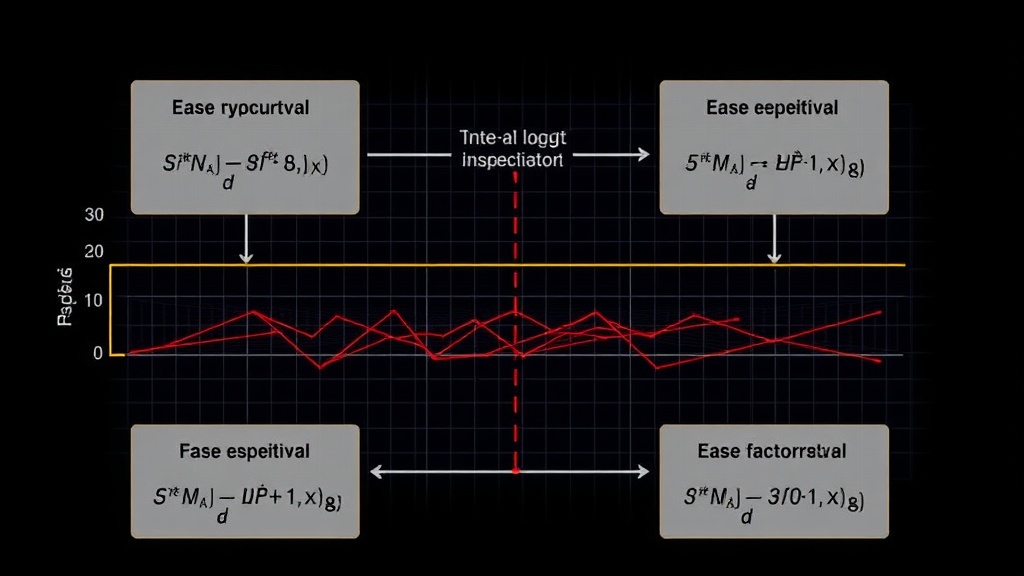
The algorithm's core strength lies in its adaptive nature. For cards you find easy, the interval grows rapidly. For cards you struggle with, the interval remains short, forcing frequent repetition until mastery is achieved. This is why tools like Anki are so effective for rote memorization tasks. The ease factor acts as a multiplier; a higher ease factor means the interval grows faster after a successful review. Conversely, a lower ease factor means the interval grows more slowly, or even resets, when you falter.
The problem emerges when a user accumulates a large number of cards. SM-2's approach to failure is to aggressively shorten the interval and reduce the ease factor. While this is effective for individual cards that are consistently difficult, it doesn't account for a common scenario: a card that was difficult *once*, or a card that is difficult due to external factors (e.g., fatigue, distraction, a complex aspect of the topic that only appears in certain contexts). In such cases, SM-2's punitive response can lead to that card being shown far more frequently than necessary, consuming valuable review time that could be better spent on genuinely challenging material.
The 'Ease Factor' Trap and Over-Repetition
Consider a user studying a complex subject like advanced physics or a dense historical period. They might encounter a particularly thorny concept. They rate it a '2' or '3', and SM-2 responds by drastically reducing the ease factor and interval. The next day, the user, having slept on it or with a fresh perspective, finds the concept now intuitively clear. They rate it a '5'. However, because the ease factor was so aggressively reduced, the interval might only grow from 1 day to 2 days, then perhaps 3 days. This card, which is now easily understood, will continue to resurface at short intervals for an extended period, disproportionate to its actual difficulty for the user at that moment.
This phenomenon is akin to a diligent student being forced to re-read the first chapter of a textbook every other day, even after they've internalized its content, simply because they once struggled with a single sentence. The algorithm's memory of past difficulty, while essential, doesn't always weigh current understanding sufficiently. This leads to what can be described as 'over-repetition' for certain cards, a significant drain on a user's limited study time, especially when managing thousands of cards.
Beyond SM-2: The Need for More Nuanced Algorithms
The SM-2 algorithm was designed for a world where digital flashcards were a novelty, and the scale of digital learning was vastly different. It prioritizes simplicity and a robust fallback mechanism. However, modern learning environments, particularly those involving complex, interconnected knowledge, demand more sophistication. Algorithms that can better distinguish between persistent, fundamental misunderstandings and transient difficulties, or those that account for the context of a review session (e.g., user fatigue, time constraints), would offer a significant improvement.
Research into alternative spaced repetition algorithms has explored various avenues. Some approaches aim to incorporate more sophisticated models of memory decay, while others attempt to predict user performance based on broader patterns rather than just individual card history. For instance, an algorithm might consider the topic of the card, the user's overall performance on related cards, or even the time of day. The goal is to create a system that is not just durable, but also optimally efficient, ensuring that review time is allocated where it yields the greatest learning benefit. This is especially crucial for professional development, where time is often the most constrained resource.
Implications for Learners and Developers
For the millions of users relying on SM-2-based tools, this analysis suggests a need for awareness. If you find yourself spending an inordinate amount of time reviewing cards that you feel you already know well, it might be SM-2's limitations at play. Strategies like manually resetting ease factors or using filtered decks for specific topics can offer some relief, but they are workarounds rather than fundamental solutions.
For developers building the next generation of learning tools, the message is clear: while SM-2 is a robust starting point, it's time to explore beyond its 1987 architecture. Innovations in machine learning and cognitive science offer opportunities to build more intelligent, adaptive, and efficient learning systems. This means moving beyond simple interval and ease factor adjustments to incorporate richer user modeling, contextual awareness, and more sophisticated memory models. The future of effective digital learning lies in algorithms that understand not just what needs to be remembered, but how and when it is best remembered by an individual learner, adapting dynamically to their evolving knowledge and cognitive state.