The Context Switching Crisis
Context switching is the silent killer of developer productivity. It’s not just about the time spent on a new task; the real cost is the cognitive overhead of re-orienting after each interruption. Studies suggest that when Work In Progress (WIP) limits are ignored, the biggest loss isn't the extra tasks themselves, but the time it takes to get back into the flow after each forced switch. This phenomenon can inflate the cost of interruptions by as much as 30%, turning efficient development teams into disjointed task-hoppers.
The core problem lies in the conflict between the 'manager schedule' and the 'maker schedule.' Managers operate in 30-minute blocks, available for spontaneous meetings and quick questions. Developers, on the other hand, require unbroken 'maker' blocks of at least two hours to achieve deep work, to truly immerse themselves in complex problem-solving. When these maker schedules are constantly fractured by the demands of a manager schedule—stand-ups, ad-hoc requests, instant messages—productivity plummets.
The solution isn't to eliminate all interruptions, which is often impossible. Instead, it's about organizing work to either eliminate them entirely or, more practically, to confine them to predictable batches. This approach aims to protect those crucial deep work periods and prevent the cognitive fatigue that arises from constant task switching.
Mapping Your Current Flow
The first step to reducing context switching is understanding your current workflow. This involves a detailed mapping of daily activities. Grab a whiteboard and list every task a developer performs: coding, code reviews, daily stand-ups, responding to Slack messages, checking emails, attending unplanned meetings, and any other recurring activity. Once listed, tag each activity as either "interruptible" or "deep work." This exercise provides a visual map of your team's current state, highlighting where the precious maker schedule blocks are being invaded. It clearly shows which activities are essential and which are contributing to fragmentation.
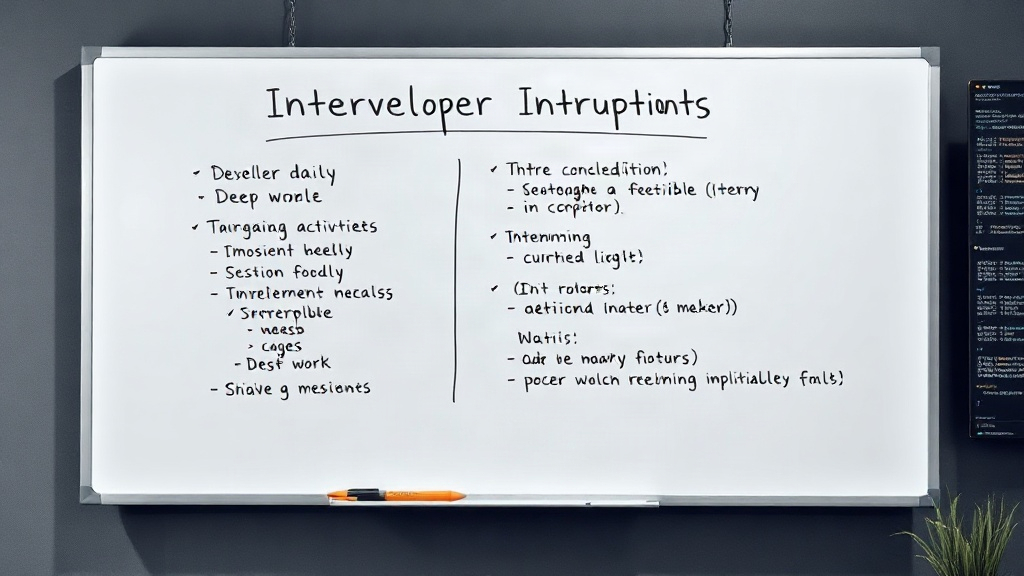
This mapping is critical. It moves the conversation from abstract complaints about interruptions to concrete data about where and when they occur. It identifies the friction points and sets the stage for implementing targeted strategies.
Implementing Batching Strategies
Once the current flow is mapped, the next step is to strategically batch similar tasks. This means grouping activities that require similar cognitive states and performing them together, rather than scattering them throughout the day. Consider these common batching opportunities:
Code Reviews
Code reviews are a prime candidate for batching. Instead of reviewing a pull request the moment it appears, establish dedicated time slots for reviews. This might mean setting aside two 1-hour blocks per day, or even a larger block every other day, for all team members to submit and review code. This allows developers to focus on writing code without immediate interruption and then dedicate their attention fully to understanding and critiquing submitted code in a focused session. Limiting the number of pull requests a developer is assigned to review at any one time (WIP limits for reviews) can also prevent them from becoming overwhelmed and switching contexts too frequently between reviewing and coding.
Communication and Notifications
Slack, email, and other communication channels are notorious for breaking concentration. While immediate responses are sometimes necessary, they are rarely required for most internal communications. Developers can benefit from disabling notifications for extended periods and checking messages in batches. This could mean checking messages only at the start and end of a deep work block, or during designated 'communication windows.' The key is to avoid letting a ping dictate the developer's attention. For urgent matters, establish clear protocols for truly time-sensitive issues that bypass standard channels.
Meetings and Stand-ups
While stand-ups are often daily, their duration and necessity should be constantly evaluated. Can they be done asynchronously? Could they be less frequent? Similarly, scrutinize all other recurring meetings. Can several smaller meetings be consolidated into one longer, more efficient session? Can some meetings be replaced with a shared document or an asynchronous update?
Work In Progress (WIP) Limits: The Unseen Guardrail
Perhaps the most powerful tool for reducing context switching is the implementation of strict WIP limits. WIP limits restrict the number of tasks a developer or a team can be actively working on simultaneously. This is not about limiting output; it's about improving flow and reducing the cost of task switching. When a developer has only one or two tasks in progress, they can maintain focus. As soon as a task is completed, they can pick up the next one without the mental churn of trying to remember where they left off on multiple other items.
Think of WIP limits like a highway with a limited number of lanes. If too many cars try to enter at once, traffic grinds to a halt. With limited lanes (WIP), cars move more smoothly, and the overall journey is faster and less stressful. Applying this to development means that when a task is finished, the team's focus immediately shifts to completing the next available item, rather than starting something new prematurely. This forces prioritization and completion, directly combating the fragmentation caused by too many partially done tasks.
When WIP limits are consistently adhered to, the cost associated with re-orienting after task switches is dramatically reduced. Developers can dedicate their cognitive resources to solving problems rather than managing task transitions. This leads to higher quality code, faster delivery cycles, and a more sustainable pace of work.
Protecting the Maker Schedule
The ultimate goal is to protect the 'maker schedule' – those uninterrupted blocks of time essential for deep, productive work. This requires a cultural shift within the team and the organization. Management must understand and respect the need for focused work. This means:
- Scheduling strategically: All meetings should be scheduled outside of designated maker blocks. If a meeting is absolutely essential during a maker block, it should be considered an exceptional event, not the norm.
- Empowering developers: Developers should feel empowered to push back politely on interruptions that fall outside of agreed-upon communication protocols or batching schedules.
- Leading by example: Managers should also adopt batching for their own tasks and communications, demonstrating the value of focused work.
By consciously mapping workflows, batching similar tasks, implementing strict WIP limits, and actively protecting maker schedules, development teams can significantly reduce context switching. This doesn't just improve productivity; it fosters a healthier, more sustainable, and ultimately more effective development environment.