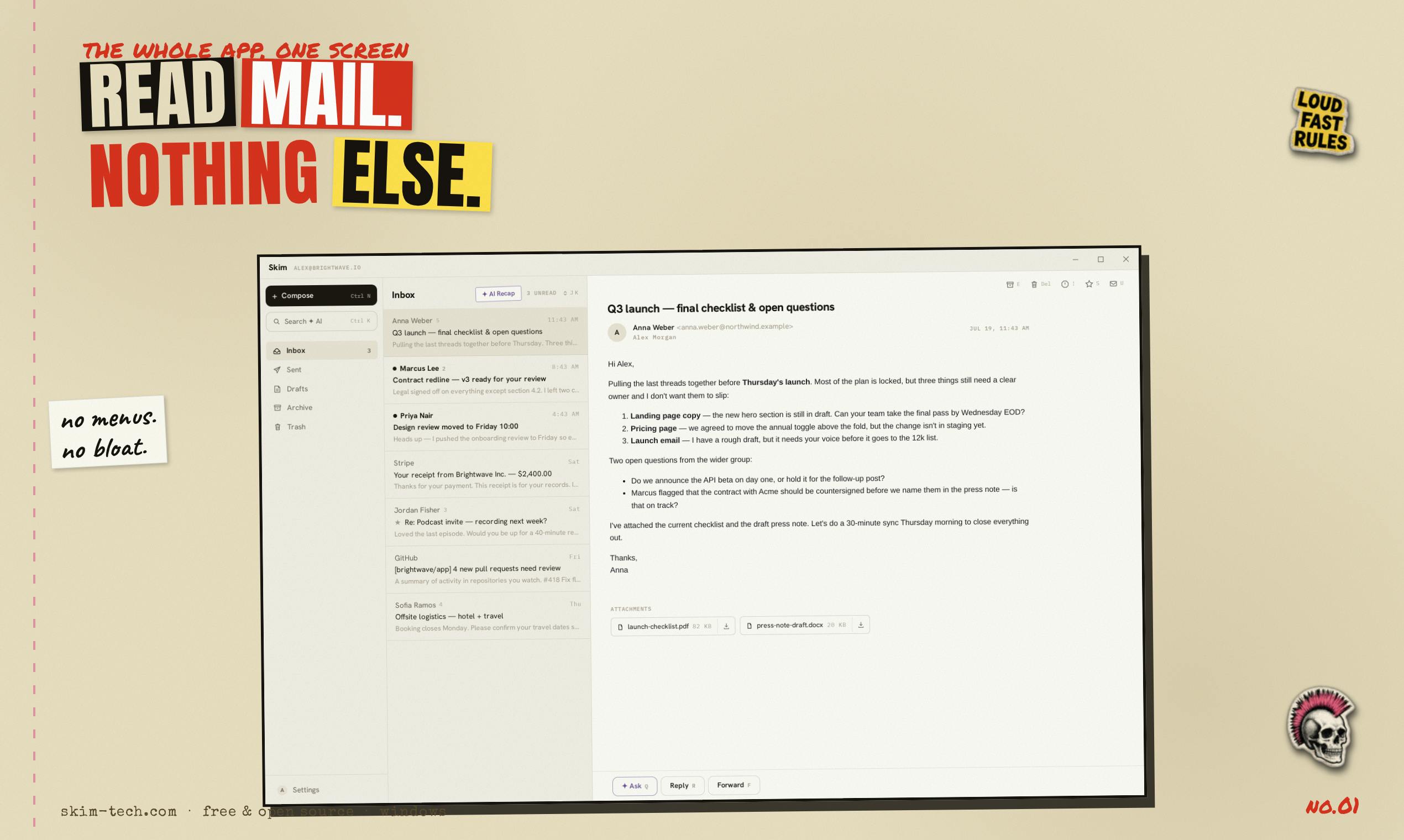
Skim: A New Contender in the AI Email Client Space
The email client landscape, long dominated by giants like Outlook, Gmail, and Thunderbird, is seeing a new challenger emerge. Skim, a free and open-source AI-powered email client, has launched for Windows, promising to bring intelligent features to the desktop. While many existing clients offer integrations with AI services or basic smart sorting, Skim positions itself as an AI-first experience, aiming to fundamentally change how users interact with their inboxes.
The core proposition of Skim is to leverage artificial intelligence to reduce the cognitive load associated with managing email. In an era where inboxes can easily become overwhelming repositories of information, tasks, and communications, Skim aims to act as an intelligent assistant, helping users prioritize, summarize, and respond more efficiently. This approach is a significant departure from traditional email clients that primarily focus on robust functionality and customization without deep AI integration at their core.
Unlike proprietary solutions that often come with subscription fees or opaque data handling policies, Skim's open-source nature offers transparency and community-driven development. This means users can inspect the code, contribute to its improvement, and trust that their data is not being used for undisclosed purposes. For developers and privacy-conscious users, this is a critical differentiator.
Intelligent Inbox Management Features
Skim's AI capabilities are designed to tackle several common pain points of email management. While specific technical implementations are not detailed in initial announcements, the stated goals point towards features that could include:
- Smart Summarization: AI models could process long email threads and provide concise summaries, allowing users to quickly grasp the essence of a conversation without reading every message.
- Priority Inbox: Beyond simple sender-based rules, Skim's AI could learn user priorities, identifying and surfacing the most critical emails based on content, sender importance, and urgency.
- Automated Responses: For routine inquiries or acknowledgments, AI could suggest or even draft replies, saving users significant time.
- Action Item Extraction: The client might identify tasks or action items mentioned within emails and help users track them, potentially integrating with to-do list applications.
- Spam and Phishing Detection: Advanced AI could offer more sophisticated detection of malicious emails than traditional filters, learning from a broader range of patterns.
The promise of an AI-first email client is to move beyond the inbox as a mere message repository and transform it into a dynamic productivity hub. Imagine an email client that doesn't just display your messages but actively helps you understand, act upon, and clear them with minimal effort. This is the vision Skim is working towards.
The Open-Source Advantage
The decision to make Skim open-source is a strategic one. It lowers the barrier to entry for users who are wary of closed-source software, especially when dealing with sensitive personal or professional communications. It also fosters a community of developers who can contribute to bug fixes, new features, and security enhancements. This collaborative model can lead to more robust and adaptable software compared to single-company development.
For developers, an open-source AI email client presents an interesting platform. It could serve as a foundation for building custom integrations or specialized AI models tailored to specific industries or workflows. The transparency of the codebase allows for a deeper understanding of how the AI components function, which is crucial for debugging and trust.
The development of Skim aligns with a broader trend of open-source AI tools gaining traction. As AI models become more accessible, developers are increasingly looking for open platforms to build upon, rather than being locked into proprietary ecosystems. This movement democratizes AI development and empowers a wider range of users and organizations.
What This Means for the Email Client Market
Skim's entry into the market, particularly with its AI-centric, open-source approach, poses an interesting challenge to established players. While incumbents like Microsoft Outlook and Google Workspace are integrating AI features, they often do so within a subscription model or as part of a larger cloud suite. Skim offers a standalone, free alternative that prioritizes AI at the fundamental level of client operation.
For users, this presents a choice: stick with established, feature-rich clients that may offer AI as an add-on, or adopt a newer, AI-native client that is open-source and free. The success of Skim will likely depend on the effectiveness of its AI features in practice and its ability to build a loyal user base through community engagement and continuous improvement.
The surprising detail here is not the existence of another email client, but its explicit positioning as an AI-first, open-source solution for Windows. This combination targets a specific, growing segment of the user base that values both intelligent automation and software transparency. It prompts the question: will more traditional email providers be forced to accelerate their AI integrations or consider more open development models to compete?
The Road Ahead
As Skim matures, its developers will need to focus on delivering on the promise of effective AI assistance without introducing new complexities or performance issues. The challenge of building AI that genuinely enhances user experience, rather than merely adding features, is significant. Early adoption will be key, and user feedback will undoubtedly shape the future direction of the project.
For Windows users looking for a smarter way to manage their email, Skim represents a compelling new option. Its open-source nature and AI-driven philosophy set it apart, making it a project worth watching for anyone interested in the future of personal productivity software.