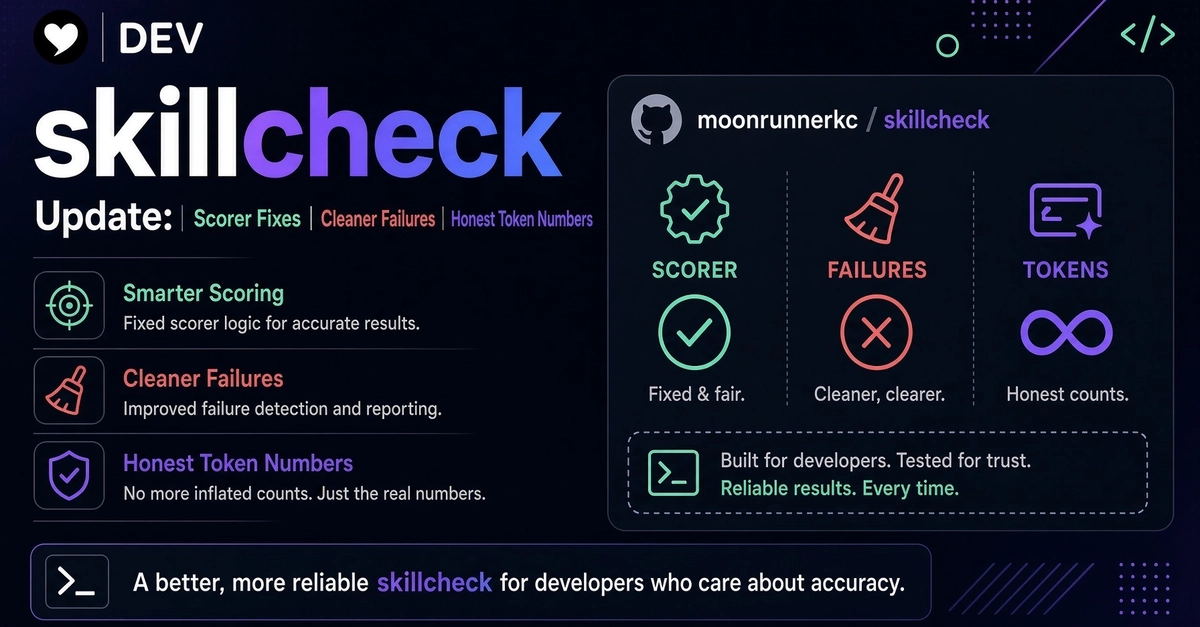
Skillcheck Hardenings: Accuracy Over New Features
The latest release of Skillcheck, the static analyzer for SKILL.md files, focuses on refining existing functionality rather than introducing new features. This strategic choice prioritizes accuracy and user experience, ensuring the tool is more reliable for developers working with AI agent skills. SKILL.md files are the standard format used by AI development platforms like Claude Code, Copilot, Codex, and Cursor to load and manage reusable agent skills. Skillcheck's core function is to validate these files, ensuring they meet structural and content requirements.
The tool performs several critical checks: it validates the frontmatter for correct formatting and essential metadata, scores the discoverability of skill descriptions (crucial for AI models understanding skill intent), verifies internal and external file references to prevent broken links, enforces token budgets to manage LLM costs, and flags potential cross-agent compatibility issues. Importantly, Skillcheck operates entirely offline, requiring no network or LLM calls, and does not mutate files, making it a safe and efficient addition to development workflows. It can be integrated as a command-line interface (CLI) tool, a GitHub Action, or a pre-commit hook.
Description Scores See Significant Improvement
A key outcome of the recent hardening pass is a substantial improvement in description scoring accuracy. Previously, skills that should have scored well were penalized due to flaws in the scoring mechanism. This update corrects those issues, leading to a notable increase in scores for many skills. The median score across Skillcheck's reference corpus has jumped from 75 to 90, reflecting a more accurate assessment of description quality and discoverability. This means developers will get a more reliable signal on how well their skill descriptions are likely to be understood by AI agents.
Furthermore, the --explain-score flag has been enhanced. It now provides granular feedback, detailing precisely which patterns in the skill description matched or missed the scoring criteria, rather than just outputting a numerical score. This transparency allows developers to understand the 'why' behind a score, enabling them to make targeted improvements to their skill descriptions. This is akin to a teacher not just giving a grade, but explaining which parts of an essay were strong and which needed revision.
Failures Made Clearer and More Actionable
Beyond scoring, Skillcheck has also improved how it reports failures. The goal was to make failure messages more intuitive and actionable, reducing the cognitive load on developers when issues arise. Instead of generic error codes or ambiguous descriptions, users will now receive clearer explanations of what went wrong, why it is a problem, and often, direct suggestions on how to fix it. This applies to all checks, from frontmatter validation to token budget enforcement.
For instance, a frontmatter error might now clearly state: "Missing required 'name' field in frontmatter. This field is essential for uniquely identifying the skill." Similarly, a token budget violation could be reported as: "Skill description exceeds the 500-token limit by 75 tokens. Consider shortening the description or splitting the skill." This level of detail ensures that developers can quickly diagnose and resolve issues without extensive debugging or guesswork, streamlining the development process for AI agents.
Transparent Token Counting for LLM Efficiency
Skillcheck's enforcement of token budgets is critical for managing the operational costs associated with Large Language Models (LLMs). This update brings greater transparency and accuracy to token counting. The tool now provides a more precise calculation of token usage within SKILL.md files, particularly for descriptions and other text-based fields that are passed to LLMs. This is vital because LLM API calls are typically priced per token, making efficient token management a direct cost-saving measure.
The previous system may have had minor discrepancies in how it counted tokens, potentially leading to unexpected costs or a false sense of security regarding budget adherence. The hardened scorer in Skillcheck ensures that the token counts reported are aligned with how major LLM providers (like OpenAI, Anthropic, etc.) would count them. This allows developers to more accurately predict and control their LLM expenses. The CLI output and GitHub Action reports will now reflect these more precise token counts, giving teams greater confidence in their budgeting for AI-powered features.
What This Means for Developers and Teams
This release signifies a commitment to the foundational aspects of AI agent development tooling. By focusing on accuracy in scoring, clarity in error reporting, and precision in resource management (token counts), Skillcheck is becoming a more robust and trustworthy utility. Developers can rely on its assessments to build better, more discoverable, and more cost-effective AI skills.
The improvements mean less time spent debugging unexpected errors or trying to understand why a skill isn't performing as expected. It also translates to potentially lower operational costs by ensuring token budgets are accurately monitored. For teams developing complex AI agents that rely on a multitude of skills, these incremental but crucial improvements in tooling can have a significant cumulative impact on development velocity and project success.