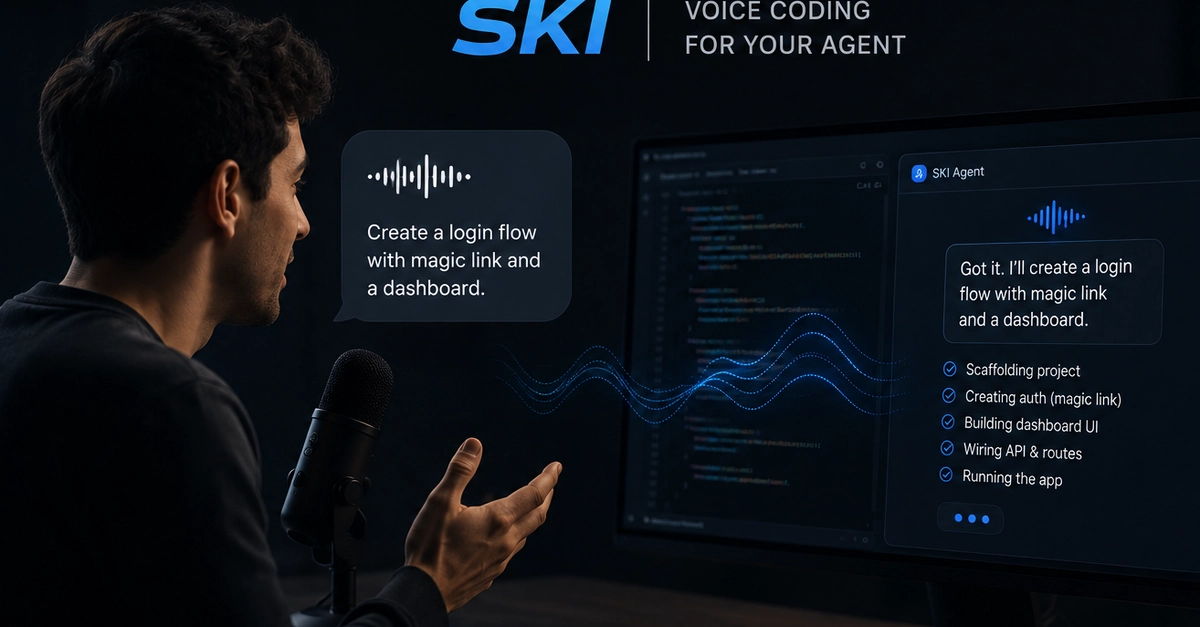
Ditching the Keyboard for Conversational Coding
The traditional workflow for interacting with AI coding assistants involves a deliberate, step-by-step process: formulating a thought, translating it into typed prompts, and then meticulously checking the output. This method, while functional, mirrors walking – controlled, sequential, and often a slower reflection of how ideas actually form in the mind. The inspiration behind SKI (Speech-to-Code Interface) is to accelerate this process by enabling a more natural, spoken interaction with AI coding agents.
SKI aims to bridge the gap between human thought and AI execution by allowing developers to speak their prompts and receive audible responses from AI agents. This bidirectional voice interface is designed to bypass the friction of typing, making the interaction feel more fluid and immediate. The core idea is to mirror the natural flow of human conversation and thought, where complete sentences and ideas often form before being articulated.
Currently, SKI supports integration with popular AI coding tools like Claude Code, Codex, and Cursor. The goal is to create a more intuitive and faster feedback loop, allowing developers to iterate on code ideas with greater speed and less cognitive overhead. Instead of a static text output, the AI agent will vocalize its responses, further enhancing the conversational feel of the development process.

Setting Up SKI: A Straightforward Process
Getting started with SKI is designed to be uncomplicated. The tool is available for download from its official website, heyski.io. Currently, SKI offers compatibility for Mac users with Apple Silicon processors running macOS 14.4 or later, and for Windows users.
The setup process typically involves downloading the application and following on-screen instructions to integrate it with your preferred AI coding assistant. This usually entails granting necessary permissions for microphone access and potentially configuring API keys or connection settings for the AI models you wish to use. The developers emphasize a user-friendly installation that requires minimal technical expertise beyond basic software setup.
Once installed and configured, SKI acts as an intermediary. When you speak a prompt, SKI captures your audio, converts it to text, and sends it to the selected AI agent. The agent processes the prompt and generates a response. SKI then takes this text response and vocalizes it back to you, completing the voice-driven loop. This eliminates the need to constantly switch between your thoughts, your keyboard, and your screen for reading AI-generated code or explanations.
The 'Type-Wait-Check' Loop vs. Voice Interaction
The conventional method of interacting with AI coding tools can be characterized as a 'type-wait-check' loop. You type a command or query, wait for the AI to process and respond, and then check the output for accuracy and relevance. This cycle, while familiar, introduces several points of friction:
- Cognitive Load: Translating a complex thought into precise typed instructions requires significant mental effort. Developers must consider syntax, potential ambiguities, and the exact phrasing that will yield the best results from the AI.
- Time Delay: The physical act of typing, especially for detailed prompts, consumes valuable time. This is compounded by the time spent waiting for the AI's response and then reading through it.
- Context Switching: Constantly shifting focus between thinking, typing, reading, and evaluating can disrupt a developer's flow state, leading to decreased productivity and increased errors.
SKI directly addresses these pain points. By enabling voice input and output, it aims to make the interaction as natural as a conversation. The 'walk' of typing is replaced by the 'ski' of speaking, allowing for a more spontaneous and rapid exchange of ideas. The expectation is that this will lead to faster problem-solving, quicker iteration on code, and a more enjoyable development experience.
Potential Impact on Developer Workflow
The implications of a truly effective voice-coding interface are significant. For developers who spend long hours in front of a screen, reducing the reliance on keyboard input could offer ergonomic benefits and help combat repetitive strain injuries. More importantly, it could fundamentally alter how developers brainstorm, debug, and learn.
Imagine describing a bug to an AI that then points out the exact line of code causing the issue, or explaining a desired feature and having the AI draft the initial implementation while you continue to converse about refinements. This hands-free, voice-first approach could be particularly transformative for pair programming, remote collaboration, and even for developers with certain physical disabilities. It opens up possibilities for using AI coding assistants in contexts where typing is impractical or impossible.
However, the success of such a tool hinges on several factors: the accuracy of the speech-to-text and text-to-speech engines, the AI agent's ability to understand nuanced spoken instructions, and the overall responsiveness of the system. The current iteration of SKI represents a significant step towards a more naturalistic human-AI collaboration in software development. The surprising detail here is not the introduction of voice interfaces, but the focus on a bidirectional, conversational flow that directly tackles the inefficiencies of the text-based paradigm.
The Future of Conversational Development
While SKI offers a compelling vision, the broader landscape of AI-assisted coding is rapidly evolving. The integration of voice as a primary input/output method is a logical progression. The question remains: what happens when AI coding agents not only understand spoken commands but can also engage in more complex, contextual dialogue, anticipating developer needs rather than just responding to explicit instructions? The journey from typing prompts to having a spoken dialogue with an AI partner is well underway, and tools like SKI are paving the way for a more intuitive and efficient future for software development.