The Performance Chasm in LLM Serving
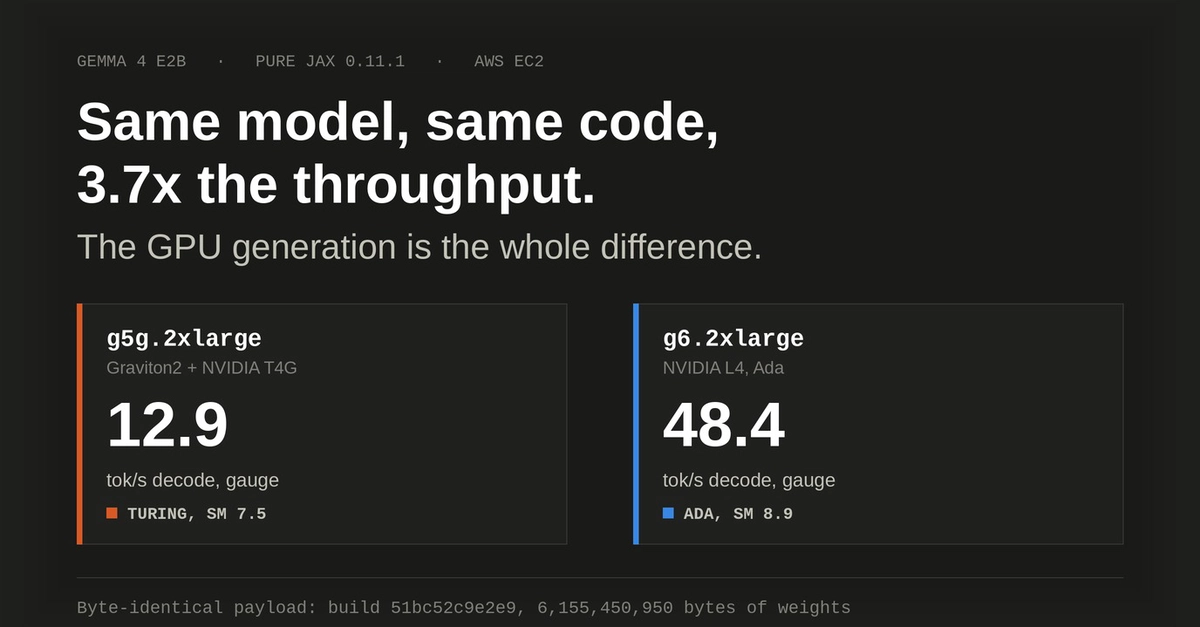
When serving Large Language Models (LLMs), even minor inefficiencies can cripple throughput and balloon costs. A recent comparison between AWS’s older g5g.2xlarge and newer g6.2xlarge instances reveals a dramatic performance gap, with the G6 instances delivering up to 3.7 times higher throughput. This disparity is particularly stark because the identical inference code, a Gemma 4b model, was run on both instance types using byte-identical payloads. The findings suggest that the hardware architecture and GPU capabilities are the primary drivers of this performance difference, not the inference software itself.
The critical insight from this comparison is that the older G5G instances, which pair an AWS Graviton2 (aarch64) host with an NVIDIA T4G GPU (Turing, SM 7.5), suffer from significant overhead. The analysis points to an astonishing 87% of decode time being lost to what appears to be a dtype conversion process. This loss is entirely invisible in standard logs, metrics, or health checks, making it a hidden performance killer. Developers relying on these older instances might be unknowingly leaving massive performance on the table.
Instance Architectures Compared
The g5g.2xlarge instance utilizes an NVIDIA T4G GPU, based on the Turing architecture with Shader Model 7.5. This is paired with an ARM-based Graviton2 CPU. In contrast, the g6.2xlarge instance features an NVIDIA L4 GPU, built on the more recent Ada Lovelace architecture with Shader Model 8.9, and is paired with an x86_64 CPU. Both instance types were tested using AWS Spot Instances, suggesting a focus on cost-effective deployment scenarios.
The difference in GPU architecture—Turing versus Ada Lovelace—is a significant factor. Ada Lovelace GPUs, like the L4, incorporate architectural improvements, including enhanced Tensor Cores and RT Cores, and generally higher clock speeds and memory bandwidth compared to Turing. These advancements directly translate to faster matrix multiplication and other core operations essential for LLM inference.
The Unseen Bottleneck: Dtype Conversion
The most surprising revelation is the hidden 87% decode time loss on the G5G instances, attributed to dtype conversion. This suggests that the data format of the model's weights or the input tensors is not natively aligned with what the T4G GPU can process most efficiently. The GPU must then spend a substantial amount of time converting data types before it can perform the actual computations. This conversion step adds latency and reduces the effective computational throughput, even though the GPU cores themselves might be capable of higher performance.
This issue is particularly insidious because it doesn't manifest as a typical performance bottleneck like high GPU utilization or slow memory access. Standard monitoring tools would likely report healthy metrics, masking the underlying inefficiency. The code itself, available on GitHub, is designed to be simple and direct, making the performance difference purely a function of the hardware's ability to handle the data and computations efficiently. The newer L4 GPU in the G6 instances likely has better native support for the required data types or performs these conversions much faster, thus avoiding the severe penalty observed on the T4G.
Implications for LLM Deployment
For organizations deploying LLMs, this comparison has immediate and profound implications. The significant throughput increase on G6 instances means that fewer instances are required to handle the same inference load, leading to substantial cost savings and reduced operational complexity. The ability to achieve 3.7x more throughput with identical code underscores the importance of selecting the right hardware for AI workloads.
Developers and ML engineers should re-evaluate their current infrastructure, especially if they are using older GPU instances for LLM serving. The hidden costs associated with inefficient hardware, like the dtype conversion overhead on G5G, can be substantial. Migrating to newer instance families, such as the G6, could unlock significant performance gains and cost efficiencies without requiring extensive code refactoring. The availability of the same code running on both platforms provides a clear, apples-to-apples benchmark for demonstrating the value of hardware upgrades.
The choice of GPU architecture and its specific capabilities—such as native data type support and computational efficiency—are critical factors in optimizing LLM inference. As LLMs continue to grow in size and complexity, the underlying hardware will play an increasingly vital role in making these technologies accessible and cost-effective for a wider range of applications. The G6 instances, powered by the L4 GPU, appear to be a significant step forward for efficient LLM serving on AWS.
What remains to be seen is how this performance delta scales with larger models and more complex inference tasks. While this benchmark focuses on a small language model, the architectural advantages of the L4 over the T4G are likely to persist, and potentially widen, as model sizes increase.