SK hynix's StreamDQ Architecture for LLM Inference Acceleration
SK hynix, a major player in memory solutions, has introduced a novel architectural enhancement designed to accelerate Large Language Model (LLM) inference. Dubbed StreamDQ (Stream DeQuantization), this innovation targets a critical bottleneck in AI workloads: the need to dequantize model weights from lower precision formats to higher precision formats for computation. The company's researchers detailed this approach in a technical paper, outlining how StreamDQ enables on-the-fly dequantization directly within the memory subsystem, specifically within custom High Bandwidth Memory (HBM) configurations. This move aims to significantly boost throughput and reduce energy consumption for large-batch LLM inference tasks, a crucial area for deploying advanced AI models efficiently.
The core problem StreamDQ addresses is the performance penalty associated with dequantization. LLMs often employ quantization techniques to reduce the memory footprint and computational load by representing model weights with fewer bits (e.g., 8-bit or even 4-bit integers). However, for inference, these weights typically need to be converted back to higher precision formats (e.g., 16-bit floating-point or 32-bit integers) for accurate calculations. This dequantization process, when performed by the main compute units, creates a data movement and processing overhead that can limit overall inference speed. StreamDQ shifts this dequantization closer to where the data resides, minimizing the distance and latency.
How StreamDQ Works: On-the-Fly Dequantization in HBM
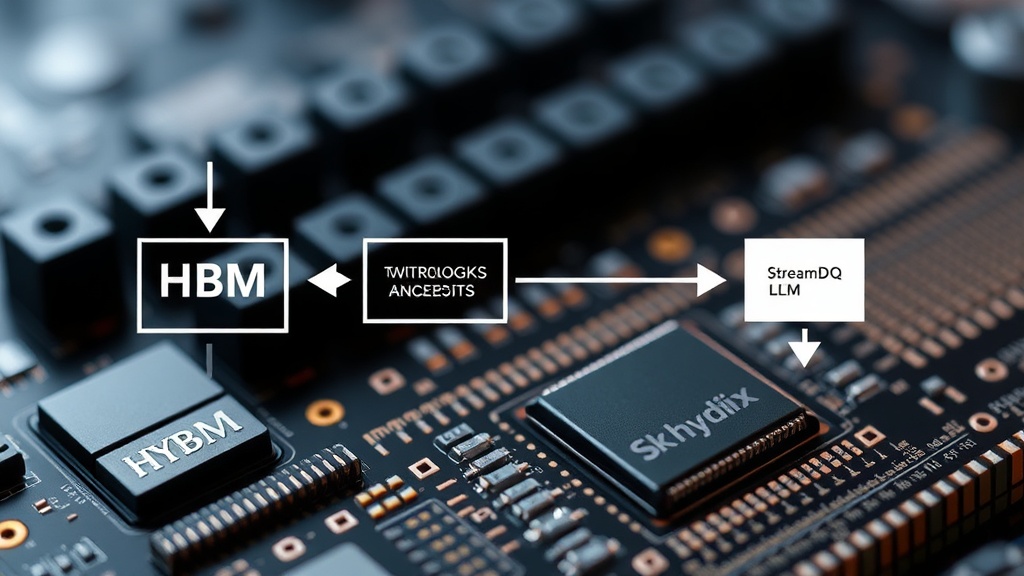
StreamDQ is described as a lightweight architectural enhancement integrated into SK hynix's custom HBM. Instead of fetching quantized weights from HBM, transferring them to the processing unit, and then dequantizing them, StreamDQ performs the dequantization process as the data is being streamed out of the HBM. This means that by the time the weight data reaches the compute units, it is already in the required higher precision format. This eliminates a significant data transfer and processing step, directly contributing to higher throughput and lower latency.
The technical paper highlights the effectiveness of this approach for mixed-precision inference, a common scenario in LLM deployment where different parts of the model might operate at varying precision levels. By integrating dequantization into the memory subsystem, StreamDQ ensures that the data is ready for computation as soon as it leaves the memory. This is particularly impactful for LLMs, which are characterized by their massive size and the sheer volume of weight data that needs to be accessed and processed during inference. The custom HBM aspect suggests that SK hynix is tailoring its memory solutions to the specific demands of AI accelerators, moving beyond general-purpose memory offerings.
Performance Gains and Energy Efficiency
The results reported by SK hynix are substantial. The StreamDQ architecture demonstrated up to a 7.08x speedup in LLM inference performance. This dramatic increase in speed is a direct consequence of reducing the dequantization bottleneck and improving data readiness for computation. Furthermore, the energy efficiency improvements are equally impressive, with StreamDQ achieving up to 90.23% lower energy consumption for mixed-precision inference workloads. This significant reduction in power draw is critical for deploying AI at scale, both in data centers where energy costs are a major concern, and in edge devices where power is inherently limited.
The energy savings stem from several factors. Firstly, by performing dequantization closer to the data source, the amount of data that needs to be moved between different components of the system is reduced. Less data movement translates directly to lower power consumption. Secondly, the specialized hardware designed for dequantization within the HBM itself is likely more power-efficient than general-purpose compute units performing the same task. This optimization is akin to using a specialized tool for a specific job rather than a multi-purpose tool, leading to greater efficiency.
Implications for AI Hardware and LLM Deployment
SK hynix's StreamDQ represents a significant step in co-designing memory and compute for AI. Traditionally, memory vendors focused on increasing bandwidth and capacity. However, as AI workloads evolve, the architecture of the memory itself is becoming a performance differentiator. By embedding dequantization logic into HBM, SK hynix is moving intelligence closer to the data, a trend that is becoming increasingly important in high-performance computing and AI. This approach could lead to more specialized memory solutions tailored for specific AI tasks, rather than relying solely on generic memory improvements.
For developers and researchers working on LLMs, this innovation promises more efficient deployment. The ability to achieve higher inference speeds with lower energy costs means that larger, more complex models can be run on existing or less powerful hardware, or that current models can be deployed with greater cost-effectiveness and lower latency. This could accelerate the adoption of LLMs in a wider range of applications, from real-time conversational AI to sophisticated data analysis tools. The focus on custom HBM also indicates a broader industry trend towards bespoke hardware solutions optimized for AI, potentially leading to a more diverse and specialized AI hardware ecosystem.
The surprise here is not that dequantization is a bottleneck, but the degree to which integrating this specific function into the memory subsystem itself can yield such dramatic improvements in both speed and energy. It suggests that the traditional separation of memory and compute, while fundamental, may be ripe for further integration at the hardware level to meet the insatiable demands of AI. The question remains how broadly this architecture can be adopted and whether it will become a standard feature in future HBM generations or remain a specialized offering for particular AI accelerators.