Bridging the Gap: The Problem with Traditional Integrations
Developers building voice and messaging integrations have long faced a common hurdle: the need for dedicated deployment infrastructure solely to act as a bridge between their application and the Sinch API. Every voice call or message event required a round trip. Your application would receive a callback from Sinch, translate that into a specific format (like SVAML or a Conversation API call), and then hand it off to the rest of your application logic. This intermediary piece, while necessary, was often uninteresting boilerplate code – just a piece that had to exist because your application’s compute environment and Sinch’s network were separate.
This architecture introduced latency and complexity. Each interaction involved an extra hop, adding overhead to even the simplest tasks. For developers, it meant managing and deploying code that didn't directly contribute to core business value but was essential for the integration to function. This extra layer of infrastructure also added maintenance burdens and potential points of failure.
Introducing Sinch Functions: Compute at the Edge
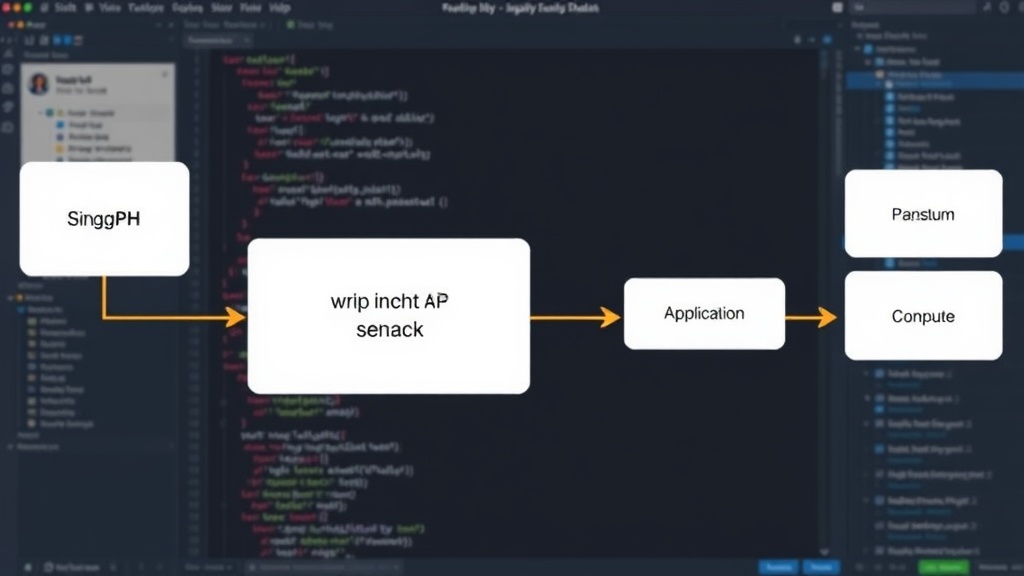
Sinch Functions aims to eliminate this intermediary layer. It’s a serverless compute service that runs directly within Sinch’s network infrastructure. This means your voice and messaging handlers execute at the origin of the callbacks, right where Sinch’s network is already processing your calls and messages. The primary benefit is a significant reduction in latency and simplification of the integration architecture.
Crucially, Sinch Functions is not a general-purpose serverless replacement like AWS Lambda or Azure Functions. The core of your application – your order lookup systems, your database writes, your complex business logic – remains where it is. Sinch Functions is specifically designed for the “glue” code required to interact with Sinch's APIs. It handles the translation and immediate processing of Sinch callbacks, allowing you to focus your primary compute resources on your unique business logic.
Think of it less like building an entire new kitchen and more like installing a smart faucet directly into your existing plumbing. The main water supply (your application logic) stays put, but the immediate interaction point (handling API callbacks) is now streamlined and integrated at the source.
Key Use Cases and Benefits
Sinch Functions is particularly well-suited for several common integration patterns:
- Voice Call Routing and IVR Logic: Instead of a server fetching SVAML from your app, Sinch Functions can directly generate and return SVAML based on the incoming call context. This enables faster responses and more dynamic call flows.
- Messaging Reply Handling: Similarly, for messaging APIs, Functions can process incoming messages, perform quick lookups, and generate appropriate responses without needing to ping your external application for simple interactions.
- Real-time Event Processing: Any scenario where Sinch callbacks need immediate, low-latency processing before being handed off to a larger application backend benefits from this architecture.
The benefits are tangible: reduced latency, simplified architecture, and potentially lower infrastructure costs by offloading simple integration tasks from your primary cloud environment. Developers can write handlers in Node.js or Python, leveraging familiar languages and tooling.
Developer Experience and Deployment
Sinch provides a CLI tool for managing Sinch Functions. Developers can write their handler code, package it, and deploy it directly to the Sinch Functions platform. The platform handles the execution environment, scaling, and management of these serverless functions. This abstracts away the operational overhead typically associated with deploying and managing even small pieces of compute infrastructure.
The development workflow involves writing standard Node.js or Python functions. These functions receive the Sinch callback events as input and return the necessary output (e.g., SVAML for voice, a message object for messaging) directly to the Sinch platform. This allows developers to concentrate on the logic of responding to Sinch events rather than the mechanics of hosting and invoking that logic.
What This Means for the Ecosystem
The introduction of Sinch Functions signals a broader trend in CPaaS (Communications Platform as a Service) towards embedding compute closer to the network edge. By running integration logic directly within their infrastructure, providers like Sinch can offer more performant and streamlined developer experiences. This move potentially lowers the barrier to entry for complex integrations and encourages more sophisticated use cases by reducing the friction associated with traditional API interactions.
For developers, this means reconsidering where the initial processing of communication events should occur. Instead of building a dedicated microservice or Lambda function for every Sinch integration, developers can now leverage Sinch Functions for these specific tasks. This frees up their primary cloud resources and simplifies their overall deployment topology. The question remains, however, how seamless the transition will be for existing integrations and what tooling will emerge to manage complex hybrid deployments where both Sinch Functions and external compute are used.