%22%20%2F%3E%0A%20%20%3C%2Fsvg%3E)
What is SIMD?
Single Instruction, Multiple Data (SIMD) is a class of parallel computers in Flynn's taxonomy. It describes computers with multiple processing elements that perform the same operation on multiple data points simultaneously. Think of it like a drill sergeant shouting a single command, "Forward march!", to an entire platoon of soldiers. Every soldier (data point) executes the same action (instruction) at the same time.
In computing, this translates to a CPU processing multiple pieces of data with a single instruction. Instead of iterating through a list one by one, a SIMD instruction can operate on a small array of numbers all at once. This is particularly effective for tasks involving large datasets and repetitive operations, such as multimedia processing, scientific simulations, and machine learning.
Modern CPUs have SIMD capabilities built into their instruction sets. Common examples include SSE (Streaming SIMD Extensions) and AVX (Advanced Vector Extensions) on x86 processors, and NEON on ARM processors. These extensions provide special registers that can hold multiple data elements (e.g., 128-bit, 256-bit, or 512-bit registers) and instructions that operate on these entire registers.
Why SIMD Matters for Performance
The primary benefit of SIMD is performance. By performing the same operation on multiple data elements in parallel, SIMD can achieve significant speedups compared to traditional scalar processing, where one instruction operates on one data element at a time. This is especially true for workloads that are data-parallel, meaning the same operation needs to be applied to many independent data items.
Consider a simple task: adding two arrays of numbers. A scalar approach would involve a loop that fetches two numbers, adds them, and stores the result, repeating for every pair of numbers. A SIMD approach, however, could load multiple numbers from each array into SIMD registers, perform a single add operation on these registers, and then store the results. If a SIMD register can hold, say, 8 numbers, you can potentially perform 8 additions with a single SIMD instruction, achieving an 8x speedup for that specific operation.
This parallelism is crucial for modern applications. Graphics rendering, video encoding/decoding, image manipulation, signal processing, and even complex scientific computations often involve massive amounts of data that can be processed in parallel. Without SIMD, these tasks would be prohibitively slow on single-core processors.
How SIMD Works Under the Hood
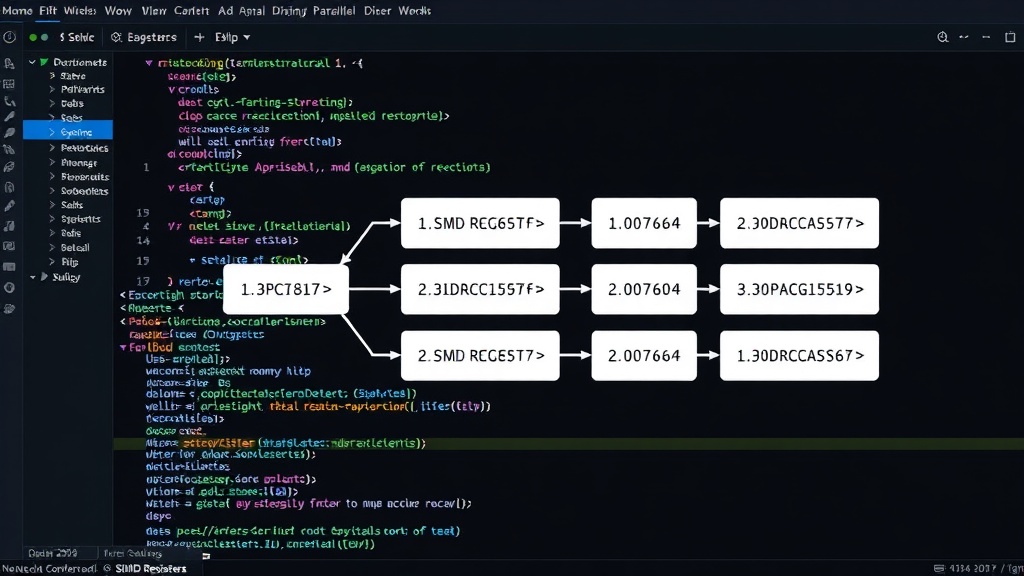
SIMD instructions operate on vector registers. These registers are wider than standard general-purpose registers, allowing them to hold multiple data elements. For example, a 128-bit SSE register can hold four 32-bit floating-point numbers or sixteen 8-bit integers. An AVX register, being 256 bits wide, can hold twice as many elements.
The instructions themselves are designed to perform operations on these entire registers. For instance, an instruction like `ADDPS` (Add Packed Single-precision floats) would take two 128-bit registers, each containing four 32-bit floats, and produce a result register with four new floats, each being the sum of the corresponding floats from the input registers. This is a single instruction, but it performs four additions.
Compilers play a significant role in leveraging SIMD. Modern compilers can often automatically detect opportunities for vectorization – transforming scalar code into SIMD instructions. This is achieved through various techniques, including loop unrolling, loop interchange, and data dependency analysis. However, automatic vectorization is not always perfect, and sometimes manual intervention is required.
Manual SIMD Programming
For maximum performance, developers can write SIMD code directly. This typically involves using compiler intrinsics or assembly language. Intrinsics are special functions provided by the compiler that map directly to SIMD instructions. They allow developers to access SIMD capabilities without writing raw assembly, offering a balance between performance and readability.
For example, using GCC or Clang, you might use intrinsics like `_mm_add_ps` to perform packed single-precision float addition. The code would look something like this:
#include <immintrin.h>

// Assuming data is aligned and has enough elements
__m128 vec1 = _mm_load_ps(array1);
__m128 vec2 = _mm_load_ps(array2);
__m128 sum_vec = _mm_add_ps(vec1, vec2);
_mm_store_ps(result_array, sum_vec);
This code snippet loads 4 floats from array1 and array2 into SIMD registers vec1 and vec2, adds them using a single SIMD instruction, and stores the result in result_array. This process would be repeated for subsequent chunks of data.
Writing SIMD code manually requires careful attention to data alignment, memory access patterns, and the specific instruction sets available on the target architecture. Incorrect usage can lead to performance degradation or even incorrect results. However, for performance-critical sections of an application, manual SIMD optimization can yield substantial gains.
SIMD vs. Other Parallelism Techniques
It's important to distinguish SIMD from other forms of parallelism. Multi-threading, for instance, involves running multiple threads concurrently, each potentially executing different instructions on different data. This is known as Single Instruction, Multiple Thread (SIMT) or Multiple Instruction, Multiple Data (MIMD) in Flynn's taxonomy, depending on the exact architecture.
SIMD is about executing the *same* instruction on *multiple* data points within a single core. It's a form of data-level parallelism. Multi-threading, on the other hand, is task-level or thread-level parallelism, utilizing multiple cores or hyper-threads to execute different tasks or threads simultaneously.
Both SIMD and multi-threading are vital for achieving high performance. SIMD excels at accelerating data-intensive, repetitive computations within a single thread, while multi-threading is used to distribute larger tasks across multiple cores. Often, the most effective high-performance applications combine both SIMD optimizations within threads and multi-threading to distribute those threads across available cores.
The Future of SIMD
As processors continue to evolve, SIMD capabilities are becoming more powerful. Wider registers, more sophisticated instructions, and improved compiler support for auto-vectorization are constantly pushing the boundaries of what's possible. The increasing prevalence of AI and machine learning workloads, which are inherently data-parallel, further cements SIMD's importance.
For developers and engineers, understanding SIMD is no longer a niche concern. It's becoming a fundamental aspect of writing efficient software. Whether through compiler optimizations or direct manual tuning, leveraging SIMD is key to unlocking the full potential of modern hardware and delivering high-performance applications.