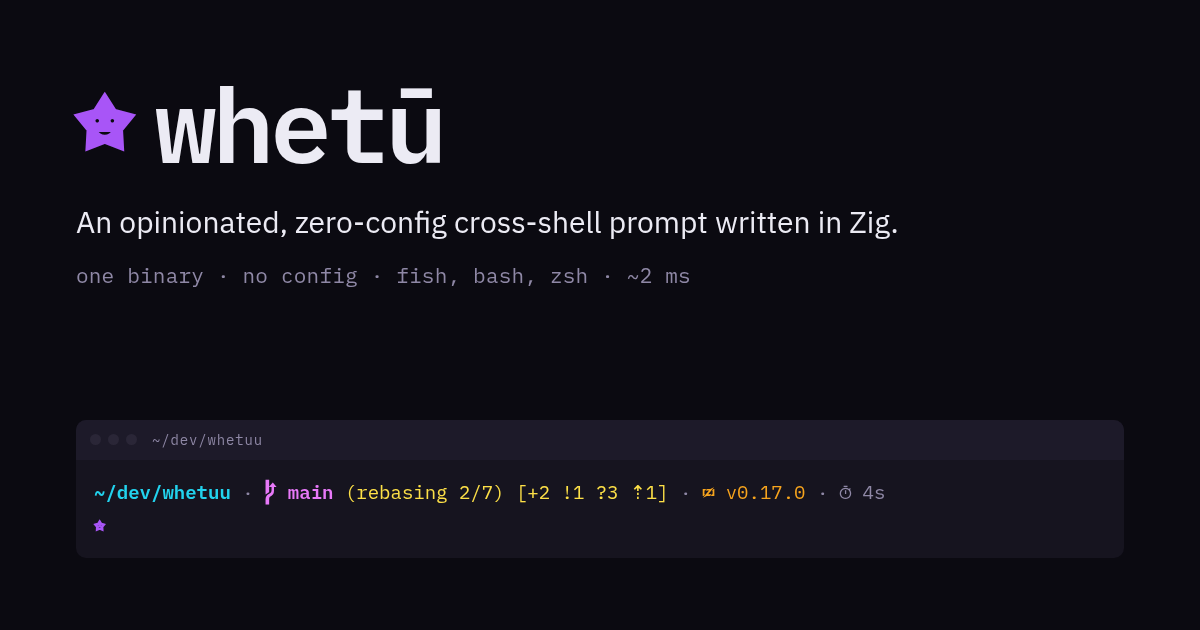
Whetuu: A New Approach to Shell Prompts
The command line is a developer's primary interface. Yet, configuring a shell prompt to be both informative and aesthetically pleasing often involves hours of tweaking dotfiles, installing plugins, and debugging complex scripts. Whetuu, a new project presented on Hacker News, aims to eliminate this friction. Written in the Zig programming language, Whetuu promises a "zero-config" cross-shell prompt that is fast, extensible, and requires no user intervention to get started.
The core idea behind Whetuu is to provide a functional and informative prompt out-of-the-box, usable across different shells like Bash, Zsh, and Fish without requiring users to edit configuration files. This contrasts sharply with many existing prompt solutions that rely heavily on shell-specific scripting and extensive customization. The project's creator, yamafaktory, emphasizes speed and simplicity, leveraging Zig's capabilities for performance and low-level control.
Why Zig for a Shell Prompt?
Choosing Zig for a command-line utility like a shell prompt is an interesting decision. Zig is a systems programming language that aims to be a better C, offering manual memory management, compile-time features, and excellent C interoperability. For a prompt, this translates to a few key advantages:
- Performance: Zig compiles to highly efficient native code. A prompt written in Zig can execute commands, fetch information (like Git status or Python virtual environment details), and render itself significantly faster than prompts written in interpreted languages like Python or JavaScript, or even shell scripts themselves. This means quicker command execution and a more responsive terminal.
- Portability: While Zig is a relatively new language, its focus on cross-compilation and its ability to easily link with C code make it a viable choice for building portable executables that can run on various operating systems and architectures without modification.
- Low Overhead: Zig executables are typically small and have minimal runtime dependencies. This is ideal for a tool that runs on every command, ensuring it doesn't bloat the user's environment.
The "zero-config" aspect is particularly noteworthy. Many developers spend significant time personalizing their prompts, adding information about Git branches, the current directory, Python virtual environments, or the status of background jobs. Whetuu's approach suggests it can intelligently detect common development environments and display relevant information by default. This allows developers to start using it immediately and only customize if they have specific needs beyond the defaults.
The project is presented as a "Show HN," meaning it's a personal project shared by its creator on Hacker News. This often implies a focus on learning, experimentation, and community feedback rather than a fully polished commercial product. However, the technical foundation—a fast, cross-shell prompt written in Zig—is compelling for anyone looking to streamline their terminal workflow.
Extensibility and the Future of Whetuu
While the "zero-config" aspect is a primary selling point, true power for command-line tools often lies in their extensibility. The project's GitHub repository, linked from the Hacker News post, reveals that while Whetuu aims for zero configuration for basic use, it does offer mechanisms for customization. These might include environment variables or a simple configuration file that can be optionally provided by the user.
The choice of Zig also suggests a potential for deep integration with other system tools or even the ability to embed custom logic written in Zig or C. This could allow for highly specialized prompt elements that are not feasible with traditional shell scripting alone. For instance, a prompt could dynamically fetch information from a local development server, query a database, or even perform complex parsing of build tool outputs.
The community response on Hacker News will be crucial for Whetuu's future. Questions about its compatibility with different shells, its performance on various operating systems, and its specific customization options are likely to arise. The project's success will depend on its ability to balance its core promise of simplicity with the flexibility that experienced users demand. If Whetuu can provide a robust, fast, and easy-to-use default experience that can be incrementally enhanced, it could become a compelling alternative to established prompt frameworks like Oh My Zsh's prompt themes or Starship.
What remains to be seen is how well Whetuu handles the vast array of development environments and tools that developers commonly use. Will it automatically detect and display information for Node.js, Ruby, Go, Docker, Kubernetes, and various testing frameworks? The "zero-config" claim hinges on its ability to intelligently infer these contexts. If it falls short, users might find themselves needing to configure it after all, potentially negating its primary advantage.
For developers who are tired of wrestling with complex prompt configurations or simply want a faster, cleaner terminal experience, Whetuu presents an intriguing new option. Its foundation in Zig suggests a commitment to performance and efficiency. As it evolves, its ability to offer both simplicity and depth will determine its place in the developer's toolkit.
The prompt is often the first thing you see when you open your terminal. It's a small part of the developer experience, but a constant one. Whetuu's ambition is to make that constant interaction as seamless and informative as possible, without demanding a significant investment of time upfront. It's a project worth watching for anyone who spends their days in the command line.