The Core Idea: Learning by Doing
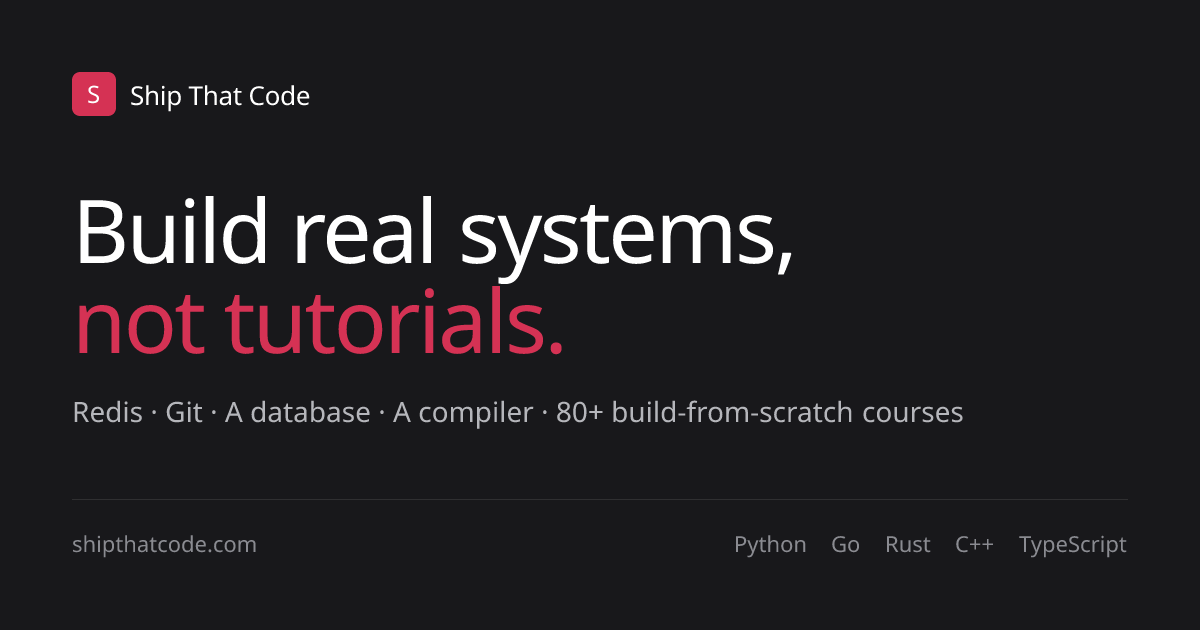
A developer has launched a project on Hacker News, titled "Show HN: Learn by rebuilding Redis, Git, a database from scratch." The initiative, shared by user `shipthatcode` (presumably the creator), aims to provide a hands-on learning experience for software engineers by guiding them through the process of building fundamental pieces of modern technology from the ground up.
The premise is simple yet profound: instead of just reading about how systems like Redis, Git, or a relational database work, developers are encouraged to implement them. This approach moves beyond theoretical understanding to practical application, forcing a deep engagement with data structures, algorithms, network protocols, and concurrency models that underpin these widely used tools.
The project targets developers who want to move beyond application-level coding and gain a more fundamental grasp of computer science principles and system design. By dissecting and recreating these complex systems, participants can develop a more intuitive understanding of their performance characteristics, limitations, and the trade-offs involved in their design.
Why Rebuild? The Value Proposition
The choice of Redis, Git, and a database is deliberate. These are not arbitrary projects; they represent cornerstones of modern software development and infrastructure:
- Redis: A high-performance, in-memory data structure store. Rebuilding it teaches about key-value stores, data serialization, network programming (especially the RESP protocol), event loops, and handling concurrent connections. Understanding Redis internals is crucial for anyone working with caching, message queues, or real-time applications.
- Git: A distributed version control system. Implementing Git involves grappling with content-addressable storage (SHA-1 hashing), tree structures, branching, merging, and the complexities of distributed consensus and synchronization. It provides deep insights into how code collaboration and history management function at a fundamental level.
- A Database: This is a broad category, but typically implies understanding concepts like data storage (on-disk vs. in-memory), indexing, query processing, transaction management (ACID properties), concurrency control, and recovery mechanisms. Building even a simplified database forces an encounter with fundamental data management challenges.
The project doesn't just offer a set of challenges; it implicitly provides a roadmap for learning. By tackling each system sequentially or in parallel, developers can build a robust understanding of different facets of computer systems engineering. This is akin to learning a language by writing a novel, rather than just studying grammar rules.
The Hacker News Reception: Initial Reactions
The Hacker News thread, accessible via the provided link, offers a glimpse into the community's initial reception. While the excerpt is brief, typical discussions around such "Show HN" posts involve:
- Enthusiasm for the learning methodology: Many developers appreciate the value of practical, project-based learning for complex topics.
- Questions about scope and difficulty: Users often inquire about the expected difficulty level, recommended prerequisites, and the scope of the reimplementation (e.g., "What subset of Redis features should be implemented?").
- Comparisons to existing resources: Discussions might touch upon other educational projects or books that cover similar ground.
- Suggestions for improvement or extensions: Community members frequently offer advice or propose additional features or systems to rebuild.
The surprising detail here is not the ambition of the project itself, but the timeless appeal of fundamental computer science challenges. In an era where high-level abstractions dominate, a project that demands a deep dive into low-level implementation often sparks significant interest.
Who is this for?
This project is ideal for:
- Junior Developers: Those looking to solidify their understanding of core computer science concepts and system design principles.
- Mid-Level Engineers: Developers aiming to deepen their expertise in specific areas like distributed systems, databases, or performance optimization.
- Technical Leads and Architects: Professionals who want to refresh their foundational knowledge or gain new perspectives on how common infrastructure components are built.
- Students: Computer science students seeking practical projects that go beyond textbook exercises.
The challenge is significant, but the potential rewards in terms of knowledge and practical skill are substantial. It’s a commitment to understanding the 'why' and 'how' behind the tools that power much of our digital world.
Moving Forward: What’s Next?
The success of such a project often hinges on the availability of clear guidance, well-defined milestones, and perhaps a community forum for support and discussion. Without further details from the project itself, it's difficult to ascertain the exact nature of the guidance provided. However, the very act of sharing this on Hacker News suggests an openness to feedback and community involvement.
If you run a team that relies heavily on systems like Redis or Git, encouraging your engineers to undertake such a rebuilding exercise could foster a deeper appreciation for the tools they use daily and potentially uncover new optimization strategies or architectural insights.