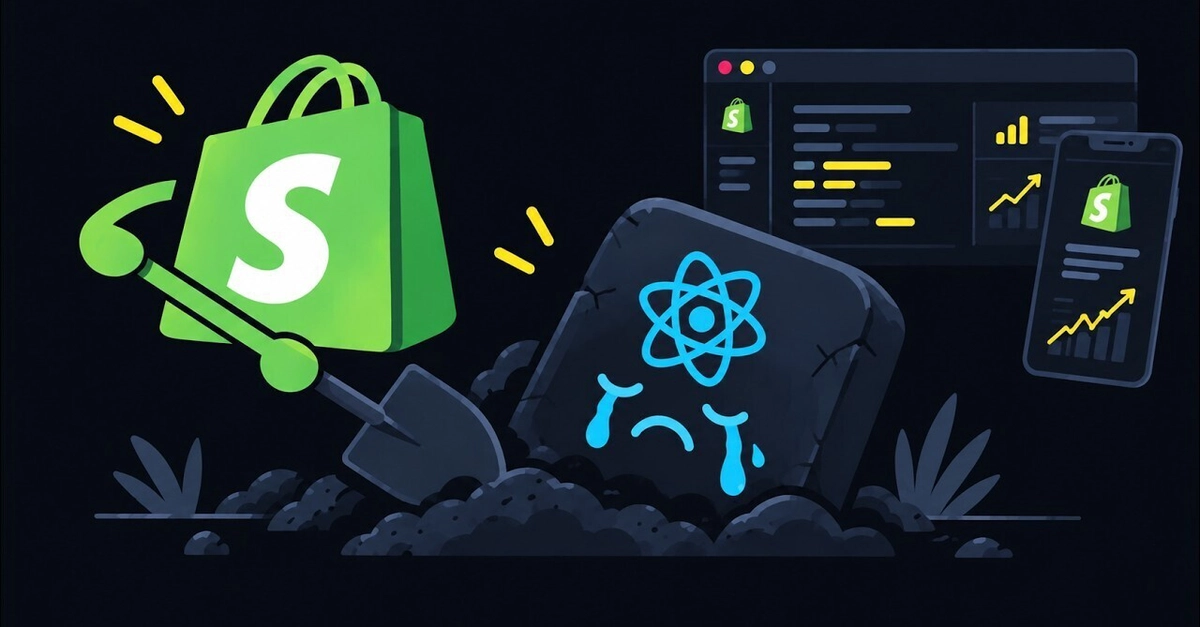
Shopify's About-Face on React Native
Shopify, a titan in the e-commerce space, has made a significant pivot in its mobile development strategy. After investing heavily in React Native for approximately five years, the company is now transitioning its flagship apps, including Shop, back to native codebases using Swift for iOS and Kotlin for Android. This move comes as a surprise, especially considering Shopify's consistent advocacy for React Native, even publishing articles as recently as January 2025 touting its bright future within the company.
The decision to abandon a shared framework, which promised code reuse, faster development cycles, and the ability for non-mobile developers to contribute to mobile apps, marks a critical inflection point. This isn't a simple declaration that React Native is inherently flawed. Instead, Shopify's reasoning points to a more nuanced understanding of the trade-offs involved in cross-platform development, particularly at scale.
The Shifting Calculation: Why Native Now?
Shopify's initial embrace of React Native in 2020 was driven by a clear economic calculation: the cost and complexity of building and maintaining feature parity across two separate native codebases for iOS and Android were substantial. The promise of React Native was to halve this effort, allowing a single team or a single codebase to serve both platforms. This also meant that developers with web backgrounds could more easily contribute to mobile applications, broadening the talent pool.
However, the reality of scaling React Native within a large, complex organization like Shopify appears to have introduced new challenges. The core issues often cited by companies that eventually move away from cross-platform frameworks include:
- Performance Gaps: While React Native has improved dramatically, subtle performance differences can still emerge, especially in highly interactive or animation-heavy UIs. Native platforms often provide more direct access to hardware and optimized rendering pipelines.
- Native Feature Lag: Keeping up with the latest platform-specific features and UI paradigms introduced by Apple and Google can be a constant race. React Native's bridge to native components can introduce delays in adopting new OS functionalities.
- Debugging Complexity: Debugging issues that span the JavaScript layer, the React Native bridge, and the native platform can be significantly more challenging than debugging a pure native application. This can lead to longer development and resolution times.
- Tooling and Ecosystem Maturity: While the React Native ecosystem is robust, it can sometimes lag behind the native development tools and best practices championed by platform vendors.
- Team Specialization vs. Generalization: The initial goal of enabling web developers to work on mobile apps is laudable. However, for highly complex applications, deep specialization in native iOS (Swift/Objective-C) and Android (Kotlin/Java) development often becomes necessary to achieve optimal results and maintainability. The cost of managing a hybrid team with varying levels of native expertise can outweigh the benefits of shared code.
Shopify's specific pain points likely revolve around the long-term maintenance of a large-scale React Native application, where the overhead of managing the framework, its dependencies, and ensuring consistent performance and access to native capabilities has become more burdensome than the perceived benefits of code sharing.
What This Means for Mobile Developers
Shopify's decision sends ripples through the mobile development community. It suggests that for organizations building mission-critical, highly performant, and feature-rich applications at scale, the traditional path of native development remains the most robust. This doesn't invalidate React Native; it simply highlights that its suitability is context-dependent. For startups or teams prioritizing speed-to-market with simpler applications, React Native can still be an excellent choice.
However, for established companies with complex user interfaces, demanding performance requirements, and a long-term vision for their mobile products, the analysis might lean towards native. The investment in native expertise, while seemingly higher upfront, can pay dividends in terms of long-term maintainability, performance, and access to the latest platform innovations.
The surprising detail here is not just that Shopify is switching, but the timing. After years of championing React Native and publishing positive outlooks, this abrupt change suggests that internal challenges or a re-evaluation of their long-term mobile strategy reached a critical point. It prompts a question for other large organizations: are they also re-evaluating their cross-platform commitments?
For developers, this reinforces the value of mastering native platform development. While cross-platform tools offer efficiency, a deep understanding of Swift, Kotlin, and the underlying mobile operating systems remains a highly valuable and often essential skill set for building best-in-class mobile experiences.
The Future of Cross-Platform Development
Shopify's move is unlikely to be an isolated incident. While frameworks like React Native, Flutter, and others continue to evolve and gain traction, this decision serves as a cautionary tale. The allure of a single codebase is powerful, but it must be weighed against the potential compromises in performance, access to native features, and long-term maintainability. Companies must conduct rigorous, ongoing assessments of their chosen development approach against their evolving product needs and business goals.
The market for mobile development tools is dynamic. What works today might not be the optimal solution five years from now. Shopify's strategic shift underscores the importance of adaptability and the willingness to course-correct when data and experience dictate a different path. For mobile developers, this means staying informed about the strengths and weaknesses of various frameworks and, critically, maintaining a strong foundation in native development principles.