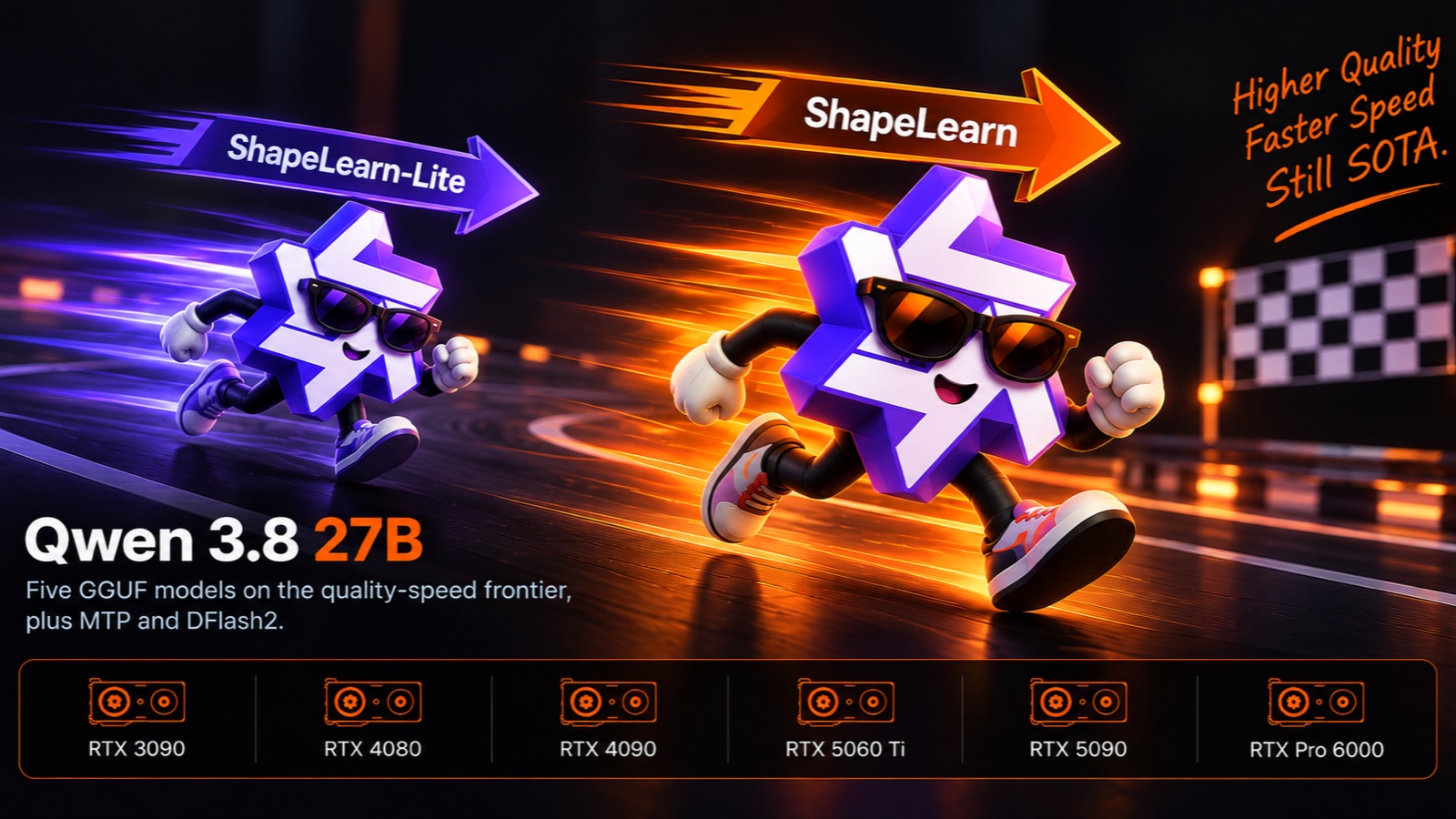
Introducing Qwen 3.8 27B for Efficient VRAM Deployment
Shapelearn has announced the release of a new variant of their Qwen large language model, specifically the Qwen 3.8 27B model, optimized to run on hardware with as little as 13.1 GB of VRAM. This development marks a significant step towards making powerful LLMs more accessible to a broader range of users, including developers, researchers, and enthusiasts who may not have access to high-end, enterprise-grade GPU clusters. The release, detailed on Shapelearn's blog and sparking discussion on Hacker News, focuses on balancing model performance with reduced memory requirements.
The Qwen family of models has gained traction for its strong performance across various natural language processing tasks. This latest iteration, Qwen 3.8 27B, builds upon that foundation but with a critical architectural adjustment or quantization strategy that allows it to fit within a more constrained VRAM footprint. Traditionally, large language models with billions of parameters require substantial amounts of GPU memory, often exceeding 40GB or even 80GB for full precision deployments. Achieving effective operation on 13.1 GB of VRAM is therefore a notable engineering feat.
This optimization is crucial for several reasons. Firstly, it democratizes access to advanced AI capabilities. Developers can now experiment with and deploy sophisticated LLMs on their local machines or on more affordable cloud instances, accelerating prototyping and development cycles. Secondly, it opens up possibilities for edge computing applications where memory and power constraints are paramount. Imagine running a capable LLM directly on a high-end consumer laptop or a compact server for real-time inference without relying on constant cloud connectivity.
Technical Considerations and Performance
While the exact methods employed for VRAM optimization are not exhaustively detailed in the announcement, it's highly probable that advanced quantization techniques are at play. Quantization involves reducing the precision of the model's weights and activations (e.g., from 32-bit floating-point to 8-bit or even 4-bit integers). This process can drastically shrink model size and memory bandwidth requirements, often with a minimal impact on performance if implemented correctly. Techniques like AWQ (Activation-aware Weight Quantization) or GPTQ (Generative Pre-trained Transformer Quantization) are common in this space.
The choice of 27 billion parameters for this model suggests a deliberate trade-off. Models at this scale often represent a sweet spot, offering a significant portion of the capabilities of much larger models (like those with 70B or 100B+ parameters) while remaining more manageable in terms of computational and memory resources. The specific performance characteristics of Qwen 3.8 27B in this quantized form will be a key area of interest for users. Benchmarks comparing its inference speed, accuracy, and generation quality against its full-precision counterparts and other models in its class will be essential for evaluating its practical utility.
The Hacker News discussion surrounding the release highlights user interest in these very aspects. Early comments often revolve around practical deployment scenarios, expected performance degradation (if any), and comparisons to other similarly sized or quantized models. The community's immediate focus on these details underscores the importance of efficient LLM deployment for real-world applications.
Implications for Developers and the AI Landscape
The availability of Qwen 3.8 27B with a 13.1 GB VRAM requirement has several profound implications. For individual developers and small teams, it means the barrier to entry for working with state-of-the-art LLMs is significantly lowered. Instead of needing to invest thousands of dollars in specialized hardware, they can leverage existing or more affordable GPU setups. This can foster innovation by allowing more diverse perspectives and use cases to be explored.
For the broader AI landscape, this release contributes to the ongoing trend of model optimization and accessibility. As more research and engineering efforts are directed towards making powerful AI models efficient, we can expect to see a proliferation of AI-powered applications across various industries. This also puts pressure on larger, less optimized models and the infrastructure providers that support them, potentially driving down costs and increasing competition.
One of the most compelling aspects is the potential for fine-tuning. Developers can take this already efficient model and further fine-tune it on their specific datasets for specialized tasks, all within a more manageable hardware environment. This empowers businesses and researchers to build highly customized AI solutions without the prohibitive costs typically associated with training or fine-tuning massive models from scratch.
What's Next?
The success of Qwen 3.8 27B in achieving its VRAM targets will likely inspire further research into model compression and efficient inference techniques. We can anticipate seeing more models released with similar optimizations, targeting different parameter counts and hardware constraints. The open-source nature of the Qwen models is also a critical factor, fostering collaboration and rapid iteration within the AI community.
As users begin to deploy and test this new variant, real-world performance data and user feedback will be invaluable. The community's ability to share experiences, identify optimal deployment strategies, and contribute to further improvements will be key to unlocking the full potential of such efficiently designed LLMs. The question remains how well this optimized version will perform on complex reasoning tasks compared to its larger, unquantized counterparts, and whether the trade-offs in VRAM are truly negligible in practical, demanding applications.