The Unseen Collapse
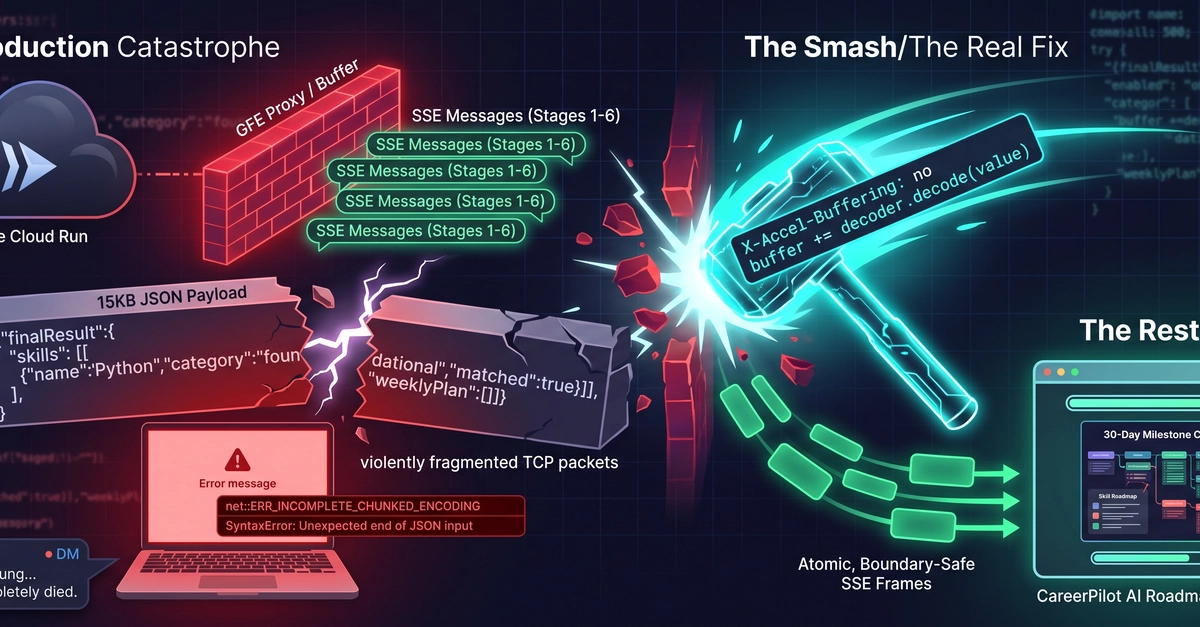
It was late, 11:14 PM, when the first alert arrived not through a sophisticated monitoring system, but a direct message on Twitter. A friend reported that CareerPilot AI, an application designed to analyze career paths, had become unresponsive, freezing for 30 seconds before crashing entirely. The immediate investigation revealed a flood of errors in the browser's developer console: GET https://careerpilot-ai.run.app/api/analyze-career net::ERR_INCOMPLETE_CHUNKED_ENCODING 200 (OK). This cryptic message pointed to a critical failure in the Server-Sent Events (SSE) stream that powered the application's agentic pipeline, running on Google Cloud Run.
The irony was stark. Locally, the development environment showcased a seamless, multi-stage agentic pipeline. The code, designed to be robust, functioned flawlessly on localhost:3000. But in production, the SSE stream, intended to provide real-time updates from the AI agent, was systematically collapsing. The error ERR_INCOMPLETE_CHUNKED_ENCODING, while seemingly technical, signaled a fundamental breakdown in how data was being transmitted and received between the server and the client.
Decoding the Chunked Encoding Error
Server-Sent Events rely on HTTP connections where the server can push data to the client without the client explicitly requesting it. This is achieved through a persistent connection that streams data in a specific format. For efficiency and flexibility, SSE often uses HTTP chunked transfer encoding. This method breaks down the response body into variable-sized chunks, each preceded by its size in hexadecimal and followed by a double CRLF. The client then reassembles these chunks to reconstruct the full message.
The error ERR_INCOMPLETE_CHUNKED_ENCODING indicates that the client (the browser in this case) did not receive all the expected chunks, or the chunks were malformed, leading to an incomplete message. In the context of CareerPilot AI, this meant that the AI's progress updates, intended to stream to the user in real-time, were failing to reach the client reliably. When the client detected this incomplete data, it interpreted the connection as broken, leading to the application freeze and subsequent crash.
What made this particular failure insidious was the 200 (OK) status code accompanying the error. This detail is crucial: the HTTP request itself was successful at a high level. The server *responded* with a 200 OK, but the *content* of that response, specifically the SSE stream, was corrupted or incomplete. This combination can be particularly deceptive, as standard HTTP monitoring might not flag the issue, assuming the connection was healthy when in reality, the data payload was compromised.
The Root Cause: A Subtle SSE Implementation Flaw
The investigation traced the problem to a specific implementation detail within the SSE handling. The application was attempting to stream multiple events, each potentially containing complex JSON payloads, through a single SSE connection. The issue arose when the server, perhaps under load or due to a specific data structure, failed to correctly format the chunked encoding for each individual event. This could be due to:
- Inconsistent CRLF Termination: Each chunk in HTTP chunked encoding must be terminated by a Carriage Return Line Feed (CRLF). If these were missing or malformed for any chunk, the client would lose its place and fail to parse subsequent data.
- Incorrect Chunk Size Calculation: The preceding hexadecimal size indicates the size of the data in that chunk. An error in calculating or transmitting this size would lead the client to read either too much or too little data, corrupting the stream.
- Interleaving of Event Data: When streaming multiple distinct events, careful management of delimiters (like
data: ...for events) is critical. If the server incorrectly interleaved or truncated these event boundaries within the chunked stream, the client would receive garbled, unparseable data.
The fact that this only manifested in production, and not in local development, suggests that the issue was likely triggered by a combination of factors present only in the deployed environment. This could include differences in network latency, server load, specific data inputs that caused edge cases in the SSE formatting logic, or subtle variations in how Google Cloud Run handled persistent connections compared to a local development server.
This is less a bug in a third-party library and more a testament to the complexity of real-time communication protocols. The SSE specification is clear, but its implementation, especially when dealing with dynamic, multi-part data streams and HTTP chunking, requires meticulous attention to detail. It's like building a complex pipe system; one tiny leak or misaligned joint anywhere along the line can cause the entire flow to cease.
The Cascade Effect on CareerPilot AI
Once the SSE stream began to fail, the application's agentic pipeline, which relied on these real-time updates to coordinate its steps, entered an indeterminate state. The client, receiving incomplete or malformed event data, would eventually time out or explicitly disconnect. This would halt the AI's processing, leaving the user interface frozen and spinning indefinitely. The ERR_INCOMPLETE_CHUNKED_ENCODING error was the symptom, but the disease was the breakdown of communication essential for the AI's operation.
The subsequent crash was a graceful degradation, or perhaps a desperate measure, by the application to prevent a completely frozen state from persisting indefinitely. Users experienced this as the application completely dying after the initial hang. The lack of robust error handling for this specific streaming failure meant that the application had no graceful recovery mechanism. It couldn't simply reconnect the SSE stream or inform the user of the progress issue; it just failed.
Lessons Learned and Future Proofing
The incident highlights several critical takeaways for developers building real-time applications, especially those leveraging SSE for agentic or streaming workloads:
- Robust SSE Validation: Implement client-side and server-side validation specifically for the SSE format and chunked encoding. This includes checking for correct CRLF termination, ensuring chunk sizes are valid, and verifying event delimiters.
- Connection Health Monitoring: Beyond standard HTTP request monitoring, implement specific health checks for the SSE connection itself. This could involve sending periodic keep-alive events or monitoring the frequency and validity of incoming messages.
- Graceful Degradation and Reconnection: Design the application to handle SSE connection drops gracefully. Implement automatic reconnection logic with backoff strategies. If reconnection fails, provide clear feedback to the user rather than letting the app hang.
- Testing in Production-Like Environments: Thoroughly test real-time streaming components under conditions that mimic production load, network latency, and data variability. Tools like Sentry, which helped identify the initial error, are invaluable for capturing these edge-case failures.
The catastrophe at CareerPilot AI underscores that even seemingly minor protocol implementation details can have cascading effects in complex, real-time systems. For developers pushing the boundaries with agentic AI and live data streams, a deep understanding of the underlying communication protocols is not optional – it's fundamental to stability.